

JAFFNA, Sri Lanka — On the morning of May 18, 2009, Sellamma walked her two sons and her son-in-law across the Vattuvakal bridge and handed them to Sri Lankan soldiers. She had been assured that men who surrendered would be rehabilitated and returned, her family has said. She spent the next 17 years on roadside protests asking where they were, and died in May without an answer.
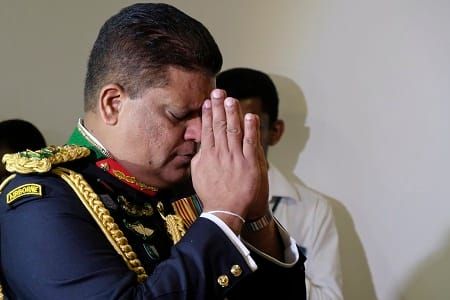
Gen. Shavendra Silva commanded the division that held the ground on the far side of that bridge.
In an extensive interview with the Indian YouTube channel IMPACT Stories, which drew coverage in Colombo this week, he offered the treatment of captured fighters as proof that his troops had run no policy of killing prisoners.
“Our aim and our biggest achievement was to capture a person alive,” General Silva said.
It is his most detailed public account since he retired as chief of defense staff at the end of 2024. He acknowledged that civilians were killed, said the government’s wartime promise of “zero casualties” was never achievable, and challenged the governments that sanctioned him to say what, precisely, they believe he did.
“I’m not a war criminal,” he said. “I fought for my country.”
His 58th Division advanced from Mannar up the western Vanni into the coastal pocket where the war ended. He said commanders used aerial surveillance to separate fighters from civilians and changed plans when the two were too close, and that the division fired its multiple-barrel rocket launchers fewer than five times in the entire campaign. The Liberation Tigers of Tamil Eelam, he said, held civilians by force, sited artillery at hospitals and inside government-declared no-fire zones, and shot at those who tried to flee.
“There would have been deaths of civilians,” he said. “Inevitable. But those are not intentional.”
Much of what he says about the LTTE is well documented. U.N. investigations found that it forcibly recruited children, prevented civilians from leaving, and fired on some who tried to escape. The question that remains is what the Sri Lankan military did during the final offensive.
Between May 17 and 19, 2009, several hundred LTTE members, civilian administrators and their relatives crossed at Vattuvakal into army-held ground. Among them was the Rev. Francis Joseph, a Jaffna priest and former principal of St. Patrick’s College, who wrote out a list of those surrendering for the military. Witnesses saw them loaded onto buses. The International Truth and Justice Project, working with the Human Rights Data Analysis Group, counted about 503 people who disappeared around the bridge, including at least 29 children; Human Rights Watch documented the same pattern in 2011. Eyewitnesses interviewed by the ITJP place General Silva at the bridge on May 18.
Before the Vavuniya High Court, the army has maintained that those who surrendered did so to the Rehabilitation Commission rather than to the military. The surrender lists have never been released. Families in Mullaitivu and Vavuniya have protested by the roadside continuously since 2017, and several of the original protesters have died waiting.
Among those who tried to surrender were several senior LTTE figures: Balasingham Nadesan, the head of its political wing and formerly its police chief; Seevaratnam Puleedevan, who ran its Peace Secretariat; Ramesh, also known as Ilango, the LTTE’s police chief; and Jawan, who headed its radio service, Pulikalin Kural. Nadesan and Puleedevan negotiated their surrender in the final hours through intermediaries in Colombo and abroad. They and several others were later found dead.
Former LTTE members and civilians interviewed separately by the Jaffna Monitor said these men had also committed war crimes against their own people, including forcing civilians to join the LTTE during the final months of the war.
But that did not change their rights when they surrendered. Under the laws of war, fighters who surrender or clearly show that they want to surrender cannot be killed.
In December 2009, Gen. Sarath Fonseka, the army commander during the offensive, told The Sunday Leader that Defense Secretary Gotabaya Rajapaksa had instructed the commander of the 58th Division not to take them alive. General Silva denied it then and denies it now. In 2011, an officer who had served in the division told Channel 4 News that the orders to kill those who surrendered came from the defense secretary and from General Silva.
Human Rights Watch documented at least 30 artillery and air attacks on hospitals in the war zone from December 2008. Shelling of the hospital at Mullivaikkal on May 2, 2009, inside the government’s own no-fire zone, killed 68 people. By May 14, the last makeshift hospital, housed in a school, had stopped functioning, and patients who could not be moved were left behind. The 2015 report of the U.N. human rights office recorded entire families killed in the bunkers where they sheltered, and found that civilians queuing for food were shelled at times and places the government knew in advance.
One of the men who helped create the first no-fire zone says the shelling of it was deliberate, and that General Silva admitted as much to his face.
The man, a Tamil former United Nations staff member who worked in the war zone and now lives abroad, told Jaffna Monitor in a series of interviews in 2024 that he drafted a one-page proposal in late 2008 for a protected area for displaced civilians and sent it to the U.N. coordinator for Sri Lanka. After the government declared the zone in January 2009, families moved in and put up tarpaulin shelters, many without digging bunkers, because they believed the declaration meant they would not be shelled. The army had been given the GPS coordinates of the U.N. humanitarian hub at Suthanthirapuram junction. About a week later, he said, shelling began shortly after 2 a.m. and resumed the following day. He estimated that more than 500 people were killed in roughly 48 hours, among them civilians waiting in line for food, a pattern U.N. investigators would later document independently.
After crossing into government-held territory, he said, he came face to face with General Silva and asked him why the no-fire zone had been shelled. The general denied it, he said, then fell silent for a long moment before acknowledging it, telling him there had been no other way to move the population out of LTTE-held ground.
Jaffna Monitor could not independently verify the exchange. General Silva has consistently denied that his forces attacked civilians deliberately.
He also disputes the arithmetic of the dead. He said the U.N. office in Colombo counted 7,000 killed, and that they were fighters in civilian clothes. That figure is an unpublished internal tally of 7,721 compiled up to May 13, six days before the fighting stopped. The 2011 panel appointed by the U.N. secretary-general concluded that as many as 40,000 civilians may have died, most from government shelling. A later internal U.N. review found that nearly all civilian casualties its staff recorded had reportedly been caused by government fire, that two-thirds of the killing was occurring inside the declared safe zones, and that more than 70,000 people were unaccounted for.
To make his case, General Silva described an encirclement operation and the body of a senior enemy commander found in civilian clothes with a weapon.
“One could say a civilian was killed,” he said. “No. He was the LTTE northern commander.”
He was describing Aanandapuram, where in April 2009 the LTTE’s northern commander, Theepan, was killed along with much of the movement’s senior military leadership.
General Silva also dismissed Channel 4’s documentaries on the final stages of the war as fabricated, saying Tamil speech in them had been mistranslated. The execution videos at the center of that reporting were examined by forensic pathologists, firearms specialists and video analysts commissioned by two U.N. special rapporteurs. Philip Alston reported that they found nothing indicating the footage was faked, and his successor, Christof Heyns, told the Human Rights Council that what it showed had happened.
The United States barred General Silva and his immediate family from entry in February 2020, citing credible information of his involvement, through command responsibility, in extrajudicial killings by the 58th Division. Britain imposed a travel ban and asset freeze in March 2025, naming him, along with two other former commanders and Vinayagamoorthy Muralitharan, the former LTTE eastern commander turned paramilitary leader known as Karuna Amman, on grounds of extrajudicial killings, torture and sexual violence. Sri Lanka’s Foreign Ministry has called the allegations unverified and unproven.
General Silva said his daughters were 12 and 7 in 2009 and had nothing to do with his decisions. He said he can no longer use his credit card abroad, and that a payment his bank sent to a foreign hospital under his military insurance was frozen.
“I have been asking, tell me what I have done wrong,” he said.
Asked about Tamils, he allowed that they had grievances and had not been treated fairly. “We can’t say they were treated 100 percent” well, he said, before rejecting the resort to arms. “There are ways and means.”
Seventeen years on, no senior Sri Lankan officer has been tried over the final offensive. Human Rights Watch reported on Sept. 1 that prosecutions remain stalled and that victims’ families face intimidation in the north and east; the U.N. high commissioner’s report two days later found no accountability for crimes committed by any party. President Anura Kumara Dissanayake’s government has not accepted the evidence-gathering mechanism created for these events.
At Vattuvakal and along the roadsides of Mullaitivu and Vavuniya, the families are still waiting.