

JAFFNA, Sri Lanka, Oct. 26, 2026 — On the night of Sept. 13, 1989, six armed men entered the Colombo home of a television announcer’s parents and waited for her to return. When she arrived, they forced her to leave with them. Her body was found the next morning on a beach at Ratmalana, south of the capital. Investigators told United Press International at the time that she had been raped and stabbed to death.
The announcer, Sagarika Gomes, worked for the state-run Sri Lanka Rupavahini Corporation. Police attributed her killing to the Janatha Vimukthi Peramuna, or JVP. The JVP was a Marxist movement then waging an armed campaign against the government, and it had ordered state broadcasters to stop presenting the news.
Thirty-seven years later, the JVP leads Sri Lanka’s elected government. On Monday in Jaffna, a deputy minister in that government promised justice for Tamil journalists killed, abducted or forcibly disappeared during and after the country’s civil war.
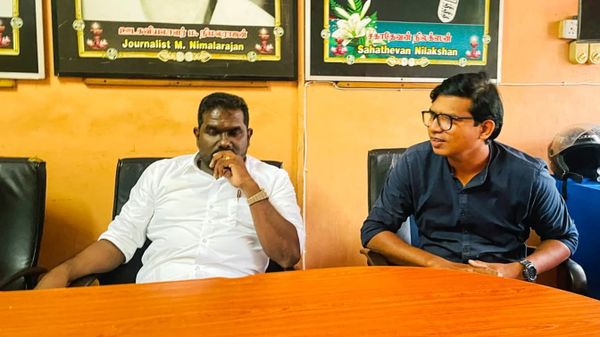
Sundaralingam Pradeep, the deputy minister of plantation and community infrastructure, made the pledge at the Jaffna Press Club. He was meeting journalists who are demanding investigations into the killings, abductions and enforced disappearances of media workers in the Northern and Eastern Provinces.
“Our government does not view journalists in the North and South differently,” Pradeep told the gathering. “We will not act like previous governments.”
He asked the journalists to give the government more time and requested a memorandum setting out their demands. He also offered to arrange a meeting with President Anura Kumara Dissanayake, who leads the JVP and the broader National People’s Power coalition. Pradeep did not give a date for the meeting, identify any case that would be reopened, or refer to killings of journalists outside the north and east.
The JVP’s own record includes killings of media workers. At least four prominent broadcasting figures were killed in attacks attributed to the party within eight weeks in 1989. One of those cases ended in a conviction that is still disputed. No prosecutions have been publicly reported in the other three. Dissanayake apologized in general terms for the party’s violence in 2014. None of his statements since has referred to the journalists and broadcasters killed, and an independent inquiry into the period that he said in 2015 the party would support has never been set up.
A campaign against state broadcasting
The JVP’s second uprising began in 1987, driven by opposition to the Indo-Sri Lanka Accord and the deployment of Indian troops in the country. The movement operated through a clandestine armed wing, the Deshapremi Janatha Viyaparaya, or Patriotic People’s Movement. It enforced strikes, threatened workers, and assassinated political opponents and civilians it accused of collaborating with the authorities.
The armed wing ordered employees of Rupavahini and the Independent Television Network to stop presenting the news. Many newscasters refused to go on air, and some went into hiding. The government deployed military personnel to keep broadcasts running.
Four killings in eight weeks
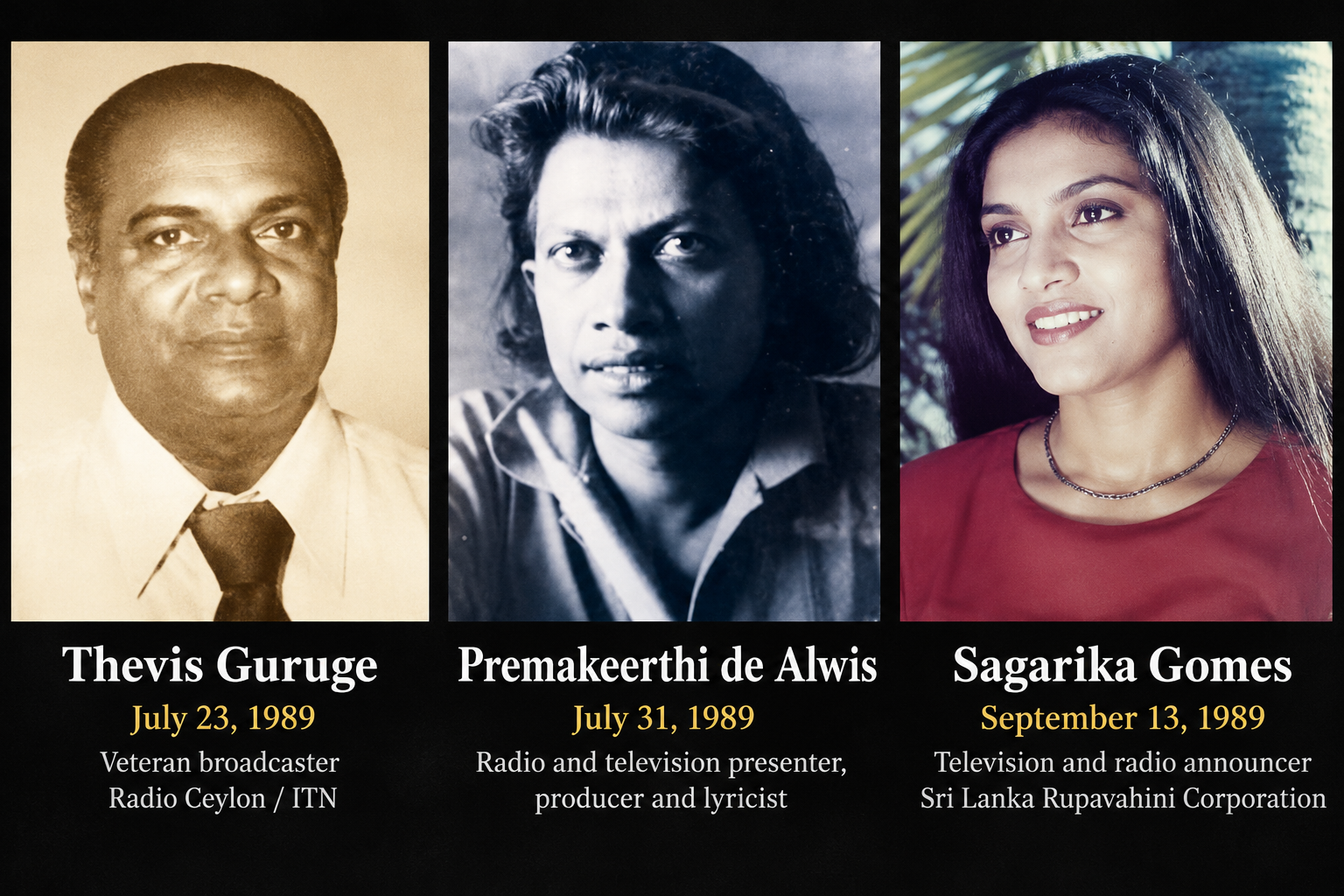
On the morning of July 23, 1989, gunmen shot Thevis Guruge on a bridge on Polhengoda Road in Narahenpita, a Colombo neighborhood, as he walked to a shop. Guruge was one of the pioneering Sinhala-language announcers at Radio Ceylon. He retired from the Sri Lanka Broadcasting Corporation in 1983 and was later appointed by the government as the competent authority overseeing ITN. The insurgents had threatened him the week before. The government blamed the killing on the JVP.
Eight days later, on July 31, armed men took Premakeerthi de Alwis, a well-known radio and television presenter, producer and lyricist, from his home in Homagama, on the outskirts of Colombo, and shot him dead. He had received several warnings from the armed wing.
His killing is the only one of the four known to have produced a conviction. In March 1994, the Colombo High Court convicted Saman Priyankara Gamage, identified in the proceedings as a JVP member, of the murder. Gamage was 17 at the time of the killing. He was sentenced to life in prison and released after 18 years for good conduct.
The case remains contested. The broadcaster’s widow, Nirmala de Alwis, later accused Hudson Samarasinghe, a former director of the Sri Lanka Broadcasting Corporation, of masterminding the killing. Samarasinghe denied the allegation and filed a libel suit against her, which was withdrawn after her death. In 2019, she appeared beside Dissanayake, then a presidential candidate, at a campaign meeting and said the JVP had not killed her husband.
On Aug. 13, Kulasiri Amaratunge, 62, the chief news editor of Rupavahini, was shot dead at his home in Ratmalana. In a UPI dispatch filed that day, the journalist Iqbal Athas reported that police said two JVP gunmen had entered the house and opened fire. Amaratunge had returned home hours earlier after about a week in hiding because of threats from the insurgents.
According to the UPI report, he was killed about two hours after the authorities began jamming the JVP’s clandestine radio station, known as Golden Voice. The insurgents had threatened to retaliate against state broadcasting staff if their transmissions were disrupted.
A month later, Gomes was killed.
She was born in Colombo in October 1961, the youngest of five children, and was 27 when she died. She studied at Presbyterian College and Holy Family Convent in Dehiwala and trained in dance under Vajira Chitrasena, one of Sri Lanka’s leading dancers. She also performed nurti and nadagam, forms of traditional Sinhala musical theater. She worked as a bookkeeper at the Tower Hall Foundation, which in 1983 sent her to Calcutta on a scholarship to study drama, before she became a television and radio announcer.
When Rupavahini newscasters refused to read the evening news under the insurgents’ threats, A. J. Ranasinghe, then deputy minister of information, asked her to take on the bulletin. She agreed.
According to police accounts reported by UPI on Sept. 14, 1989, the six men who came for her carried automatic weapons. She told her parents she would come back because she had harmed no one. Joggers found her body on the beach the following morning.
The killing of Jinasena Kasthriarachchi, a newspaper correspondent, has also been attributed to the movement.
Violence on both sides
The JVP, founded by Rohana Wijeweera, first took up arms in April 1971, attacking police stations in an attempt to overthrow the government of Prime Minister Sirimavo Bandaranaike. The uprising was crushed, and thousands of young insurgents were killed. Available records do not document killings of journalists by the movement during that first rebellion.
The second uprising was far more violent. Government figures cited by the International Truth and Justice Project put the number of people killed by the JVP between late 1987 and March 1990 at 6,517. Somawansa Amarasinghe, a former party leader, acknowledged that nearly 6,000 people died as a result of its violence.
The state’s response killed far more. Security forces and pro-government death squads abducted, tortured and killed suspected JVP members and sympathizers on a mass scale, many of whom had no part in the violence. Estimates of the dead run as high as 60,000. Journalists were among the victims of state-linked violence. Richard de Zoysa, a journalist and actor, was abducted from his home in Colombo and killed in February 1990, a murder blamed on a pro-government paramilitary squad.
Wijeweera was captured and killed in November 1989, and the armed movement collapsed soon afterward. In November 2024, the Frontline Socialist Party, a breakaway faction of the JVP, wrote to Dissanayake urging him to investigate state crimes committed during the insurgency, including Wijeweera’s killing.
Apology and a promised inquiry
The JVP abandoned armed struggle after 1989 and entered parliamentary politics. It contested elections and held seats in Parliament for more than three decades before Dissanayake led the National People’s Power coalition to the presidency in September 2024 and to a parliamentary majority two months later.
In May 2014, shortly after he became the JVP’s leader, Dissanayake apologized for the party’s past violence in an interview with the BBC. During a budget debate in Parliament in late 2015, he said the party would support an independent commission to investigate the events of 1988 and 1989. In 2018, he said the JVP had accepted the scale of its mistakes during that period and had apologized publicly on several occasions. He has since expressed regret but has not repeated the apology.
None of those statements referred to the journalists and broadcasters killed in attacks attributed to the party’s armed wing. Public records reviewed for this article show no apology from Dissanayake or the JVP to their families.
The party’s general secretary, Tilvin Silva, has taken a harder line. In 2025, he said the JVP had taken up arms when it was necessary and that its fighters were rebels who should not be called terrorists. He dismissed calls for a broad inquiry into the party’s violence, saying accountability lay with the United National Party government of the time.
No independent commission on the period has been established, including in the two years since the party came to power.
The question in Jaffna
The journalists who met Pradeep on Monday were seeking investigations into cases in the north and east, where decades of conflict left many families of murdered and missing media workers without answers. Their demands are separate from the JVP’s history.
Pradeep’s statement that the government makes no distinction between journalists in the north and south would, if applied as stated, extend to the broadcasters killed in 1989. He did not address those cases on Monday, announced no investigative mechanism or timetable, and did not say when the journalists would meet the president.