
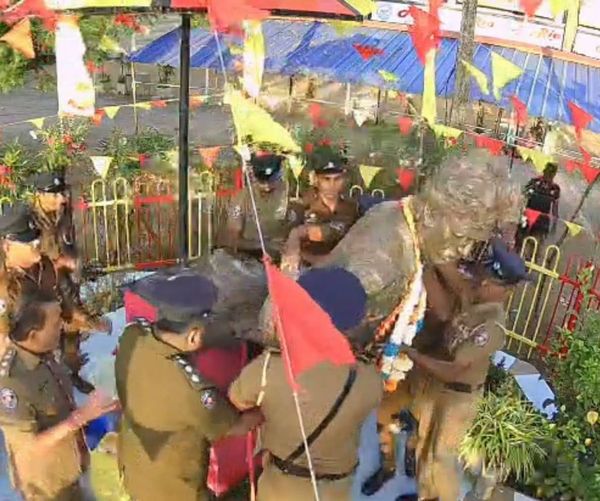
JAFFNA, Sri Lanka — Sri Lankan police removed a statue of Thileepan, a Tamil Tiger political leader who starved himself to death in 1987, from a memorial in Jaffna before dawn on Sunday, hours after the last of 12 days of commemorations had ended.
The removal set off protests across the Tamil-majority north and left President Anura Kumara Dissanayake’s government, which won unprecedented Tamil support in recent elections, trying to explain an operation carried out by a police force it controls. It also opened a public fight among Tamil politicians, some of whom accuse the organizers of installing the statue to provoke exactly this outcome.
The statue honored a senior member of the Liberation Tigers of Tamil Eelam, which remains banned in Sri Lanka and is designated a terrorist organization by several governments, including India, the United States and the European Union. A permanent public monument to an LTTE member was unlikely to win official approval under current law.
Critics of the organizers say they understood that from the start. They accuse the Tamil National People’s Front, the main force behind the commemoration, of putting up the statue without permission in the expectation that police would act and that the removal would inflame Tamil sentiment against the government. The accusation has been made by activists and, on the record, by a senior Jaffna municipal official. The TNPF did not respond to requests for comment on it.
A predawn operation
More than 20 police officers, led by the officer in charge of the Jaffna police station, arrived in two vehicles at the Thileepan Memorial Square in Nallur and carried the statue away, according to accounts from the site. CCTV footage showed officers lifting it off its pedestal.
The statue had been placed at the memorial on Sept. 15, the anniversary of the day Thileepan began his fast, and had been the focus of daily tributes since. Organizers and many news reports called it bronze. Jaffna’s mayor, Mathivathani Vivekanandarajah, said it was made of fiber. She said the TNPF had sought temporary permission from the Municipal Council to place a fiber statue at the site, which stands on municipal land.
Police offered no explanation at first. Later on Sunday, the police spokesman, F.U. Wootler, said the action followed a complaint that a group called “Ellalan Padai” was commemorating a member of a banned organization. He said the statue was removed to protect reconciliation between ethnic communities and to prevent what he called a “war mentality.”
The Police Media Division said the council’s permission for this year’s commemorations had covered the events only through Saturday. Police said they had informed the Jaffna Magistrate’s Court, which is scheduled to take up the matter on Oct. 2.
Earlier reports citing police sources said the authorities regarded any statue or commemoration of Thileepan as impermissible under the Prevention of Terrorism Act because he had held the rank of lieutenant colonel in the LTTE. Police have not said which provisions of the law they relied on.
By Sunday morning, residents had laid garlands on the empty pedestal. By 5 p.m., protesters had gathered outside the memorial, accusing the government of a double standard in deciding which of Sri Lanka’s war dead may be remembered. Some chanted, “Let the people’s uprising erupt; let Partheepan’s dream come true,” using Thileepan’s birth name, Rasaiah Parthipan.
The North-East Association of the Families of the Forcibly Disappeared called for simultaneous protests at 2 p.m. on Monday in all eight districts of the Northern and Eastern Provinces, including Nallur, Trincomalee, Kilinochchi, Ampara, Mannar, Batticaloa, Vavuniya and Mullaitivu.
The governing party’s problem
The episode lands hard on Mr. Dissanayake’s National People’s Power, which broke decades of Tamil loyalty to Tamil parties by presenting itself as a clean break from Sri Lanka’s political establishment.
Critics point to the history of the Janatha Vimukthi Peramuna, the party at the core of the NPP. The JVP led two armed insurrections against the state and still commemorates its founder, Rohana Wijeweera, and members killed in those uprisings. Unlike the LTTE, the JVP is a legal party and has sat in Parliament for decades.
Rajkumar Rajeevkanth, a social activist, accused the government of bowing to Sinhalese nationalist pressure from the south. He said Tamils, who have pursued their demands through democratic politics since the war ended 17 years ago, had a right to remember those they believed had died for them. He noted that NPP lawmakers had themselves paid tribute at the statue before it was removed.
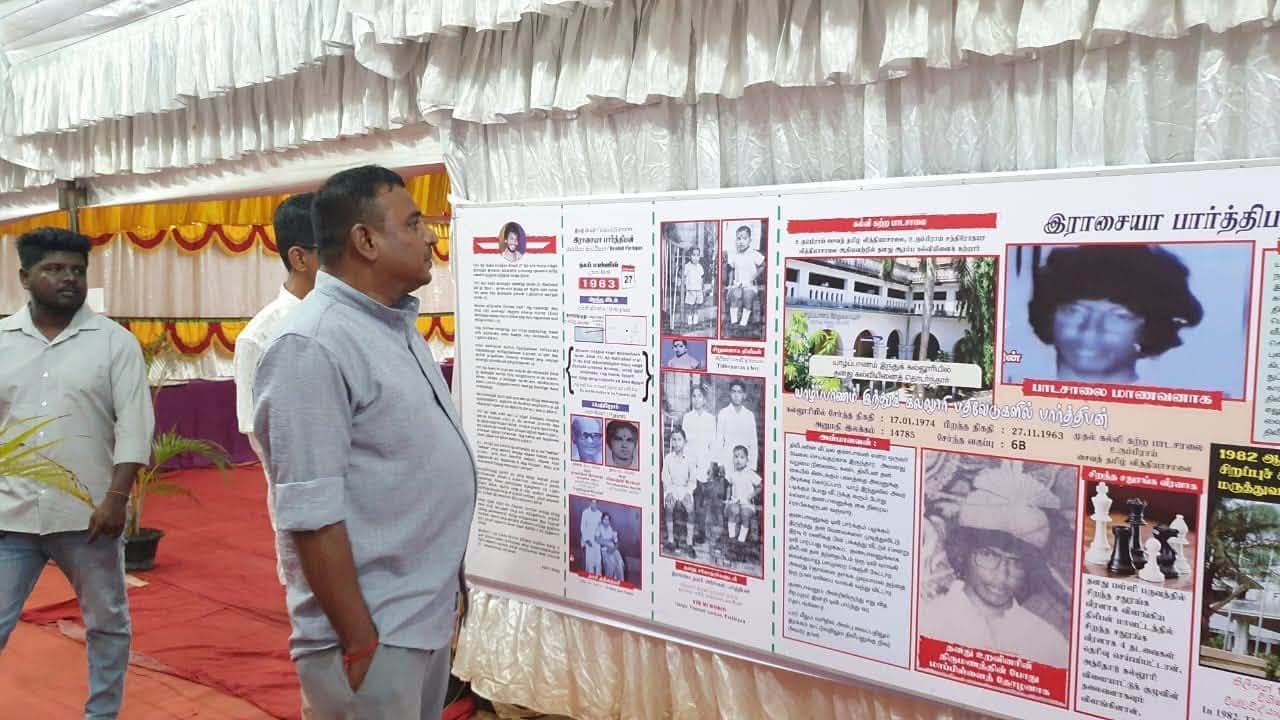
The party’s own record on Thileepan complicates its position further. At last year’s commemoration, Jeyachandramoorthy Rajeevan, an NPP member of Parliament for Jaffna, paid tribute to Thileepan and visited an exhibition about him in Nallur. Ramalingam Chandrasekar, the fisheries minister and the NPP’s Jaffna organizer, also went to the memorial to pay tribute but was blocked by hard-line nationalists affiliated with the TNPF. He later said he had gone on humanitarian grounds.
On Sunday, Mr. Chandrasekar said the government had nothing to do with the removal.
“The National People’s Power government has nothing to do with the removal of Thileepan’s statue,” he said. “The Jaffna Municipal Council must take responsibility for this.”
He said the council should explain whether it had granted permission for the statue and whether that permission had been withdrawn. “Because the Municipal Council failed to make the appropriate decisions on this matter, the police ended up doing what the Municipal Council should have done,” he said.
The explanation has little basis in how Sri Lanka is governed. The police are a national force under the central government, which Mr. Chandrasekar serves as a cabinet minister. Municipal councils have no authority to direct them, and the police themselves cited a terrorism-related complaint, not a municipal dispute.
The minister’s past praise of the LTTE has also resurfaced. In an earlier interview, he said, “We bow our heads to the dedication of the Tigers’ leaders and the Tigers,” and described biting into a cyanide capsule as no simple thing. Speaking of LTTE suicide operatives who lived for years in Colombo while awaiting orders, he said: “They live a comfortable life in Colombo. But when the time comes, destroying oneself and destroying the enemy is no easy task.”
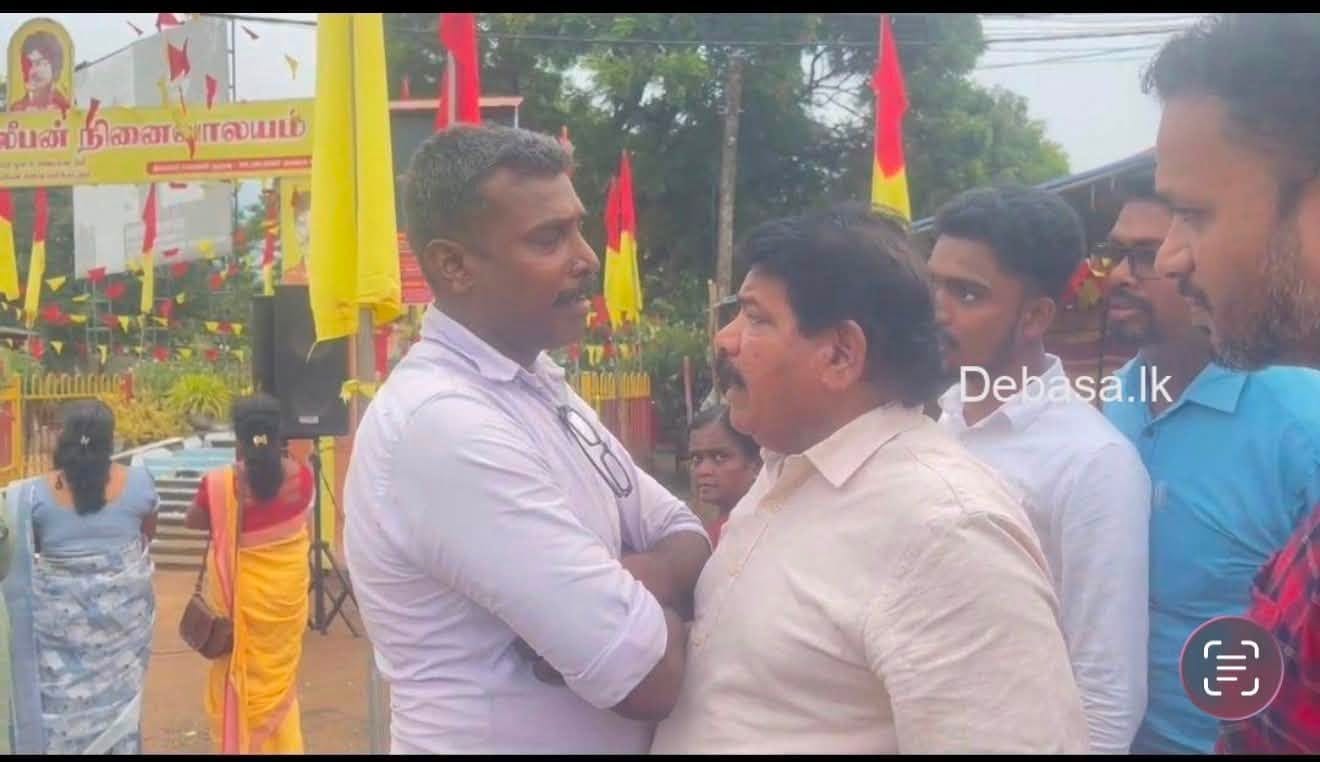
Varatharaja Partheepan, a former member of the Jaffna Municipal Council, accused the NPP of winning Tamil votes with promises it has since abandoned. “During election campaigns, those who deceived the people by promising to erect a bronze statue of leader Prabhakaran and to establish ports named after his parents, and thereby gained a foothold in this land, are now beginning to reveal their true face,” he said.
During the last parliamentary election campaign, a video circulated in Jaffna praising the LTTE and its leader, Velupillai Prabhakaran, pledging to fulfill the dreams of LTTE fighters and promising a harbor named after Mr. Prabhakaran’s mother. After a backlash in the south, the NPP distanced itself from the video. Several independent actors said they had verified that the video was sponsored by the NPP.
Dr. Sellaththamby Thilaganathan, a member of Parliament from the Vanni district, said, “Personally, I am saddened by the removal of Thileepan’s statue.”
Tamil parties turn on each other
The removal has also sharpened a bitter contest among Tamil parties.
Selvarajah Kajendren, general secretary of the TNPF, condemned the operation and accused the government of betraying its promises to Tamil voters. He said supporters told him more than 15 officers arrived without warning, walked onto the memorial grounds in their boots and took the statue by force.
Mr. Kajendren also blamed C.V.K. Sivagnanam, acting leader of the Ilankai Tamil Arasu Kadchi, or ITAK, which controls the Jaffna Municipal Council. He said his party had asked the mayor on Sept. 18 for a council letter needed to obtain permission to use loudspeakers during the commemoration, and that she told them her party leadership feared it could cause complications.
When he raised the matter with Mr. Sivagnanam, Mr. Kajendren said the ITAK leader told him: “Whom did you ask before placing this statue here? If this statue is not removed by the 26th, I will remove it myself.”
Mr. Kajendren accused ITAK of acting as an agent of the police and of working with the government. No evidence has been made public that Mr. Sivagnanam or ITAK ordered or took part in the police operation.
Municipal officials gave a sharply different account. Mayuran, chairman of the council’s Works Committee and an ITAK member, said the organizers had not sought permission before installing the statue.
“They approached us seeking permission only after the statue had already been installed, and an issue had arisen,” he said.
He said permission was then granted for the statue to remain until Sept. 26, on the understanding that it would be removed after that date. “When the CID questioned us about this, the mayor, myself and the TNPF member who had sought permission all told the CID that the statue would be removed on the 26th,” he said, referring to the police Criminal Investigation Department.
He accused the TNPF of engineering the confrontation. “The Tamil National People’s Front is acting with the deliberate intention of putting up the statue, placing people at risk and discrediting our struggle,” he said. “They behave as though they alone are the protectors of Tamil nationalism, while engaging in activities that are contrary to the law.”
Questions over the money
The statue has also drawn allegations about how the commemoration was financed.
Arun Siddharth, a Jaffna activist who openly opposes the LTTE, alleged in a Facebook post that police had found the statue was molded fiber finished to look like bronze. Police have not commented publicly on the material, though the mayor has since said it was fiber.
Citing Sri Lankan intelligence officials, Mr. Siddharth alleged that organizers raised about 8.73 million rupees from LTTE sympathizers abroad for the statue, a 12-day archive exhibition and a vehicle procession. He said a budget of about 9 million rupees, including more than 1 million for the statue, had been circulated to overseas supporters through WhatsApp groups, and that one London donor, originally from Mullaitivu and with three brothers who died as LTTE fighters, had sent 1.8 million rupees to cover the statue.
He further alleged that members of the organizing committee divided the money among themselves, that the Swiss branch of the Tamil Coordinating Committee, a diaspora organization, sent about 5 million rupees, and that organizers paid editors at pro-LTTE Tamil media outlets in Jaffna to describe the statue as bronze. He attributed the Swiss figure to an unnamed informant.
Mr. Siddharth did not publish documents supporting the allegations, and they could not be independently verified. The organizing committee and the Tamil Coordinating Committee in Switzerland had not responded to the allegations at the time of publication.
Pressure from the south
The removal followed criticism of the commemorations from Sinhalese nationalists. Battaramulla Seelarathana Thera, leader of the Janasetha Peramuna, told reporters in Colombo that the events were causing pain among Sinhalese.
“Thileepan was a terrorist,” he said, adding that he had not been an innocent civilian. He criticized commemorations of Mr. Prabhakaran, alleged that such events served Tamil diaspora organizations, and cited soldiers who lost limbs, sight or hearing in the war. He called on Mr. Dissanayake to intervene, saying all communities should live in Sri Lanka under the same law.
Tamil politicians pointed in turn to military victory monuments and newly built Buddhist statues across the North and East, and said the state had no right to decide whom Tamils may remember.
A contested figure
Thileepan was 23 and a senior LTTE political figure on the Jaffna Peninsula when he began his hunger strike in Nallur on Sept. 15, 1987, less than two months after India and Sri Lanka signed an accord that brought Indian troops to the island. He refused food and water and died on Sept. 26.
His demands were aimed mainly at India. They included the release of Tamil detainees held under emergency and anti-terrorism laws, an end to state-backed Sinhalese settlement in Tamil areas, a halt to new police stations in the North and East, and the withdrawal of security forces from schools.
His death drew huge crowds in Jaffna and hastened the collapse of relations between the LTTE and India. Within weeks, the Indian Peace Keeping Force and the Tigers were at war.
The LTTE became notorious for suicide bombings, assassinations and attacks on civilians during a conflict that ended in 2009, but Many Tamils remember Thileepan for a protest of a very different kind. Most hunger strikers accept water. Thileepan refused both food and water, a practice known as a dry hunger strike, and died 12 days later. Such protests are rare, since the body usually cannot survive more than a few days without water, and documented deaths from them are rarer still. His admirers regard his as the only known death from a dry hunger strike. Admirers also often describe his fast in Gandhian terms, a comparison given an edge by the fact that his demands were directed at India. The state and many Sinhalese regard his rank in the LTTE as inseparable from the group's record. For many Tamils, it is the manner of his death that defines him.
The Nallur memorial has been destroyed twice: once after government forces took Jaffna in the 1990s, and again after it was rebuilt during the cease-fire of the 2000s. Commemorations have continued at the site in most years since.