
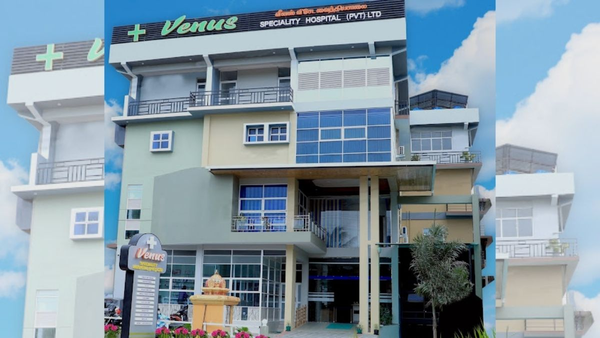
JAFFNA, Sri Lanka — A private hospital in Jaffna has been fined 3 million Sri Lankan rupees after pleading guilty to charging patients more than the government-set maximum price for a common blood test, the largest penalty imposed in a nationwide enforcement drive against private hospitals and medical laboratories.
Venus Speciality Hospital (Pvt) Ltd, on Palaly Road in Kandarmadam, had been charging Rs. 550 for a Full Blood Count, or FBC, test, despite a legally prescribed maximum charge of Rs. 400 for the test and its report, according to Sri Lanka’s Consumer Affairs Authority.
The violation was uncovered during a special inspection carried out by CAA officers on July 13. The authority subsequently filed legal action against the hospital in the Jaffna Magistrate’s Court.
When the case was taken up on July 21, the hospital pleaded guilty to the charge, according to the authority. The court imposed a fine of Rs. 3 million and ordered the hospital to publish a notice about the offence in national newspapers at its own expense.
Following public inquiries about the legal basis for the price ceiling, the Consumer Affairs Authority issued a clarification on its official Facebook page, citing a price-control order that has been in effect for nearly 6 years.
Under Order No. 67, issued under Section 20(5) of the Consumer Affairs Authority Act, No. 9 of 2003, the maximum charge for an FBC test and its report is Rs. 400. The same order sets a maximum charge of Rs. 1,200 for a Dengue NS1 Antigen test and its report.
The price controls took effect on July 29, 2020, and were published in Gazette Extraordinary No. 2186/17, dated July 29, 2020, according to the authority.
The CAA urged patients using private hospitals and medical laboratories to be aware of the legally prescribed maximum charges and to obtain proper bills or official receipts for payments. Consumers who are charged above the prescribed rates can lodge complaints through the authority’s 1977 hotline during office hours, providing receipts and other available evidence.
The Venus case was among 23 prosecutions brought following a series of inspections and raids targeting private hospitals, medical laboratories, and pharmacies across Sri Lanka. Courts have so far imposed fines totaling Rs. 5.798 million in those cases, according to figures released by the CAA.
The violations identified during the broader enforcement operation varied across institutions and included the use of expired chemicals for diagnostic and laboratory testing, the storage of expired medicines for patient care or sale, charging laboratory fees above the maximum prices prescribed by the authorities, and storing expired chemicals alongside unexpired supplies without proper segregation.
The CAA’s statements do not indicate that Venus Speciality Hospital was accused of using expired chemicals or possessing expired medicines. The case against the Jaffna hospital concerned charging Rs. 550 for an FBC test for which the legally prescribed maximum was Rs. 400.
Another Jaffna health care institution, Yarl Mother Care Hospital, was fined Rs. 100,000 by the Jaffna Magistrate’s Court on July 21.
Lanka Hospital Diagnostics (Pvt) Ltd received the second-largest individual fine, Rs. 800,000, from Colombo Magistrate’s Court No. 5. Asiri Hospital Holdings PLC, Nawaloka Laboratories, Kings Hospital Colombo, and Durdans Hospital were each fined Rs. 100,000 in separate cases before the same court.
Other prosecutions involved health care institutions and laboratories in Badulla, Anuradhapura, Eravur, Negombo, Bandarawela, and Matara. Ceylon Hospital PLC was fined Rs. 400,000 in Badulla and Rs. 50,000 in a separate case in Negombo.
The enforcement campaign comes amid concerns over the cost and oversight of private health care in Sri Lanka, where many patients depend on private laboratories for routine diagnostic testing.
The CAA said further legal action was expected against other institutions investigated during the operation and that inspections and raids would continue across the country.
Members of the public can report suspected overcharging and other consumer law violations to the CAA through its 1977 hotline during office hours.