

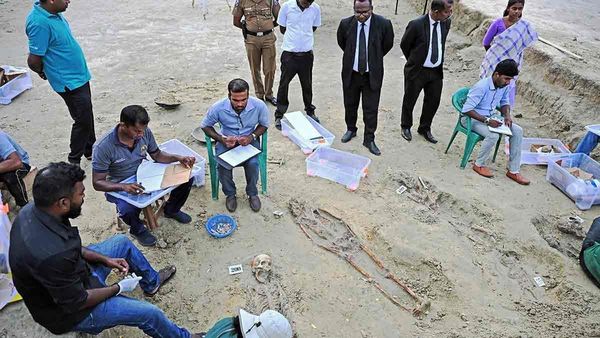
JAFFNA, Sri Lanka — International accountability experts, senior lawyers, and United Nations officials have called on Sri Lanka to immediately launch a full criminal investigation into the Chemmani mass grave, arguing that the recovery of nearly 500 human skeletons has already established sufficient grounds for a criminal inquiry and that excavation alone cannot deliver justice.
Speaking during a special online discussion in Geneva organized by the International Truth and Justice Project (ITJP) following the release of its report, The Chemmani Mass Grave: We Are Still Searching, the experts warned that Sri Lanka risks repeating the failures of the original Chemmani investigation more than two decades ago unless those responsible are identified and prosecuted.
The discussion brought together Johan Soufi, head of the Sri Lanka Accountability Project at the Office of the United Nations High Commissioner for Human Rights (OHCHR); senior Sri Lankan lawyer K.S. Rathnavel; and Ingrid Massagé, chair of the Sri Lanka Campaign and an international researcher on justice and accountability.
Excavation Is Not an Investigation
Soufi drew a sharp distinction between the ongoing archaeological excavation and a criminal investigation, saying the two should not be conflated.
“Excavation means recovering the bodies from the ground and ensuring they receive dignified treatment,” he said. “A criminal investigation is about establishing what happened, who was responsible, and when the crimes were committed.”
He argued that the evidence already emerging from Chemmani provides an adequate basis for criminal proceedings.
“The information recovered from Chemmani indicates that those buried there did not die of natural causes,” Soufi said. “Moreover, individuals previously convicted have testified that many people who were killed were buried there. That provides the necessary basis to begin a criminal investigation.”
Soufi also recalled that the 2015 OHCHR investigation into Sri Lanka identified enforced disappearances as among the gravest violations committed against civilians during the country’s conflict. He said Sri Lanka must not only investigate the crimes but also hold those responsible accountable, adding that the U.N.'s Sri Lanka Accountability Project stands ready to assist those efforts.
Nearly 500 Skeletons, but No Criminal Inquiry
Massagé contrasted the current response with the government’s handling of the original Chemmani investigation in 1999.
During the first excavation, only 15 skeletons were recovered. Yet the Criminal Investigation Department (CID) opened investigations while excavations were still underway, questioning more than 300 witnesses and recording statements from over 400 people.
Today, she noted, the situation is markedly different.
Nearly 500 human skeletons have now been recovered during the renewed excavations ordered by the Jaffna Magistrate’s Court, yet no criminal investigation has been announced.
“It is deeply shocking,” Massagé said, “that despite the discovery of nearly 500 skeletons, no criminal investigation has begun.”
She also criticized recent remarks by Sri Lanka’s Justice Minister, who visited the excavation site and said the identities of those responsible were not known.
“That is equally shocking,” she said.
Massagé said the current process should differ fundamentally from that of 1999 because Sri Lanka is no longer in the midst of a civil war, creating greater scope for credible truth and justice mechanisms.
Questions Over Command Responsibility
Senior Attorney K.S. Rathnavel argued that the Chemmani case raises questions about accountability within Sri Lanka’s military hierarchy.
He recalled that nine soldiers were named in the prosecution over the 1996 rape and murder of schoolgirl Krishanthi Kumaraswamy, whose case led to the original discovery of the Chemmani mass graves. Seven soldiers were convicted.
But Rathnavel said that those convicted were all ordinary soldiers.
“No senior military officers, including generals, were ever punished,” he said.
“That raises the question of whether those who truly bore responsibility escaped accountability while lower-ranking soldiers were made responsible.”
He added that such an outcome was consistent with Sri Lanka’s longstanding pattern of impunity.
Evidence Already Exists
Rathnavel said Chemmani occupies a unique place in Sri Lanka’s human rights history because it contains evidence of some of the gravest alleged crimes committed against civilians.
He noted that the existence of the mass graves first became public after a convicted soldier revealed, following his sentencing in the Krishanthi Kumaraswamy case, that the bodies of many other victims had been buried in Chemmani.
Excavations began in 1998 but were halted in 2000 following intervention by the Attorney General’s Department, effectively ending the investigation.
The issue resurfaced in February 2025 after workers renovating the Chemmani Hindu cemetery discovered human skeletal remains, prompting the Jaffna Magistrate’s Court to order new excavations.
Rathnavel noted that Jaffna had been under Sri Lankan military control since 1996 and said it was implausible that crimes of such scale could have occurred without the military’s knowledge.
He also pointed to the significance of the location itself.
According to Hindu religious practice, bodies are cremated rather than buried. The discovery of hundreds of skeletons buried haphazardly, many reportedly layered on top of one another, strongly suggests the site was not an ordinary cemetery, he said. The court has since declared the area a crime scene.
Calls for International Expertise
Massagé also questioned the forensic approach adopted in the current excavations.
Although international experts monitored the 1999 excavations, they were not permitted to intervene directly, she said.
This time, while the site has been visited by the U.N. High Commissioner for Human Rights, European Union ambassadors, and other international representatives, no international forensic specialists have been formally incorporated into the excavation process.
She further noted that DNA samples have not been collected from victims’ relatives either during the original Chemmani investigation or the current excavations, preventing authorities from matching recovered remains with missing persons.
She cited the example of the Matale mass grave, where recovered skeletons remain in storage years after excavation, with no meaningful progress in the investigation.
Massagé also referred to a 2003 commission appointed by Sri Lanka’s Human Rights Commission under Dr. Devanesan Nesiah, which interviewed victims, families, and witnesses and identified 35 individuals who, according to its report, should be held accountable.