
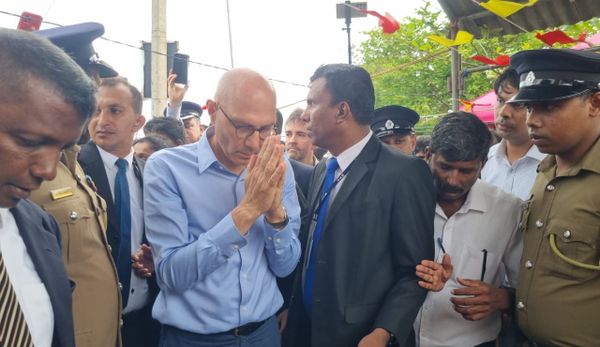
GENEVA — Nearly two years after Sri Lankans elected a government that promised to dismantle the machinery of impunity, the United Nations human rights office said Thursday that the opening for change was closing.
In a report to the Human Rights Council, the office credited the government with moving against corruption and reopening several political killings and disappearances. But it found that Colombo has gone on detaining people under the counterterrorism law it pledged to abolish, has made almost no progress on wartime crimes by either side, and has not stopped the intelligence services from watching and threatening victims, activists and journalists in the north and east.
“This Government still has an opportunity to turn the tide,” the U.N. High Commissioner for Human Rights, Volker Türk, said in a statement accompanying the report, which covers October 2025 through July 2026 and goes before the Council when it convenes here on Sept. 7.
The National People’s Power government of President Anura Kumara Dissanayake took office in late 2024 promising a new constitution, repeal of the Prevention of Terrorism Act, an independent public prosecutor and the release of political prisoners. None of it has been legislated. What the report describes is a state that has changed its political language without changing many of its habits.
The country’s Human Rights Commission recorded 602 cases of torture and ill-treatment in 2025 and another 138 by April this year, along with 18 deaths in custody last year and three more by April. Of the 1,125 complaints of arbitrary arrest and detention it received in 2025, the police took no action in 530.
Among the dead was a 40-year-old man held at Welikada Prison in Colombo on a minor drug charge, who died on May 3 after what the report describes as a severe beating following a suspected escape attempt. Three prison officers were arrested. Another inmate had died days earlier. In July, violence inside Negombo Prison killed at least 32 people, 22 of them detainees and 10 prison officers, in a system the U.N. says is strained by inadequate resources and by overcrowding that owes much to the jailing of people for offenses as minor as drug use.
The Prevention of Terrorism Act, the law that has shaped the Tamil experience of the Sri Lankan state for two generations, remains in force. The Human Rights Commission was notified of 46 detentions under it in 2025 and 12 more by March. A replacement drafted in December, the Protection of the State from Terrorism Act, drew a detailed rebuke from the U.N. office in February, which warned that it would reproduce and in places widen the powers it was meant to retire: broad criminal definitions, sweeping executive authority, arbitrary detention and thin protection against torture and enforced disappearance. The Cabinet approved publishing a bill in the gazette on Aug. 17. As of the end of that month, no text had been made public.
Surveillance remains common in the north and east. The U.N. office said it received 16 complaints from people who said they had been watched, questioned or threatened by military and civilian intelligence officers, including from the Criminal Investigation Department and the Terrorism Investigation Division.
Officers asked about their organizations, funding, protests and commemorations, as well as trips to Geneva and contact with U.N. human rights bodies. Some activists also reported death threats, visits to their homes and warnings that they could be disappeared or face false charges.
In January, the U.N. Committee on Enforced Disappearances was told that authorities had threatened a person who had provided information to the committee four months earlier.
The report singles out the killing of Albino Arul Pius, a 17-year-old shot in the head by police at Allaipiddy in Jaffna on Feb. 10 after officers said the vehicle he was travelling in had not stopped at a checkpoint. The police initially described the dead youth as an adult. He died at Jaffna Teaching Hospital. His family has since reported being watched and threatened, and has asked for an independent investigation.
Land remains unresolved. The government released almost 1,000 acres held by the military in the north and east in 2025, while communities went on demanding thousands more in Vasavilan and Valikamam in Jaffna and Keppapilavu in Mullaitivu. Religious sites have become flashpoints of their own: a shrine built on private land at Thaiyiddy in Jaffna, still disputed after years, and a proposal to install an Air Force radar inside the Thirukoneswaram temple precinct in Trincomalee.
At Chemmani-Sithuppaththi, on the edge of Jaffna town, excavators had recovered remains corresponding to more than 477 people, among them children, by late July. Later counts run higher. The U.N. welcomed the resumption of the dig and the magistrate’s decision to let diplomats observe it, then made the point the families have been making for months: that exhumation without impartial criminal investigation, including into command responsibility, produces bones and not answers. It urged the government to seek international forensic assistance.
Enforced disappearance, the report says, remains a defining feature of Sri Lanka’s impunity. The Office on Missing Persons has still established the fate of no one. Parents and spouses are dying without learning anything.
A few emblematic cases have moved. Sivanesathurai Chandrakanthan, the former Eastern Province chief minister known as Pillayan, was indicted in August over the 2006 disappearance of Sivasubramaniam Raveendranath, the vice chancellor of Eastern University. In March, the Court of Appeal set aside the 2016 acquittals in the killing of the Tamil parliamentarian Nadarajah Raviraj and ordered a retrial. August also brought the 20th anniversary of the execution of 17 Action Contre la Faim aid workers at Muttur, on which the report records no new step of any kind.
The government has made more progress in the investigation into the 2019 Easter Sunday bombings. Former State Intelligence Service director Suresh Sallay was arrested in February. On June 3, a Colombo magistrate imposed a travel ban on former President Gotabaya Rajapaksa and two Army intelligence officers. On July 31, a special trial-at-bar found former police chief Pujith Jayasundara and former defense secretary Hemasiri Fernando guilty on several charges and sentenced them to death.
The U.N. noted these developments but raised concerns about the death sentences, the lack of effective legal representation for 22 defendants after their lawyers withdrew, restrictions on family members and the lack of public access to the proceedings.
There has been little progress on crimes committed during the war. The report says there has been no accountability for serious violations committed by any side, and that meaningful security sector reform has yet to take place.
Colombo’s posture toward Geneva has not softened. It continues to reject the Council resolutions that underpin the U.N.'s Sri Lanka accountability project, whose repository now holds more than 123,000 items from over 500 witnesses and sources, and has declined to engage with it. In May it rejected outright a U.N. brief on conflict-related sexual violence built on consultations with 27 survivors, and has not taken up an offer to discuss the findings.
Mr. Türk’s recommendations run from the achievable to the unlikely: a moratorium on the terrorism law pending repeal, the release of long-held detainees, the return of occupied land, support for memorialisation, a stronger Office on Missing Persons, the removal from office of anyone credibly accused of serious violations, and a special judicial mechanism with an independent counsel. To member states he suggested prosecutions under universal jurisdiction and targeted sanctions.
Behind all of it is a clock. On Jan. 16, Sandya Ekneligoda, who has spent 16 years looking for her husband, the cartoonist Prageeth Ekneligoda, answered her telephone to a man identifying himself as a retired brigadier who told her she would be killed. A second such call came on April 13, days after she wrote to President Dissanayake objecting to the promotion of a military intelligence officer accused in her husband’s case.