

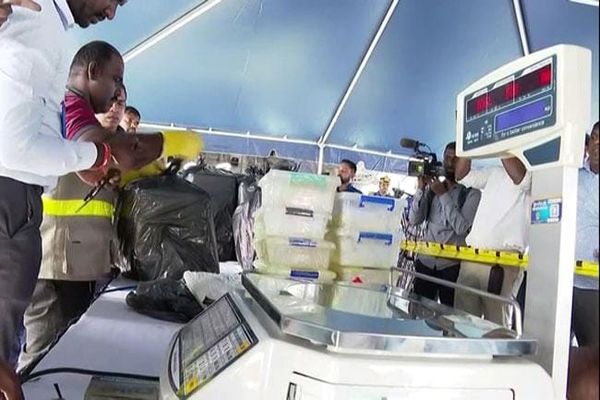
COLOMBO, Sri Lanka — The seizure of 463 kilograms of crystal methamphetamine at the Port of Colombo this week grew out of a weeks-long international intelligence operation involving American, Pakistani and Sri Lankan authorities, according to new details released Wednesday by the United States Embassy, offering a fuller account of an interdiction initially described largely through the actions of Sri Lankan investigators.
The Embassy said the U.S. Drug Enforcement Administration’s New Delhi Country Office and Sri Lanka’s Police Narcotics Bureau conducted a “joint operation” against a Pakistan-based trafficking network attempting to move methamphetamine through Sri Lanka to international markets.
More significantly, it said intelligence on suspicious maritime containers moving from Pakistan to Colombo was developed between Aug. 14 and Aug. 29 by the DEA’s Foreign Counterparts Unit and the Special Investigations Cell of Pakistan’s Anti-Narcotics Force.
The disclosure shows that the intelligence trail began well before Sri Lankan officers opened the container at Colombo port on Monday, Aug. 31, and that authorities outside Sri Lanka had been tracking suspicious cargo movements before the seizure.
Sri Lanka Police had already acknowledged an American role, saying information received by Senior Deputy Inspector General Ranmal Kodituwakku had originated with the DEA.
But the police account focused largely on what happened after the intelligence reached Sri Lanka.
Investigators from the Central Crime Investigation Bureau obtained a court order and, working with the Police Narcotics Bureau and Sri Lanka Customs, inspected suspicious containers at the port. They found the methamphetamine tightly packed and concealed among a shipment of towels.
The American statement goes further. It describes the case not simply as a Sri Lankan operation triggered by foreign intelligence, but as a joint U.S.-Sri Lankan counternarcotics operation built on intelligence developed over more than two weeks, with Pakistan’s principal anti-drug agency also involved.
The Embassy did not explain why it released the more detailed account two days after the seizure, and there is no evidence of a dispute between Washington and Colombo over credit for the operation.
But the statement puts the international role firmly on the public record.
Hours after it was released, Deputy Inspector General Ashoka Dharmasena also described the operation to reporters as a joint effort that followed a tip-off.
The chronology raises further questions.
Police say the container arrived in Colombo from Pakistan on June 27 and was being held for re-export to Morocco. The intelligence period identified by the U.S. Embassy, Aug. 14 to Aug. 29, began roughly seven weeks after the container reached Colombo.
Investigators obtained a court order and opened the container on Monday afternoon.
Sri Lankan estimates of the street value have ranged from more than 8 billion rupees to more than 15 billion rupees. Drug valuations can vary considerably depending on the assumptions used to calculate street prices.
A 44-year-old businessman from Dematagoda, whose company police say was involved in bringing the container into Sri Lanka, was arrested.
A police source familiar with the investigation identified him to Jaffna Monitor as Arumugam Sasinthiran, 44, of Dematagoda. Police said he was involved in the onion and potato trade.
Further questioning led investigators to three Pakistani nationals, aged 33, 36 and 51, who were also taken into custody.
Police sources say investigators are examining whether the shipment was organised by a Sri Lankan trafficker known by the alias Parevi Suda, who is believed to have moved from Dubai to Pakistan, along with two other Sri Lankan suspects.
One important question remains unresolved: Where were the drugs ultimately headed?
The U.S. Embassy said the Pakistan-based network was attempting to smuggle methamphetamine “through Sri Lanka to international markets,” casting Colombo as a transit point.
Sri Lankan investigators, however, suspect the paperwork listing Morocco as the container’s onward destination may have been a cover and are examining whether the drugs were actually intended for distribution in Sri Lanka.
Mr. Dharmasena said intensified interdiction of maritime smuggling routes had pushed traffickers toward commercial container shipments. He said an anti-narcotics campaign begun in October had resulted in the seizure of nearly 14 tonnes of illegal drugs, including methamphetamine, heroin and cocaine.
Public Security Minister Ananda Wijepala told Parliament this week that much of the illegal narcotics entering Sri Lanka originated in Afghanistan and Pakistan and reached the island by sea. He estimated that Sri Lanka had about 400,000 drug users.
Crystal methamphetamine, commonly known in Sri Lanka as “Ice,” has become an increasingly significant part of the country’s illegal drug trade. Police recorded 68,132 arrests involving the drug in 2024, a 161 percent increase from the previous year, and reported seizures of more than 1,360 kilograms.
Wednesday’s statement also placed the operation within a longer history of American assistance to Sri Lankan law enforcement. The Embassy said the cooperation built on training and technical assistance provided by the U.S. State Department’s Bureau of International Narcotics and Law Enforcement Affairs to Sri Lanka Police and Customs.
The Embassy also said such operations target transnational criminal organisations that fund terrorism. It did not accuse those arrested in the Colombo case of financing terrorism or identify any terrorist organisation connected to the seized shipment.