
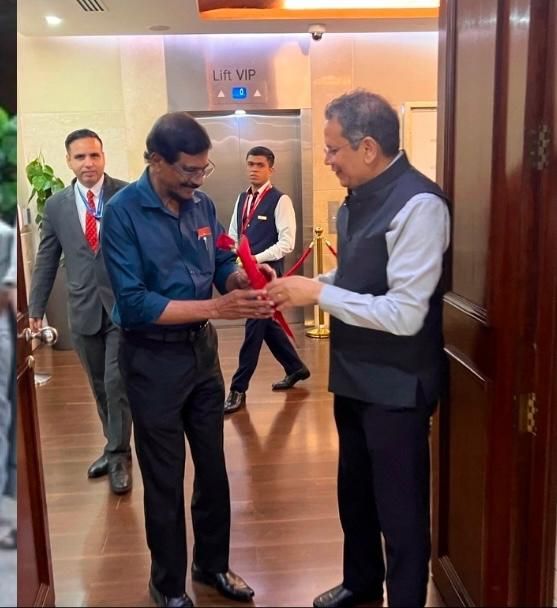
NEW DELHI — A delegation from the Janatha Vimukthi Peramuna, the Marxist-rooted party at the center of Sri Lanka's government, is in New Delhi this week for talks with Prime Minister Narendra Modi's Bharatiya Janata Party, the latest sign of a turnaround for a movement that once treated India as a threat to Sri Lankan sovereignty.
The five-member delegation, led by the JVP’s general secretary, Tilvin Silva, who is often regarded as the most powerful man in Sri Lanka, arrived on Sept. 27 at the BJP’s invitation and is scheduled to stay until Oct. 1.
Mr. Silva and his colleagues are due to meet India's external affairs minister, S. Jaishankar; the BJP's national president, Nitin Nabin; and B.L. Santhosh, the party's national general secretary for organization, according to a statement from Vijay Chauthaiwale, who heads the BJP's foreign affairs department. They are also expected to meet Rekha Gupta, the chief minister of Delhi.
The itinerary includes sessions with leaders of BJP departments and affiliated organizations at the party's national headquarters, as well as visits to India's Parliament and the BJP's Delhi office. The BJP said the trip was meant to strengthen ties between the two parties and allow them to exchange organizational experience.
The visit is part of the BJP's "Know BJP" program, through which India's governing party hosts delegations from foreign political parties to acquaint them with how it is organized and run.
For the JVP, the trip marks how far the party has traveled. It emerged in the late 1960s as a Marxist revolutionary movement and led two armed uprisings against the Sri Lankan state, in 1971 and from 1987 to 1989. The second was fueled in large part by opposition to the 1987 Indo-Sri Lanka Accord and the deployment of Indian troops on the island, which the JVP denounced as Indian interference. Suspicion of "Indian expansionism" was for years a staple of the party's political education.
The party now leads the National People's Power coalition, which brought President Anura Kumara Dissanayake to power in 2024 and won a large parliamentary majority weeks later. Mr. Dissanayake, a longtime JVP leader, visited New Delhi at the Indian government's invitation in February 2024, while still in opposition, and made India his first foreign destination as president that December. Mr. Modi visited Colombo in April 2025, when the two governments signed a memorandum of understanding on defense cooperation.
The BJP, a Hindu nationalist party that has governed India since 2014, is an ideological contrast with the JVP, whose roots lie on the revolutionary left and which spent most of its history as an opposition movement far from the centers of power it now occupies.
Alongside Mr. Silva, the delegation includes Chandrika Adikari, a member of the JVP's Central Committee; Aboobucker Athambawa, a member of Parliament; Kabilan Suntharamoorthy, a member of a JVP district committee; and Kalpana Madhubhashini, a member of the party's international department.
The JVP did not respond to a request for comment on the purpose of the visit.