

JAFFNA, Sri Lanka — IMDb has flagged "unusual voting activity" on Best of the Best, the new Netflix film starring the Canadian actor Maitreyi Ramakrishnan, after Sinhala nationalist social media pages in Sri Lanka urged their followers to give the movie one-star ratings because she identifies as an Eelam Tamil.
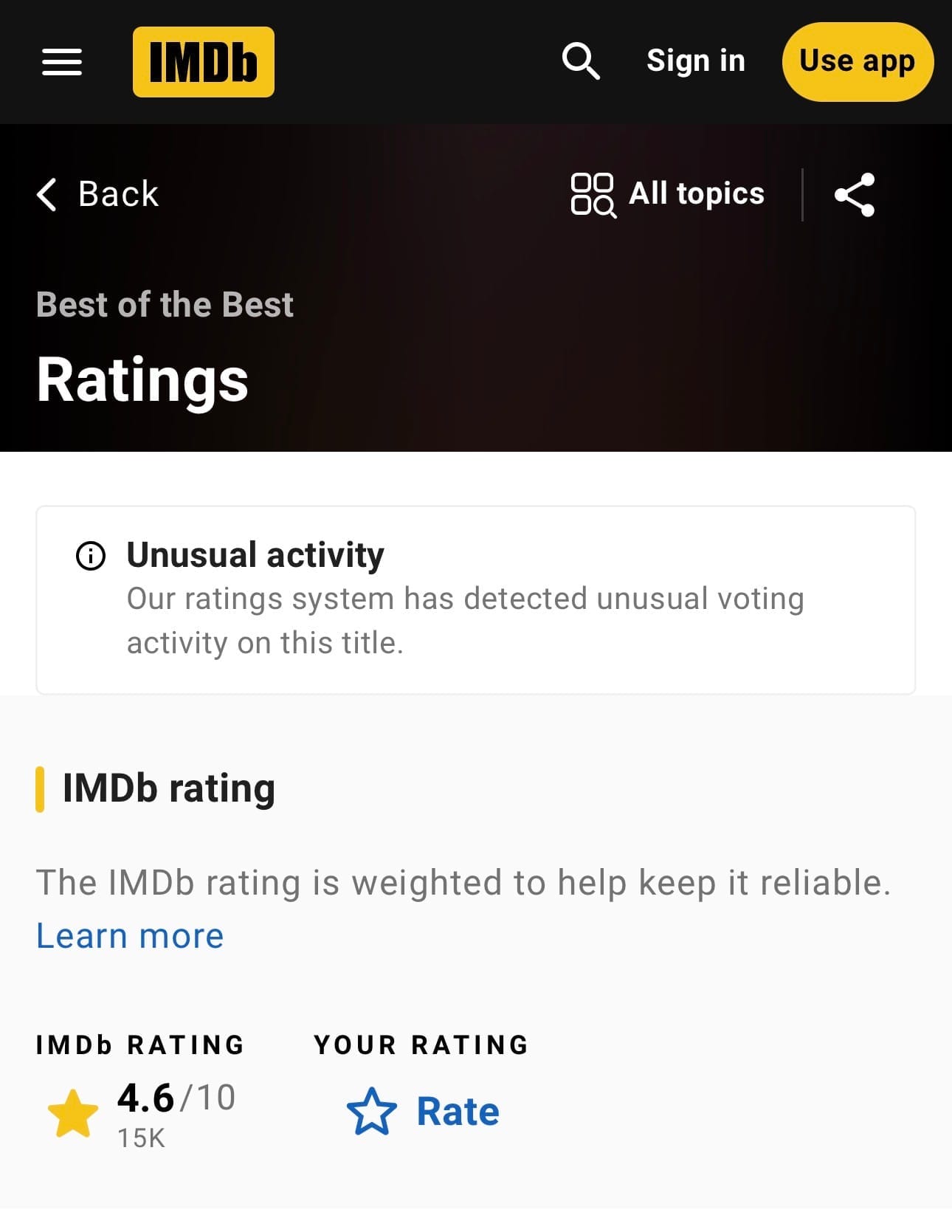
The warning appeared as the number of ratings from Sri Lanka rose sharply. The Canadian Tamil Congress, an advocacy group, has condemned what it called "orchestrated online harassment and targeted attacks" against Ms. Ramakrishnan.
As of Tuesday morning, the film had an overall IMDb rating of 4.6 out of 10 from about 15,000 ratings, according to the site's ratings page as viewed by Jaffna Monitor. Above the score, IMDb displayed a notice saying, "Our ratings system has detected unusual voting activity on this title."
About 9,100 of those ratings came from Sri Lanka, according to IMDb's geographic breakdown. Of those, 79.3 percent, or about 7,200, gave the film one star, the lowest possible rating. Another 17.7 percent, or about 1,600, gave it two stars. Together, 97 percent of the ratings from Sri Lanka were one or two stars. Among Sri Lankan users, IMDb showed a weighted rating of 1.2 out of 10 and an unweighted mean of 1.3.
Shortly after the film's release on Sept. 18, Jaffna Monitor recorded about 1,200 one-star ratings from Sri Lanka, which then accounted for 90.8 percent of the country's votes.
IMDb does not say what activity triggered its warning or where it originated. The data does not show that all, or most, of the 9,100 ratings from Sri Lanka resulted from the organized campaign. IMDb says its headline rating is weighted rather than calculated as a simple average, a method it says is intended to keep ratings reliable.
The warning followed an earlier Jaffna Monitor investigation that documented Sinhala nationalist Facebook pages instructing followers to go to IMDb and give the film one star. The campaign began after Ms. Ramakrishnan, 24, publicly described herself as "a Tamil Eelam woman" and explained why she does not identify as Sri Lankan.
The Sri COM, a Sinhala-language Facebook page with more than 150,000 followers, urged its audience to rate Best of the Best one star and to post negative reviews. The page also supplied an English-language prompt that followers could enter into ChatGPT or Google's Gemini to generate reviews saying Ms. Ramakrishnan's acting made the film difficult to watch. Followers were told to post the generated reviews on IMDb and return with screenshots showing they had done so.
When the film's rating fell, the page credited its followers and thanked them as "true Sri Lankans." It later discussed targeting another film featuring Ms. Ramakrishnan.
Other pages and accounts amplified the effort. Jaffna Monitor identified several with a combined following of more than 500,000, though those reviewed represented only part of the activity.
On Rotten Tomatoes, 82 percent of 17 critics' reviews were positive as of Tuesday, and the audience score stood at 74 percent from more than 50 ratings. The two sites use different rating systems and draw on different audiences, so their scores are not directly comparable.
The Canadian Tamil Congress said the campaign was an attempt to dictate how Ms. Ramakrishnan should describe herself.
"The coordinated campaign against Ms. Ramakrishnan is not merely a disagreement; it is a direct attempt to police her identity and usurp her personal agency," the group said in a statement. "Every individual possesses the fundamental right to choose, define, and express their own identity exactly as they see fit."
The group described identity as "deeply personal, multifaceted, and evolving" and rejected efforts by outside groups or individuals "to enforce rigid definitions of belonging or to dictate how Tamil youth in the diaspora navigate their identities."
In an interview in the days before the film's release, Ms. Ramakrishnan said, "I love who I am as a Tamil Eelam woman." In another, she said describing herself as a Sri Lankan Tamil was "not truly how I feel about my identity." She said she preferred the wording her character uses in the film: "I'm Tamil. My family's from Sri Lanka."
She has expressed the same view before. In remarks quoted on her IMDb profile, she said: "My identity isn't being Sri Lankan. That's not my country. My country is Canada. But my culture is definitely Tamil."
Sinhala nationalist pages portrayed her identification as an Eelam Tamil as evidence that she supported the Liberation Tigers of Tamil Eelam, or L.T.T.E., the separatist group that fought the Sri Lankan government until its military defeat in 2009. Jaffna Monitor found no public statement by Ms. Ramakrishnan expressing support for the L.T.T.E., and the clips circulated by the pages did not contain one.
Some Tamils, particularly in communities shaped by war and displacement, use "Eelam Tamil" as an ethnic and regional description. "Tamil Eelam" was also the name the L.T.T.E. gave to the independent state it sought to establish in Sri Lanka's north and east. The group carried out suicide bombings, assassinations and other attacks during the civil war and was accused of grave abuses against civilians. Canada designated it a terrorist entity in 2006.
Ms. Ramakrishnan was born and raised in the Toronto area to Tamil parents from Sri Lanka and became internationally known as the lead in Netflix's Never Have I Ever. In Best of the Best, she plays Maya in a comedy about two childhood friends who join a competitive Bollywood-fusion dance team at U.C.L.A.
The Canadian Tamil Congress said her public profile did not diminish her right to decide how she describes her heritage. "CTC stands in solidarity with Maitreyi Ramakrishnan," the group said, calling on Canadians to reject cyberbullying and to create an environment in which people can express their heritage "without fear of intimidation”.