

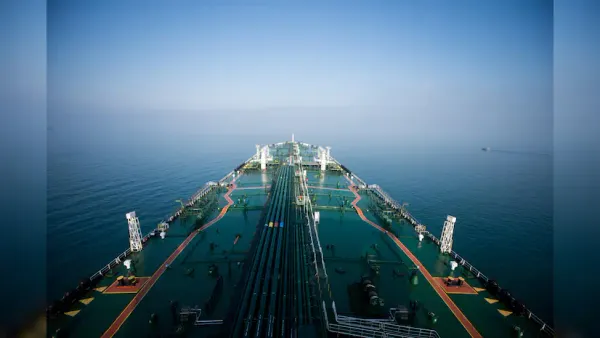
COLOMBO — Nearly 20 Iranian oil tankers, all of them empty, have gathered in waters near Sri Lanka, unable to sail home because an American naval blockade has closed Iran's ports. Their presence has brought the war between Washington and Tehran close to Sri Lanka and to one of the world's busiest shipping lanes for the second time this year.
Sri Lanka's Foreign Ministry said on Saturday that it was tracking the vessels but bore no responsibility for them and was providing them nothing. Thushara Rodrigo, the ministry's director general of public diplomacy, said the ships were away from Sri Lankan territory and that Colombo therefore had no binding obligation toward them.
Where exactly they are sitting is disputed. TankerTrackers.com, a maritime intelligence service, places the fleet inside Sri Lanka's exclusive economic zone, with roughly 13 confirmed Iranian-flagged vessels, several belonging to the state-owned National Iranian Tanker Company, alongside ships linked to Iran's sanctions-evading shadow fleet. The Foreign Ministry says they are anchored beyond the zone's outer boundary. Neither has published coordinates.
The count has also moved. Days earlier, Foreign Minister Vijitha Herath told Agence France-Presse that authorities were monitoring 11 tankers under American sanctions.
The distinction the ministry is drawing carries legal weight. Sri Lanka's territorial sea extends 12 nautical miles from the coast and falls under full sovereignty. The exclusive economic zone reaches 200 nautical miles but confers only resource rights; foreign vessels retain broad rights of navigation there.
Samir Madani, a co-founder of TankerTrackers.com, told the Financial Times that the vessels' draft levels showed they were riding empty, which suggests they are waiting for an opening to return to Iran and load. That, he said, leaves them exposed to attack, consistent with earlier American strikes on tankers making for Iranian export terminals.
Washington imposed the blockade on April 13, after talks in Islamabad failed to produce a settlement. A 14-point memorandum of understanding signed on June 17 lifted it and reopened the Strait of Hormuz, but the agreement broke down within weeks, and the blockade was reinstated in mid-July. On August 19, President Trump announced a further expansion of sanctions, which Treasury Secretary Scott Bessent has described as an economic D-Day. Data from the analytics firm Kpler shows Iranian crude loadings have fallen to almost nothing since mid-July.
Sri Lanka has already absorbed one consequence of this war. Before dawn on March 4, the American attack submarine U.S.S. Charlotte sank the Iranian frigate IRIS Dena with an MK-48 torpedo in international waters off Galle, on the southern coast — the first sinking of an enemy warship by a U.S. submarine torpedo since the Second World War. Of about 180 people aboard, the Sri Lankan navy rescued 32 and recovered 87 bodies. Eighty-four sets of remains were repatriated to Iran on March 13; the survivors stayed in Sri Lanka. Accounts of the strike's distance from shore have ranged from about 20 to 40 nautical miles, but all place it outside the territorial sea.
A day after the sinking, Colombo permitted a second Iranian warship, the IRIS Bushehr, and its crew of 219 into Sri Lankan waters and gave it safe harbour.
The law that made the Dena a lawful target also explains the tankers' positioning. Belligerents may not attack vessels inside the territorial sea of a neutral state, which gives ships hugging that boundary a measure of protection they lose the moment they cross out of it.
The fleet has not held still. United Against Nuclear Iran, an advocacy group that tracks sanctioned shipping, reported that most Iran-flagged tankers left the Galle anchorage from August 23 and began loitering elsewhere near the island, which it attributed to enforcement pressure following publicity about their presence.
Opposition politicians have pressed the government in Parliament over Iranian vessels near Colombo before. Cabinet spokesman Nalinda Jayatissa said in March that ministers knew considerably more than they had disclosed and promised a full report once the matter was resolved. No such report has been presented.