

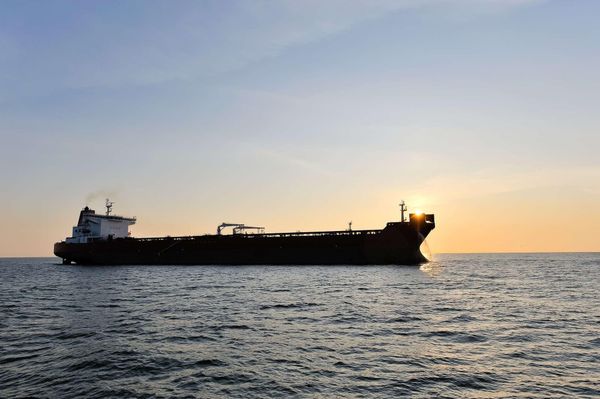
COLOMBO: Sri Lanka's Foreign Ministry said this week that American warnings against servicing sanctioned Iranian tankers anchored off the island apply to every country, after The Wall Street Journal reported that Washington had pressed the government to cut off food, fuel and water to the ships.
The Journal reported on Sept. 30 that about 20 empty Iranian oil tankers were drifting roughly 15 miles off Sri Lanka's southwest coast with their engines idled, and that their food, fuel and fresh water were running short. Citing Sri Lankan government documents and companies that supply ships, the newspaper said U.S. officials had pressed Sri Lanka in recent weeks to stop local vessels from provisioning the tankers and their crews.
Thushara Rodrigo, director general and spokesman of the Foreign Ministry, said in a statement that several journalists had asked him whether the United States had warned Sri Lanka of sanctions if it supplied or serviced the vessels. He said the measures were a general American policy applied worldwide and were not aimed at Sri Lanka or any other country. Under the sanctions, announced on Aug. 24, any person or company that provides services to vessels under U.S. sanctions risks losing access to the American financial system, he said.
Mr. Rodrigo said the sanctions were publicly known and well understood in the merchant shipping industry, and that similar vessels were waiting in other oceans because of the conflict. Citing the sensitivity of the matter, he asked the news media to report "carefully and accurately."
His statement did not address the Journal's report that American officials had pressed Sri Lanka over local supply boats.
According to the Journal, the U.S. Embassy in Colombo told the Sri Lankan government in August that it was tracking 19 Iranian tankers off the western coast. The embassy urged officials to instruct local port service providers to refuse the ships support or risk U.S. secondary sanctions, the newspaper reported. It also reported that when two Iranian-flagged container ships anchored inside Colombo's port limits in early September, the Sri Lanka Ports Authority wrote that servicing them was not "prudent" because of the sanctions risk. Shipping companies told the Journal that permission to deliver food, drinking water, fuel and repair services to Iranian vessels had become increasingly hard to obtain.
On Sept. 8, Foreign Minister Vijitha Herath said the U.S. Embassy had contacted his ministry to ask whether the authorities knew about several Iranian vessels in international waters and were tracking them. He said the Defense and Ports Ministries had been informed and that the Sri Lanka Navy was monitoring the ships. "They are not in our waters," he said.
Mr. Herath said 47 vessels had been identified in international waters more than 24 nautical miles from Sri Lanka's territorial waters. The group included several Iranian-flagged ships along with other commercial vessels, he said, and none had asked the government for facilities or assistance, and none had been given. He said it was common for cargo ships to wait in international waters off Sri Lanka, Thailand, Malaysia and Indonesia between operations, and that apart from monitoring them, the government had taken no action.
Mr. Rodrigo and Mr. Herath both placed the ships about 24 nautical miles away. The Journal's figure of 15 miles is about 13 nautical miles, just outside the territorial limit. Sri Lanka's territorial sea extends 12 nautical miles from its baseline. The navy has said the vessels were near the country's exclusive economic zone but outside its sovereign waters, and therefore beyond its direct jurisdiction.
Counts of the tankers have changed over the past six weeks. On Aug. 31, Reuters, citing the analytics firm Vortexa, reported that 27 sanctioned tankers tied to the Iranian oil trade were idling empty near Sri Lanka after discharging their cargoes. An analysis by BBC Sinhala and BBC Verify found 21 Iranian vessels in international waters near Sri Lanka on Sept. 15. United Against Nuclear Iran, a U.S. advocacy group that tracks Iranian shipping, said on Oct. 1 that 20 empty Iran-flagged tankers were off Sri Lanka. According to the group, most of them left the anchorage off Galle from Aug. 23, and by Sept. 29 many had moved to another anchorage farther north along the coast.
Dozens of Iranian and Iran-linked tankers that carried sanctioned oil to China have been stuck in waters near Sri Lanka and Malaysia since July, when the United States reimposed its blockade of the Strait of Hormuz. Before the war, tankers carrying Iranian crude sailed to international waters off Malaysia, transferred the oil to other ships bound for Chinese refineries and returned to Iran to reload. The blockade has prevented the empty ships from making the return voyage.
The Aug. 24 measures were part of a wider Treasury Department campaign called Operation Economic Outcast. The Treasury's Office of Foreign Assets Control authorized secondary sanctions covering Iran's shipping, aviation, gold, digital asset and technology sectors, and added nearly 60 Iran-related individuals, companies and vessels to its sanctions list. Among them was Shipoil Ltd, a Hong Kong-registered company accused of arranging refueling and other services for vessels carrying Iranian crude and petroleum products. The measures came a week after a June memorandum of understanding between Washington and Tehran, which had raised the possibility of broader sanctions relief, expired.
The Trump administration has also imposed further sanctions on Iran and told its trading partners to cut ties with Tehran as it seeks concessions from Iran in the conflict.
Mr. Rodrigo said in his statement that the people of Sri Lanka needed accurate information on how the secondary sanctions apply.