

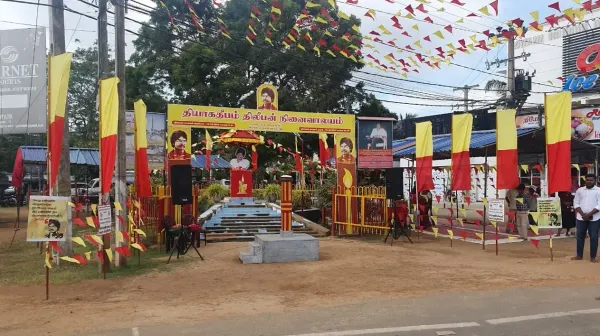
JAFFNA, Sri Lanka: A former mayor of Jaffna told the city’s municipal council on Monday to disregard a letter from the district’s top police officer asking it to remove a structure from the memorial to Thileepan, the Tamil Tiger political leader who died on hunger strike in 1987.
“Had I been the mayor, I would have torn that letter up and thrown it into the dustbin,” said the former mayor, Visvalingam Manivannan. “The Deputy Inspector General of Police has no legal grounds to issue orders to the Municipal Council. The police cannot interfere in the council’s functions. If they need to, let them file a case.”
He then addressed the council’s current leadership. “I want to say one thing to today’s mayor and to the Municipal Council. You need not pay any heed to this letter,” he said. “If the memorial of Thiyaga Theepam Thileepan is removed, Jaffna town will erupt. People will take to the streets and protest. The police can move even a single stone of that memorial only by getting past the people’s protest.”
The letter is the latest turn in a dispute over the memorial in Nallur that began in September. A bust of Thileepan appeared there during his annual commemoration, and police took it away hours after the commemoration ended. The parties that condemned the removal most loudly have not said who put the bust there.
Mr. Manivannan, a senior attorney-at-law, spoke at the prize-giving for the Rasaiah Parthipan (Thileepan) Chess Tournament 2026, held to mark the 39th anniversary of Thileepan’s death. The ceremony was organised by the Thiyaga Theepam Thileepan Aavanakaapagam, an archive dedicated to his memory, at the Thanthai Chelva Mandapam near Jaffna Central College. Rajaratnam Kumaran, a well-known physics teacher, was chief guest. Navaratnam Nantharoopan, a chartered engineer, and Mr. Manivannan were special guests, and the three presented prizes to the winning students. The organisers’ invitation described Thileepan, born Rasaiah Parthipan, as a former student of Jaffna Hindu College and an accomplished chess player.
Thiyaga Theepam means “lamp of sacrifice” in Tamil, and many Tamils refer to Thileepan by that title. He led the political wing of the Liberation Tigers of Tamil Eelam in Jaffna. In September 1987, he began a fast at Nallur, demanding that India honour commitments made to the Tamils under the Indo-Sri Lanka Accord. He refused both food and water and died on the 12th day. Most hunger strikers accept water, and deaths from a fast without it are rare. His admirers gave him the title after his death.
What the police letter says
The letter, from the Deputy Inspector General of Police for Jaffna District, became public on Oct. 31. It was addressed to the Commissioner of the Jaffna Municipal Council and written only in Sinhala, although the council is Tamil-run and serves a Tamil-speaking city.
The letter says a fiberglass statue of Thileepan had been placed in front of the Rio ice cream outlet on Point Pedro Road, within the Jaffna Police Division. Police concluded that a memorial to a member of a proscribed organisation, in a public space in a main town, could again create a war mentality among the public and obstruct reconciliation. They filed a report in the Jaffna Magistrate’s Court under case number JAF/MC1/PC/02317/26-B. On Sept. 27, the letter says, officers from the Jaffna Police Station removed the statue and handed it over to the court.
Police investigations, the letter states, found that the land belongs to the Nallur temple and was leased to the council on Oct. 2, 2017. A temporary, stage-like structure bearing Thileepan’s photograph has since been built on the same spot. The letter describes it as an unauthorised construction and says memorials of this kind in public places would be a major obstacle to inter-ethnic reconciliation. Because the council holds the land, the letter asks it to take the necessary steps under municipal law to remove the structure.
“A legally built memorial”
Selvarajah Kajendren, general secretary of the Tamil National People’s Front and a former member of Parliament, condemned the letter on Saturday. He said it violated the public’s basic right to remember the dead and exposed what he called the racism of President Anura Kumara Dissanayake’s government.
Mr. Kajendren said the memorial was first built lawfully in 1988 under the then Municipal Commissioner, with contributions from council staff and the public. According to him, the army later destroyed it. It was rebuilt in 2003 under the ceasefire, when the peninsula was under military control and international truce monitors were on duty, and he said no one complained to the police or the monitors that it was illegal or provocative. It was destroyed again after fighting resumed in 2006. In 2016, he said, a fence was built around the site with a member of Parliament’s decentralised budget allocation and the approval of the Northern Provincial Council.
“Funds could not have been allocated to an illegal site,” he said. “This is not an illegal building. The Jaffna Municipal Council must not allow this.”
A bust no one has claimed
The bust appeared at the memorial on Sept. 15, the first day of the commemorations. Organisers described it as bronze. The mayor, Vivekanandaraja Mathivathani, later said it was made of fibre, and the police letter calls it fibreglass.
The mayor has said the request for permission reached the council at its monthly meeting on Sept. 15, when the bust was already standing at the memorial. The council voted to let it remain temporarily, until Sept. 26. She said the police repeatedly asked the council to get a written undertaking from the organisers that it would be removed after that date, and the council refused. Mayuran, chairman of the council’s Works Committee, has said the organisers sought permission only after the bust had been installed and an issue had arisen.
More than 20 police officers removed the bust before dawn on Sept. 27. Protests followed across the north. Mr. Kajendren accused the Ilankai Tamil Arasu Kachchi, which controls the council, of acting for the police. Fisheries Minister Ramalingam Chandrasekar said the government had nothing to do with the removal and that the council must take responsibility. The mayor said neither the council nor her party’s leadership was responsible.
The court did not take the bust. Last month the Jaffna Magistrate’s Court declined to take it into custody. The magistrate asked the police why they had not established who erected it and on what basis they had brought it to court. The police took it back to their Jaffna headquarters and said they would seek the Attorney General’s advice.
Police then summoned four people for questioning: Mr. Kajendren; a man known as Pon Master; and two members of the Tamil Makkal Kootani, Varatharajan Partheepan and Pathmanathan Mayooran, chairman of the Nallur Pradeshiya Sabha. Mr. Partheepan, who ran an archival exhibition next to the memorial, said neither he nor Mr. Mayooran had anything to do with installing the statue. The inquiry has been linked to the Prevention of Terrorism Act.
The Tamil National People’s Front, which ran the main memorial site during the commemorations, has not said publicly who installed the bust. Mr. Manivannan did not address the question on Monday.
Sabapathy, a Jaffna resident, keeps a portrait of Thileepan among the deities in his home's prayer room and worships him there. He directed his anger at the Tamil nationalist parties, which he accused of doing business in Thileepan’s name.
“A man went without food and water until he died for you,” he told Jaffna Monitor. “You cannot even say, ‘We installed the bust,’ and go to jail for him. Then what use is your Tamil nationalism?”