

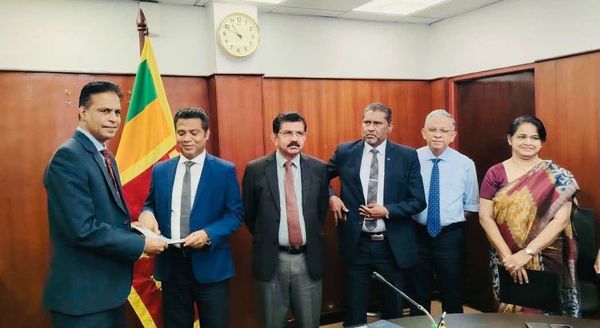
BATTICALOA, Sri Lanka, Nov. 3 — Dr. Gunasingam Sugunan, director of Kalmunai North Base Hospital, has been appointed to head Batticaloa Teaching Hospital, weeks after Sri Lanka’s Human Rights Commission found that the Kalmunai hospital administration had violated the rights of six Muslim women healthcare assistants in a dispute over their religious attire.
Health Minister Dr. Nalinda Jayatissa handed Sugunan his appointment letter at the Ministry of Health in Colombo on Monday. Health Ministry Secretary Dr. Anil Jasinghe attended the ceremony, at which new directors were also appointed to the teaching hospitals in Ragama, Kalubowila and Peradeniya, and to Lady Ridgeway Hospital for Children in Colombo.
The appointment comes as Kalmunai North Base Hospital faces a November 11 deadline to report on its implementation of the Human Rights Commission’s recommendations. The commission found in October that the hospital administration had acted arbitrarily and discriminatorily in preventing six newly appointed Muslim women from working while wearing headscarves and other modest clothing alongside their prescribed uniforms.
The dispute began in August when nine Muslim women appointed as healthcare assistants by the Health Ministry reported for duty at the hospital in Ampara District.
According to complaints submitted by the women, hospital officials instructed them during an orientation session to remove their headscarves, long sleeves and trousers, which they wore in addition to the prescribed uniform. Three complied, while six refused.
The six women said they were subsequently prevented from signing the attendance register and told they could either comply with the dress instructions, accept a transfer or resign.
Hospital authorities maintained that they were enforcing existing government regulations on official uniforms.
The controversy reached Parliament in August, drawing interventions from lawmakers and senior Health Ministry officials.
On August 18, Ilankai Tamil Arasu Kachchi parliamentarian Kaveendiran Kodeeswaran told Parliament that Sugunan had not been present when the initial decision was taken. He defended the hospital’s acting administration, saying it had followed established regulations rather than acted out of communal prejudice.
Two days later, Health Minister Jayatissa defended the ministry’s uniform policy, explaining that standardised uniforms were necessary for identifying healthcare workers and maintaining hygiene, patient care and infection control.
He said the ministry’s uniform committee determined the prescribed clothing for each category of employee and that workers could not independently add to or alter their uniforms.
Jayatissa acknowledged the cultural concerns raised by the dispute.
“They have their own cultural identity. But there are circulars,” he told Parliament, adding that the government would consider whether the regulations needed to be revised.
Deputy Health Minister Dr. Hansaka Wijemuni also maintained that employees whose positions required prescribed uniforms had to follow the regulations. Those seeking modifications on religious, cultural or climatic grounds should apply to the uniform committee, he said.
Wijemuni acknowledged at the time that he did not know precisely what had occurred at Kalmunai or who had prevented the women from working.
The Health Ministry subsequently attached the affected women to Ashraff Memorial Hospital in Kalmunai.
Human Rights Commission finds discrimination
The Human Rights Commission of Sri Lanka reached a different conclusion from the hospital administration.
In findings issued on October 12, the commission determined that neither the 1989 nor the 2022 public administration circulars relied upon by the hospital explicitly prohibited religious head coverings or additional modest clothing.
It described the administration’s interpretation of those regulations as “arbitrary, unreasonable and discriminatory.”
The commission also observed that another government hospital in Ampara District permitted Muslim female employees to wear similar religious clothing while performing their duties.
It found that the decision to transfer the women without a disciplinary inquiry had further violated their rights.
The commission recommended that Kalmunai North Base Hospital issue written instructions permitting staff to wear head coverings, long sleeves and trousers alongside their prescribed uniforms.
It also called for the six women to be offered the opportunity to return to the hospital and for an impartial investigation into their allegations of harassment.
Beyond the Kalmunai dispute, the commission recommended that the Ministry of Public Administration introduce a national circular permitting public officers to wear religious attire with their official uniforms, provided their faces remained identifiable.
The hospital director and the secretary of the Ministry of Public Administration were directed to report on the implementation of the recommendations by November 11.
Sugunan’s departure comes before that deadline. It was not immediately clear who would be responsible for submitting the hospital’s response following his transfer, or whether the six women would be offered their former positions.
Political controversy
The dispute also became the subject of political accusations.
On August 19, Jaffna District independent parliamentarian Ramanathan Archchuna accused Sugunan of discriminating against Muslim employees.
Medical professionals familiar with both men told Jaffna Monitor that differences between Sugunan and Archchuna predated the latter’s entry into politics. Those accounts do not establish whether their earlier disagreements had any bearing on the allegations raised in Parliament.
On October 17, the Political Council of Tamil-Speaking Peoples called on the government to review the uniform regulations governing healthcare assistants, taking religious and cultural sensitivities into account, and to establish a timetable for the review.
Sugunan has not publicly commented on the allegations.
There has been no official indication that his appointment to Batticaloa Teaching Hospital was connected to the controversy.
Fifteen years in health administration
Sugunan brings 15 years of experience in health administration to Batticaloa Teaching Hospital.
Before heading Kalmunai North Base Hospital, he served as medical superintendent of Kaluwanchikudy Base Hospital, Regional Director of Health Services in Kalmunai, District Director of Health Services in Batticaloa and director of Vavuniya Base Hospital.
Originally from Kaluwanchikudy in Batticaloa District, he attended Sivananda Vidyalayam in Batticaloa before obtaining his medical degree from the University of Jaffna. He subsequently completed a postgraduate master’s degree in administration at the University of Colombo.
He currently lives with his family in Batticaloa.
Sugunan was scheduled to preside over his final official function at Kalmunai North Base Hospital on Tuesday, a ceremony recognising the hospital’s National Productivity Award achievement.
Dr. R. Muraleeswaran, who had been serving as acting director of Batticaloa Teaching Hospital, will continue as Regional Director of Health Services in Batticaloa.