

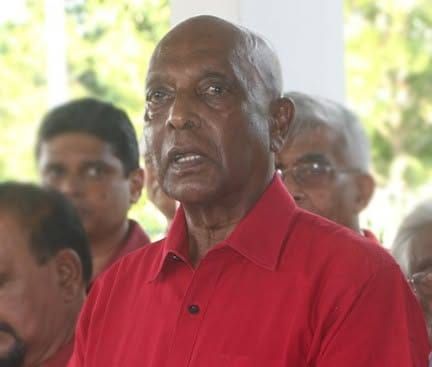
Lal Wijenayake, a Kandy lawyer and six-decade veteran of Sri Lanka’s left who in his final months went to the Supreme Court to oppose a constitutional amendment introduced by his own party, the governing National People’s Power, died on Saturday evening at a private hospital in Kandy. He was 85.
At his death, Mr. Wijenayake sat on three of the N.P.P.'s senior bodies: its Leadership Council, its Executive Committee and its National Operations Committee. He came to the coalition, which is built around the Janatha Vimukthi Peramuna, or J.V.P., after more than half a century in the Lanka Sama Samaja Party, the country’s oldest political party. He joined it with the long-held aim of abolishing the executive presidency created under J.R. Jayewardene’s 1978 Constitution.
This year he became the most senior figure inside the party to fight the government in public. The issue was the 22nd Amendment to the Constitution, which raised the retirement age of Supreme Court judges to 67 from 65 and of Court of Appeal judges to 65 from 63. Mr. Wijenayake argued that changing the terms of service of judges while they sat on the bench would give future governments a lever over the judiciary. The Bar Association of Sri Lanka, which also opposed the measure, asked Chief Justice Preethi Padman Surasena to withdraw from hearing challenges to it on the ground that he would be its first beneficiary.
In late July, at a news conference with senior lawyers, Mr. Wijenayake said that none of the party bodies on which he served had approved the proposal, and that he had been told to stay quiet after he raised questions about it. In a newspaper interview, he said the call had come from K.D. Lalkantha, the agriculture minister and a senior J.V.P. figure in Kandy, who asked him, “Why don’t you keep silent on this matter?” The party has disputed his account of the call.
He replied in a letter to Mr. Lalkantha, sending copies to President Anura Kumara Dissanayake and to the party’s general secretary, Nihal Abeysinghe. In the same interview, he said that the rule of law depended on an independent judiciary, that his objection was one of principle and that he had no personal quarrel with the party’s leaders. He also said he could not tell where decisions in the party were being made.
When the bill was tabled in Parliament in August, he took it to court. On Aug. 31, he filed a petition in his own name asking the Supreme Court to rule that the amendment needed approval by the people at a referendum. He filed a second through Lawyers for Democracy, a group he had helped found, arguing that the bill was inconsistent with Article 3 of the Constitution, which places sovereignty in the people. In a statement, he said it misled the public to present the dispute as a contest between the government and the opposition.
He lost. A five-judge bench headed by Chief Justice Surasena determined that a two-thirds majority in Parliament was sufficient, a ruling announced to lawmakers on Sept. 22. Three days later Parliament passed the amendment by 158 votes to 63.
Within days, Mr. Wijenayake told a newspaper that he had met President Dissanayake, that he would not disclose what was said and that he would remain in the party. He said his view of the amendment had not changed and that he would keep supporting the Bar Association’s efforts against it, but he ruled out joining opposition protests. Dr. Abeysinghe said the party accepted his right to hold a personal view.
He kept up his opposition on other fronts. In September the government published the Protection of the State from Terrorism Bill, its proposed replacement for the Prevention of Terrorism Act of 1979, a law used for decades to detain Tamils in the north and east. Amnesty International and other rights groups said the new bill still defined terrorism too broadly. Mr. Wijenayake campaigned against it, and in the week before his death he was working to establish a Left Centre in Kandy.
Tributes on Sunday came from across political lines, and several dwelt on his break with the government. Ali Sabry, a President’s Counsel who was justice minister under President Gotabaya Rajapaksa and later foreign minister, called him “a legend in his own right” and wrote that whatever his political allegiance, “his conscience remained his own.” Mr. Wijenayake, he wrote, treated democracy, equality, the separation of powers and the independence of the judiciary as beyond negotiation, and “would not surrender a lifetime of conviction to the demands of the political moment.”
“It is easy to speak of judicial independence from the opposition benches,” Mr. Sabry wrote. “It takes courage to defend it against one’s own side. A change of government cannot turn yesterday’s wrong into today’s right.” Of those who had shifted their positions after the change of government, he asked, “If our principles change with the government, what were we defending in the first place?”
Rajeev Amarasuriya, president of the Bar Association of Sri Lanka, which led the legal challenge to the amendment, said Mr. Wijenayake had told him during the dispute that he might sit on the N.P.P.'s Leadership Council but “I will not compromise my principles.” Mr. Amarasuriya noted that he had spent more than 52 years at the bar.
Lionel Bopage, a former general secretary of the J.V.P., wrote in a Facebook post that Mr. Wijenayake had made “a lasting contribution to Sri Lanka’s constitutional development.” He wrote that Mr. Wijenayake had opposed the Prevention of Terrorism Act and its proposed replacement alike, regarding both as threats to civil liberties, and that only the week before his death he had led the founding of the Left Centre in Kandy.
The former Sri Lanka cricket captain Kumar Sangakkara, who grew up in Kandy, wrote that he had known Mr. Wijenayake since childhood as “Lal Maama,” a family friend who bought him chocolate milk when he visited his father’s offices, took him to Champa Stores each year for a birthday present and joined the political arguments at the family home. It was Mr. Wijenayake who collected him from school to tell him that his grandfather had died, Mr. Sangakkara wrote, and who introduced him to the Rubaiyat of Omar Khayyam.
Lal Wijenayake was born in Kandy in 1941 and educated at Dharmaraja College there. He studied science at the University of Peradeniya, where he joined the L.S.S.P. as a student and was elected president of the students’ council, a post that brought him into regular dealings with the vice chancellor, Sir Nicholas Attygalle. He later served on the university senate. He taught school for a time before entering Sri Lanka Law College, and he began practicing law in 1969.
His first major brief came two years later. After the J.V.P.'s armed uprising of April 1971 was put down, he appeared as junior counsel to S. Nadesan, one of the leading civil liberties lawyers of the period, defending accused insurgents before the Criminal Justice Commission.
He built his practice in Kandy largely on cases brought by people with little power. He represented farmers in the Mahaweli settlements who challenged a water tax that a United National Party government, acting on World Bank advice, tried to impose on them. Friends said his arguments in that case helped defeat similar levies elsewhere. After 1977 he defended families facing eviction from land distributed by the Land Reform Commission. He also litigated for trade unions, among them the Ceylon Federation of Labour and the Lanka Estate Workers’ Union. According to accounts published after his death, he once turned down an offer to be named a President’s Counsel.
In the L.S.S.P. he rose to the Central Committee and the Politburo and served as the party’s treasurer. In 1988, while the J.V.P. was threatening candidates and the Sri Lanka Freedom Party was boycotting the vote, he stood in the first elections to the provincial councils created under the Indo-Lanka Accord. He became leader of the opposition in the first Central Provincial Council.
He broke with his own party’s leadership more than once. In 2014, when the L.S.S.P. voted to back Mahinda Rajapaksa for a third presidential term, he was among 13 members who voted against. He told a newspaper at the time that the dissenters planned to form a Left Centre to bring leftists together behind a common candidate opposed to the executive presidency. He later helped establish the United Left Front.
In a note written some years before his own death, the Marxist scholar Kumar David, a longtime comrade, said that Mr. Wijenayake had defended the democratic rights of Tamils during years when leftists who did so were threatened by the state and by others, and that he “did not blink or retreat.” Mr. Wijenayake condemned the Liberation Tigers of Tamil Eelam and also spoke out against atrocities committed by the armed forces.
In January 2016, a year after Mr. Rajapaksa’s defeat in the presidential election, Prime Minister Ranil Wickremesinghe made him chairman of the Public Representations Committee on Constitutional Reforms, a panel drawn from political parties and civil society that traveled the island collecting public views on a new constitution. It received submissions from more than 5,000 people and organizations, with Jaffna among the districts that sent the most. Its members included Harini Amarasuriya, then a university lecturer, who became prime minister after the N.P.P. took power in 2024. The committee delivered its report on May 31, 2016, setting out dissenting opinions where its members could not agree. The constitution it was meant to inform was never enacted.
Mr. Wijenayake wrote on politics in Sinhala and English. He collected Sri Lankan paintings and was a close friend of George Keyt, whom he looked after in the painter’s last years; Keyt’s final work hung in his house in Kandy. He walked around Kandy Lake most days and bought his newspapers from the same agent. For his 80th birthday, the writer Liyanage Amarakeerthi put together a volume of essays about him without his knowledge. It was launched at Dharmaraja College.