

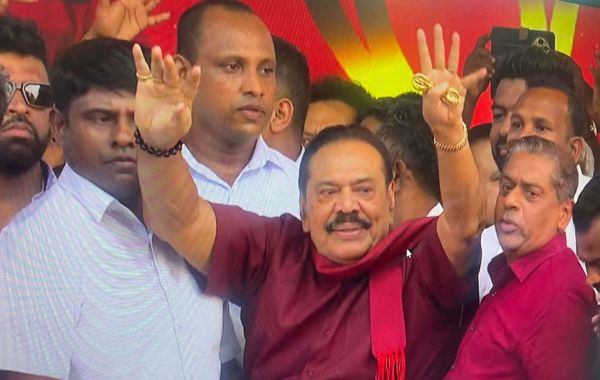
ANURADHAPURA — Mahinda Rajapaksa raised both arms to the crowd at the Anuradhapura Municipal Council Grounds on Saturday afternoon. Several men stood close around him, steadying him as he came before supporters. He made no speech. At 80, the politician who once held some of the country’s largest rallies with hour-long addresses gave this one an appearance instead.
Held in one hand, its ornate ends showing between his fingers, was the small pronged object he has carried through more than two decades of Sri Lankan politics. Reports over the years have identified it as a vajra, sometimes as a Vajra Yantra, and in Sinhala political slang it is known as the “vashee bole.” He has been photographed with it throughout his presidency, the military defeat of the Liberation Tigers of Tamil Eelam, his rise to dominance in Sinhala politics, his unexpected electoral defeat, his family’s return to power and its collapse.
The occasion was the Sri Lanka Podujana Peramuna’s “Janasatana” rally, held at a bad moment for the party he built. His eldest son, Namal Rajapaksa, the SLPP’s national organiser, was not there. The Commission to Investigate Allegations of Bribery or Corruption arrested him on 4 September, and he was remanded until 18 September over an alleged bribe linked to the purchase of wide-body aircraft for SriLankan Airlines. He denies wrongdoing. He had organised the Anuradhapura rally himself, and the party’s general secretary, Sagara Kariyawasam, said he had asked colleagues to make sure it went ahead regardless.
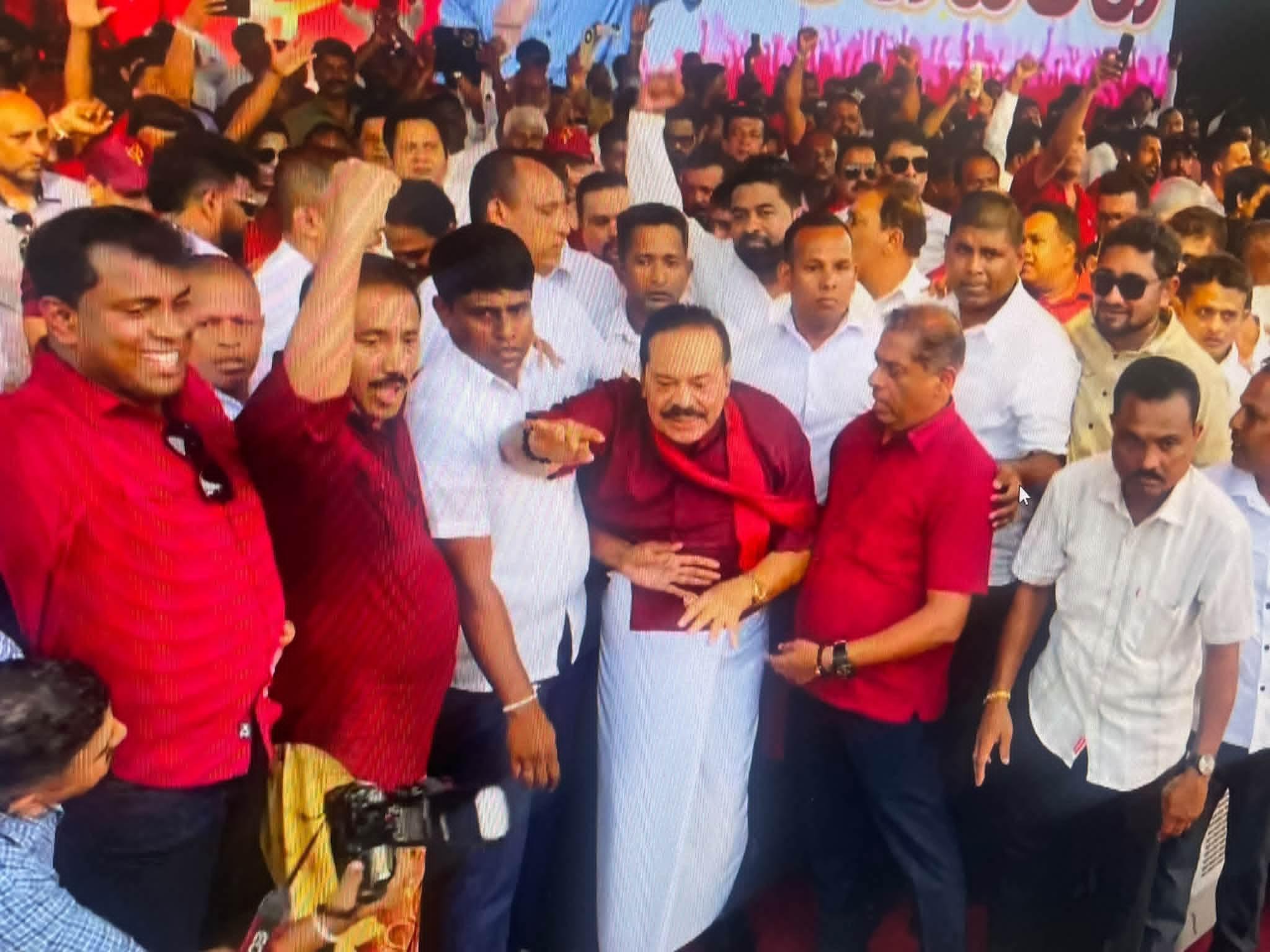
The SLPP organised the rally to protest the government’s failure to fulfil its promises to farmers and the wider public. Former ministers Wimal Weerawansa, Udaya Gammanpila and Tiran Alles were among those on the platform, along with Ramanathan Archchuna, the independent parliamentarian elected from Jaffna, who publicly praised Rajapaksa and predicted that Namal Rajapaksa would win the presidency in 2029.
Party figures had said in advance that the former president would not address the crowd from the main stage. What Anuradhapura produced was the appearance itself: Rajapaksa, visibly needing help, arms up, the object in view.
The words came the next day.
In a statement posted on Sunday afternoon, Rajapaksa thanked the crowd and described the rally as the start of a people’s struggle for the self-respect of the motherland. He wrote that the history of Anuradhapura itself was one of invasion, resistance, betrayal, decline and recovery, and that those lessons still applied.
“I believe that, for a country, an enemy within can be more dangerous than an enemy from outside,” he said, adding that those who sell out the country for personal gain are dangerous and that those who justify such betrayal and spread falsehoods about it are more dangerous still.
He said the SLPP’s purpose was to rebuild a country where people could live safely and happily, with its culture, identity and national character intact. He thanked the clergy, long-standing allies, younger politicians and the supporters who had stood through the heat.
What the Object Is
The object began drawing attention in the press in December 2014, weeks before the election that removed Rajapaksa from office. At a meeting with representatives of the print and electronic media that month, he set it on the table in front of him. Around the same period, Namal Rajapaksa was seen carrying a similar one.
Contemporary accounts identified it as a vajra and described it variously as brass, yellow metal or golden-hued. Its actual composition has never been publicly established.
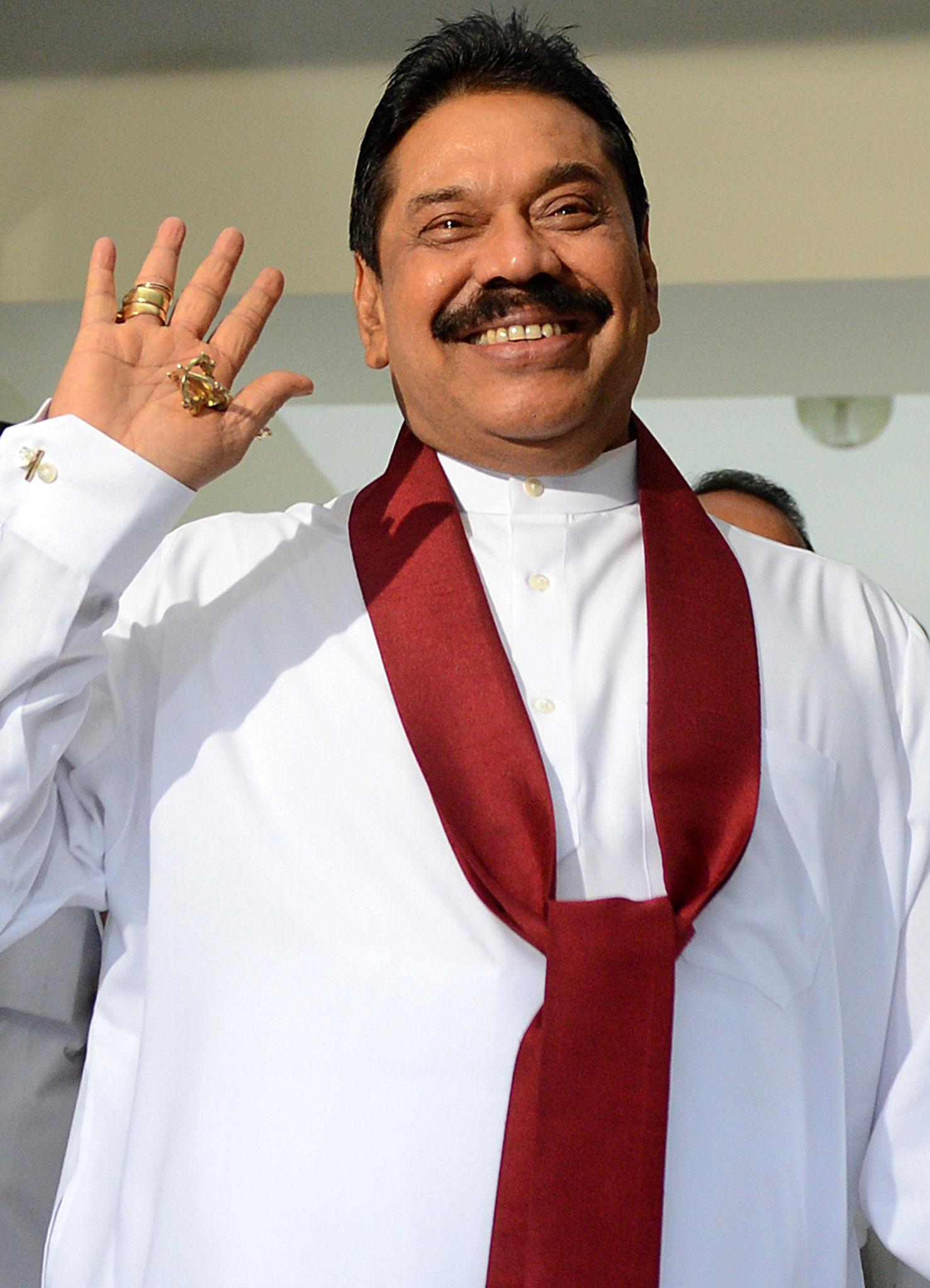
Photographs explain why it is easy to misread. Rajapaksa closes his hand around the centre, leaving only the symmetrical pronged ends visible on either side of his fist. From a distance, those two pieces can look like a pair of heavy rings. They are the two ends of a single object.
The vajra long predates Rajapaksa and Sri Lanka’s modern politics. The Sanskrit word carries the meanings of both thunderbolt and diamond, suggesting irresistible force on one hand and indestructibility on the other. In Hindu tradition, it is the weapon of Indra, the god of thunder and storms. It later became a central ritual implement in Vajrayana Buddhism.
Its standard form is a narrow central grip with matching prongs at either end. Ritual practice distinguishes a peaceful vajra, whose prongs meet at the tip, from a wrathful one, whose prongs splay outward.
The Healer and the President
Reports published in January 2015, citing a person described as close to Rajapaksa, said Eliyantha White, the spiritual healer who became closely associated with him, gave the three-to-four-inch object to Rajapaksa in 2005. Neither Rajapaksa nor anyone in his family has confirmed that account.
White drew a considerable following. Politicians, cricketers and other prominent figures sought his treatments even as questions persisted about his medical qualifications and the healing powers attributed to him. He was given the title of royal physician during Rajapaksa’s time as prime minister. He died in September 2021 after contracting COVID-19, having claimed earlier in the pandemic to have found a cure for it.
If the account of the talisman’s origins is accurate, it entered Rajapaksa’s possession at the start of the most powerful stretch of his political life.
He won the presidency in November 2005. Less than four years later, government forces defeated the LTTE and ended nearly three decades of civil war. The victory made him an overwhelming figure for much of the Sinhala electorate and carried him to a second term in 2010. In the folklore that grew around him, the object came to stand for protection, strength and victory.
When Rajapaksa lost to Maithripala Sirisena in January 2015, it stayed with him.
A news agency photograph taken that April provides the clearest published view of the object, showing Rajapaksa waving with it gripped across his palm and its matching ends extending from either side of his hand.
A Politics of Omens
The talisman belonged to a wider political culture around Rajapaksa in which astrology, auspicious timing and ritual protection were unusually visible.
None of that is peculiar to him. Astrology, gemstones, blessed threads and auspicious hours are ordinary parts of daily life for many people across South Asia, politicians included. Under Rajapaksa, however, such practices moved conspicuously to the front of the political stage. The country acquired a royal astrologer who spoke publicly about his role in matters of state, and astrologers appeared on state media as political commentators.
Rajapaksa’s reliance on the astrologer Sumanadasa Abeygunawardena was widely reported. So was the belief that his decision to call the January 2015 presidential election nearly two years early followed astrological advice that the timing favoured him.
He lost that election and went on carrying the object afterwards.
Political mythology attached itself to his greatest victory as well. An elephant calf was celebrated as having been born on the day the war ended in May 2009, an echo of the omens the Mahavamsa attaches to the birth of the warrior king Dutugemunu, and it was named Dinuda, for victory. It later emerged that the animal had been born months earlier. The omen had been assembled after the fact, an example of how symbolism and political mythology became intertwined with the Rajapaksa victory narrative.
The vocabulary of Sunday’s statement has its own history here. Invasion, betrayal, the enemy within, and the protection of national character have long been part of the working vocabulary of Sinhala nationalist politics, and Anuradhapura is a city where that language carries particular weight.
On this occasion, Rajapaksa applied that language to a government and a bribery investigation.
Namal Rajapaksa is due before the Colombo Chief Magistrate's Court on 18 September. The party says its rallies will continue in the meantime, with his father expected to attend.