

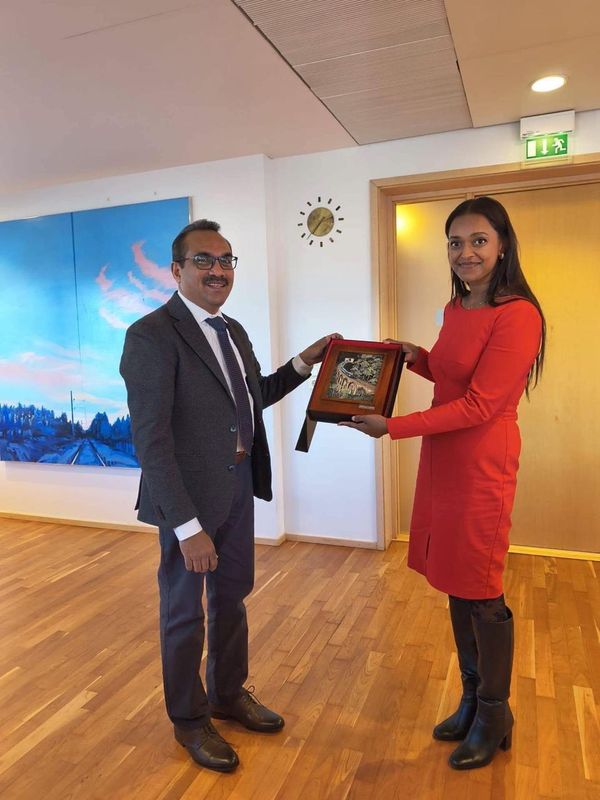
Bimal Rathnayake, who lost Sri Lanka’s ports and aviation portfolio amid allegations that he obstructed Indian-funded projects in the north, was received in Oslo by Kamzy Gunaratnam, who has questioned Colombo’s treatment of Tamils in the Norwegian Parliament.
JAFFNA, Sri Lanka, Oct. 18 — Sri Lanka’s transport minister, Bimal Rathnayake, whose opposition to developing two major transport facilities in the Tamil-majority north has drawn accusations of ethnic prejudice from critics inside and outside his governing coalition, has met his Norwegian counterpart, Kamzy Gunaratnam, a Sri Lankan-born politician who has publicly challenged Colombo over minority rights and postwar reconciliation.
Mr. Rathnayake, a senior figure in the governing National People’s Power coalition, was stripped of the ports and civil aviation portfolio in a cabinet reshuffle last year. Sources within his own political movement have linked the change to his resistance to developing Jaffna International Airport at Palaly and Kankesanthurai Port.
Ms. Gunaratnam, a Labour Party politician, has raised concerns in the Norwegian Parliament about militarization, religious rights and the government’s progress on reconciliation in Sri Lanka’s north and east.
A Courtesy Visit
In a Facebook post, Ms. Gunaratnam said she had welcomed Mr. Rathnayake and his delegation to Norway’s Ministry of Transport for a pleasant courtesy visit. The ministers discussed environmentally sustainable transport, combating social dumping in the transport sector and road safety.
Mr. Rathnayake told her that more than 2,700 people had died in road accidents in Sri Lanka last year, many of them young. “It was heartbreaking to hear,” she wrote, according to a translation from Norwegian.
She said they had also discussed a subject particularly close to her heart: representing people of every ethnic, social and geographical background. That responsibility carried special weight in Sri Lanka, she wrote, “where the wounds of the civil war still affect society.”
She wished the delegation success in its reconciliation efforts and in building infrastructure that would bring the country together and help overcome social divisions. “Because that is precisely what good transport policy is also about,” she concluded. “Connecting people.”
Removed From Ports and Aviation
In October 2025, President Anura Kumara Dissanayake removed ports and civil aviation from Mr. Rathnayake’s responsibilities, leaving him in charge of transport, highways and urban development.
Sources within the Janatha Vimukthi Peramuna, the party at the core of the governing coalition, told Jaffna Monitor that the decision was linked to his resistance to the two India-backed projects. One party member who said he knew the minister well described his outlook as “inherently anti-Tamil and anti-India,” alleging that his objections were driven by ethnic and political considerations rather than economics.
Mr. Rathnayake said at the time that the changes followed four to five months of discussion about government priorities, including the economy, national unity and public service delivery. He described his new responsibilities as substantial and said they required greater interaction with the public.
At a later news conference at the National People’s Power office in Jaffna, he defended the government’s right to decide the future of the two projects, even where India had offered funding.
“As a government, we are concerned about development,” he said. “But it is the government that will decide what development should be undertaken and where.”
He argued that Indian assistance for Palaly would not cover the full cost of the proposed development, leaving Sri Lanka to borrow the rest, and cited the costly failure of Mattala Rajapaksa International Airport in the south. “Our government will not undertake development that results in such losses,” he said.
India Bypassing Rathnayake, Source Says
Asked about the minister’s remarks, a senior source who works closely with the Indian High Commission said Mr. Rathnayake no longer held the ports and aviation portfolio and was not the official with whom the Indian mission was discussing the projects.
“He is not the concerned minister, and the embassy is not talking to him,” the source said.
The Case for the Northern Projects
Critics say the Mattala comparison does not hold, since Palaly and Kankesanthurai are existing facilities with established links to India rather than new projects built on uncertain demand. Palaly has operated scheduled flights to Chennai, and Kankesanthurai handles the passenger ferry to Nagapattinam in southern India.
The financing also differs. In 2024, India converted its $45.27 million line of credit for the Kankesanthurai rehabilitation into grant assistance of about $65 million. Indian sources familiar with the project previously told Jaffna Monitor that New Delhi remained prepared to absorb reasonable cost increases arising from delays and revised estimates.
Northern business representatives see both facilities as important to lowering freight costs, attracting tourists and expanding regional trade. A fully developed Kankesanthurai Port could allow cargo from southern India to reach the north directly instead of passing through Colombo and travelling hundreds of kilometres by road. Expanded air services through Palaly could allow visitors, investors and members of the Tamil diaspora to reach Jaffna without first flying into Colombo.
Questions of demand, financing and implementation remain open, and critics argue the projects should be judged on their own merits.
Vivekanathan, a Jaffna resident, questioned the minister’s insistence on Sri Lankan control. “If the government is so insistent that it alone decides how development money is spent,” he asked, “why does it keep going to India for help whenever it faces financial difficulties?”
Gunaratnam’s Challenge to Colombo
Born in Sri Lanka in 1988, Ms. Gunaratnam settled in Norway and entered politics through the Labour Party. She served as Oslo’s deputy mayor from 2015 to 2021, was elected to Parliament, and was appointed transport minister on Sept. 11, 2026.
In January, she submitted a formal question to Foreign Minister Espen Barth Eide about Sri Lanka’s human rights record under President Dissanayake. She cited reports of Hindu temples being demolished, Buddhist structures being established in Tamil areas, the discovery of mass graves, and continued military control in the north and east. She asked whether the government was honouring its promises to its citizens and the international community, and what Norway would do to promote accountability, demilitarization and the protection of ethnic and religious minorities.
The question led to a parliamentary debate on Feb. 26, in which she spoke about her family’s experience of the war. She recalled that her mother, heavily pregnant with her, had sheltered in temples and schools whenever air-raid warnings sounded. She also spoke of families still searching for relatives who disappeared during the conflict and of the human remains found at Chemmani in Jaffna.
“The civil war ended in May 2009, but when a war ends, it does not necessarily mean that the conflict ends,” she told Parliament.
Her intervention also reflected the concerns of Norway’s sizeable Sri Lankan Tamil community, which has continued to campaign for accountability for wartime abuses.