

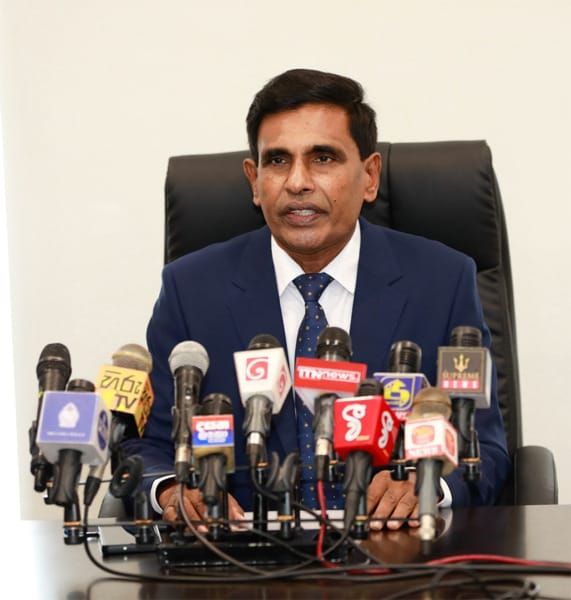
COLOMBO, Sri Lanka — Sri Lanka’s public security minister told Parliament that the Criminal Investigation Department is investigating a complaint over the killing of 186 Tamil villagers outside Batticaloa in 1990, but he gave no indication that investigators had questioned the army officer the complaint accuses.
The minister, Ananda Wijepala, was replying to questions submitted on Aug. 6 by Shanakiyan Rasamanickam, a Tamil member of Parliament from Batticaloa, under Standing Order 27(2), which allows a member to seek a ministerial statement on a matter of public importance.
Mr. Rasamanickam had asked for the current status of the inquiry, including the number of witness statements recorded, how many people had been summoned and questioned, whether any suspects had been identified, arrested or charged, and whether the case had been referred to the Attorney General.
Mr. Wijepala gave a timeline of how the complaint had been handled. He did not say whether any suspect had been identified, whether anyone other than the complainant had given a statement, or whether the Attorney General’s Department had been consulted.
The complaint was lodged on Sept. 27, 2025, at the Kokkuvil police station in Batticaloa District by Kulandai Vadivel, a resident of Sathurukondan. It states that 186 people were abducted and killed in the Sathurukondan area on Sept. 9, 1990, and names an army officer, Warnakulasuriya, as responsible.
The police summoned Mr. Vadivel several times to give a statement, but he did not appear, the minister said. A police inspector later went to find him and recorded statements from him on two occasions. The investigation, Mr. Wijepala said, was proceeding on the basis of those statements.
The deputy inspector general of police for the Eastern Province forwarded the complaint to the inspector general of police on Nov. 21, 2025. On Dec. 6, it was handed to the Criminal Investigation Department’s Homicide and Organised Crime Investigation Division.
According to Mr. Rasamanickam’s written question, the department’s homicide division issued a police message form dated March 20, 2026, under reference number 2026/03/20, requiring a person to appear at the new C.I.D. headquarters in Colombo on Aug. 14 at 9 a.m. in connection with the inquiry into “the Sathurukondan killings and disappearances of September 1990.” The question does not name the person summoned.
In Parliament, Mr. Rasamanickam asked why the police were questioning the man who had made the complaint rather than the officer he had named.
The killings took place on the evening of Sept. 9, 1990, during the presidency of Ranasinghe Premadasa. Soldiers and Muslim Home Guards rounded up residents of Sathurukondan, Kokkuvil, Panichchaiyadi and Pillaiyaradi, on the northern outskirts of Batticaloa town, and took them to the nearby Boys’ Town army camp, telling them they would be released after questioning. Most of those taken were elderly people, women and children.
One man, Kandasamy Krishnakumar, escaped after being stabbed. He later told the International Committee of the Red Cross and human rights groups that the others had been killed with knives and machetes.
A presidential commission appointed by President Chandrika Kumaratunga and led by a retired judge, K. Palakidnar, documented 184 deaths, including five infants and 42 children under 10. The commission found strong evidence of the massacre and urged that legal action be taken against those responsible. No one has been prosecuted. The complaint and local memorials put the number of dead at 186.
Four days before the Sathurukondan killings, soldiers took 158 people from a refugee camp on the Eastern University campus at Vantharumoolai, north of Batticaloa. None of them was seen again.
Mr. Rasamanickam pointed out that the government had opened investigations into the 2019 Easter Sunday bombings on the strength of an interview that Azad Maulana, a former aide to the eastern politician Sivanesathurai Chandrakanthan, gave to Britain’s Channel 4. He asked why statements from people who had lost family members in massacres during and after the war could not serve the same purpose.
His written question had separately asked whether the police or any other agency had opened investigations or prosecutions over allegations made in Channel 4 documentaries about the armed conflict. Mr. Wijepala said no investigation had been opened on the basis of Channel 4 material concerning the conflict in the Northern and Eastern Provinces. The broadcaster aired several documentaries on the final phase of the war, beginning with “Sri Lanka’s Killing Fields” in 2011, that accused government forces of killing civilians and executing prisoners.
Mr. Rasamanickam named the Sathurukondan killings, the Vantharumoolai disappearances and the 1985 attack on the Kumudini, a passenger ferry off the island of Delft in Jaffna, as massacres for which no government had delivered justice. He said his position remained that past massacres should be investigated through an international mechanism.
Mr. Wijepala said the government’s position was that killings in the north and east should be properly investigated.
He told Parliament that the authorities did not have accurate data on the armed conflict and the killings between 1979 and 2009, and that information was now being gathered across the country. Mr. Rasamanickam had asked how many conflict-related incidents in the Northern and Eastern Provinces were registered with the police, and for a list giving the name or location and year of each. The minister did not say whether the figures he gave were limited to the two provinces or covered the whole country.
Of 413 incidents recorded as massacres, investigators had examined 397, filed cases in 13, and closed three investigations without charges. Of 1,104 recorded homicides, 541 had been investigated; 94 had been filed, and 469 had been closed without charges.
There were 148 recorded disappearances, of which 95 had been investigated, with cases filed in 34 and 19 closed without charges. A further 139 incidents were listed as other serious crimes. Of those, 123 had been investigated, cases had been filed in six, and 10 investigations had been concluded.
Across the four categories, the figures show 1,804 recorded incidents and cases filed in 147. In the homicide category, the number of cases filed and closed together, 563, exceeds the 541 listed as investigated. The minister did not explain the difference.
Families of the Sathurukondan victims gather each year on Sept. 9 at a memorial in the village. In 2021, the police questioned two Batticaloa municipal councillors about why they had attended the commemoration.