

By Jaffna Monitor Staff
A 15-year-old girl who disappeared from her home in the hills of Kandy District in July has been found living in a forest cave with a baby girl about two months old, police said. She had given birth there without a doctor or midwife.
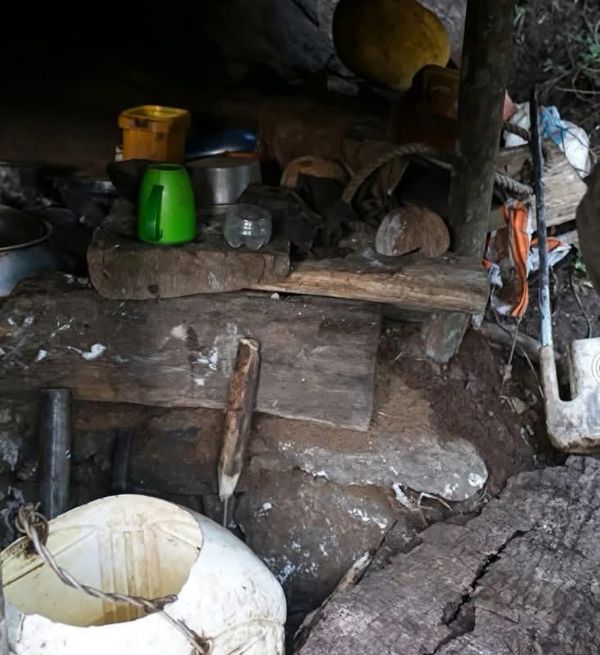
Officers from the Ududumbara Police found the two after noticing that a young man from the area was buying far more rice each day than one person could eat. They followed him into uninhabited forest on the western slopes of the Knuckles range. There he led them, without knowing it, to a rock overhang screened with plastic sheeting and cloth.
Police arrested a 23-year-old man who is said to be the baby's father, and a 36-year-old relative of his who is accused of helping him. The girl and her baby were taken to the National Hospital in Kandy.
Jaffna Monitor is not naming the girl or her village. Sri Lankan law prohibits publishing anything that could identify a child who is the victim of a sexual offence.
The girl's family searched for her on their own before reporting her missing to the Ududumbara Police. Sinhala-language news reports put the date of the complaint at July 13.
The inquiry was led by the station's officer-in-charge, Chief Inspector Thusitha Dombagammana, and for weeks it went nowhere. Officers questioned her friends and checked the places she usually went. No one had seen her.
The lead came from a shop in the village. The young man had been buying rice there in amounts that made little sense for someone living alone, and officers began watching him. One day they followed him as he carried the rice away from the houses and into dense forest. In thick undergrowth they found the cave. Police surrounded it and confirmed that the girl inside was the one reported missing.
If the baby was carried to full term, the girl would have been about seven months pregnant when she disappeared. Police have not said whether her family knew she was pregnant.
According to what the girl and the 23-year-old told investigators, the baby was born on the floor of the cave. The umbilical cord was cut with a knife used for kithul tapping, the local trade of drawing sap from the fishtail palm to make treacle and jaggery. The man told police he had treated mother and child with herbs gathered in the forest, including karanda leaves. He said he bathed the baby in the large pan used to boil kithul sap into treacle.
One Sinhala news site reported that both men were produced before the Teldeniya magistrate and remanded until Nov. 20. Police have not said what charges they will face.
Under Sri Lanka's Penal Code, sexual intercourse with a girl under 16 is rape whether or not she consented. The offence carries a minimum sentence of 10 years. Ududumbara Police said they were still investigating what happened to the girl.
Doctors in Kandy are expected to examine both mother and baby for complications from an unattended birth. One report said the baby appeared to be healthy. The hospital has not commented.
The risks were considerable. The World Health Organization says mothers aged 10 to 19 face higher rates of eclampsia, uterine infection after delivery and systemic infections than women in their early 20s. Their babies are also more likely to be born early or underweight. Heavy bleeding after childbirth is the leading cause of maternal death worldwide, according to the W.H.O. In hospitals, women are given an injection of oxytocin right after delivery to reduce it. In the cave there was no such drug and no one trained to stop a bleed.
The knife posed a separate danger. A cord cut with an unclean blade is the main route by which tetanus reaches a newborn, the W.H.O. says. The disease usually shows itself within the first four weeks, first as an inability to suck and then as stiffness and spasms. The girl may have had some protection. Sri Lankan schoolchildren receive a tetanus-diphtheria booster at 12, and a mother's antibodies cross the placenta to her baby. High vaccination rates are a large part of why the country has eliminated neonatal tetanus. At two months old, the baby is past the period in which tetanus from the cord would normally appear.
Karanda, the leaf of the Pongamia tree, is a common village remedy for wounds. A 2016 laboratory study in rats found that an extract of the leaf sped healing and was active against several kinds of bacteria. It has never been tested as a treatment for newborns.
The rock and plastic kept off the rain. For warmth, the baby depended largely on her mother's body. The W.H.O. advises keeping a newborn skin to skin with the mother after birth to prevent a dangerous drop in body temperature. Breast milk alone gives a baby all the nutrition it needs for the first months of life, and the earliest milk carries the mother's antibodies. The mother, in turn, depended on the rice brought to her each day.
The baby has also missed the vaccines Sri Lankan infants routinely receive: BCG in the first weeks after birth, and the first pentavalent dose at two months.
Cases of people living for long periods in caves and forests are rare. In 1978, Soviet geologists came upon the Lykov family in the Siberian taiga. The family had lived there in isolation since fleeing religious persecution in 1936, and two of the children, Dmitry and Agafia, were born there and had never met an outsider. Shoichi Yokoi, a Japanese soldier, hid in a cave he had dug in Guam's jungle for almost 28 years after American forces retook the island in 1944. Two fishermen found him in January 1972. In 2023, four Indigenous children survived 40 days in the Colombian Amazon after a plane crash killed their mother. The eldest, Lesly, 13, kept the youngest, 11-month-old Cristin, alive by dripping cassava flour mixed with water into the baby's mouth from a leaf. And in July 2025, police in Karnataka, India, found a Russian woman living with her two young daughters in a hillside cave near Gokarna.
Those cases involved adults who chose to hide, or children stranded by accident. The girl found in Ududumbara is a minor under the law. Investigators have yet to establish whether she went to the cave willingly, was kept there, or both. Police have also not said how many people knew where she was, or whether anyone else helped hide her.