

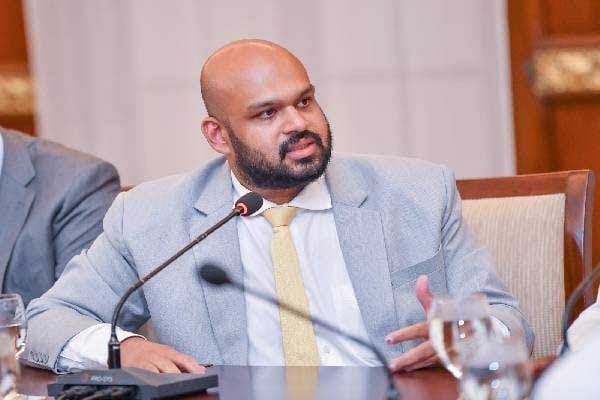
COLOMBO, Sri Lanka — Batticaloa District MP Shanakiyan Rasamanickam on Tuesday accused the Government of continuing to rely on outdated wartime justifications to retain civilian lands under military occupation in the Northern and Eastern Provinces, arguing that nearly 17 years after the end of Sri Lanka's civil war, it could no longer invoke "national security" to deny displaced people the return of their properties.
Raising a series of questions in Parliament, Mr. Rasamanickam sought detailed information on the total extent of privately owned and State-owned lands occupied by the armed forces in the North and East, the lands released since the present Government assumed office, the locations and dates of those releases, the extent of lands that remain under military control, and the Government's timeline for returning all remaining civilian lands.
He also questioned the continued military occupation of 16 Grama Niladhari Divisions and parts of three others in Valikamam North, as well as the status of lands in Myliddy, Palaly, Keppapilavu, and Kilinochchi. In addition, he sought clarification on the release of lands occupied by places of worship, schools, and other civilian institutions.
Responding after the Government's lengthy statement, Mr. Rasamanickam said the limited time available for supplementary questions had prevented him from addressing every aspect of the Minister's response.
"The Minister repeatedly relied on the term 'High Security Zone' to justify the continued occupation of civilian lands," he said. "However, at the recent Defence Consultative Committee meeting, it was acknowledged that areas declared as High Security Zones during the war, based on the security circumstances that existed at the time, do not necessarily need to continue under that designation today. If that is the Government's own position, why are wartime justifications still being used to deny people access to their lands?"
The MP also disputed the Minister's assertion that the public had access to religious sites within the Palaly and Myliddy areas.
"The Minister claims that people can visit these religious sites. That is simply not the reality," he said. "There is no access to St. Sebastian's Church, Myliddy Roman Catholic School, or Vasavilan Sri Velupillai Vidyalayam. In fact, even the original site of St. Sebastian's Church no longer exists. It is therefore misleading to suggest that normal access has been restored."
Mr. Rasamanickam further challenged the Government's argument that the military's continued presence in the Northern Province was necessary for maritime security, narcotics interdiction, and disaster response.
"If preventing narcotics trafficking and responding to disasters are the reasons for maintaining such a heavy military presence in the North, then the same principle should apply equally along the Southern and Western coastlines," he said. "These are national responsibilities, not responsibilities unique to the Northern Province. The burden of militarisation cannot continue to fall disproportionately on one region under the guise of national security."
Referring to the Minister's recent visit to the Northern Province, during which discussions were held with district representatives, the MP questioned why the Government's response indicated that only 11 affected landowners would receive the return of their lands while 44 others would continue to wait.
"What criteria has the Government used to decide that only 11 people deserve justice while the remaining 44 continue to seek the return of their original properties?" he asked. "What is the timeline for resolving the claims of those who are still deprived of their lands?"
He also criticised the Government's position on privately owned lands in Kilinochchi, where the Minister indicated that approximately Rs. 8 million would be paid to acquire lands because permanent military structures had already been built on them.
"Who authorised the military to construct permanent buildings on private land in the first place?" Mr. Rasamanickam asked. "The owners certainly did not grant permission. How can the Government now argue that, because public funds have been spent on those unlawful constructions, the rightful owners should permanently lose their land? Occupying private property without consent and then attempting to legitimise that occupation through compensation is neither just nor acceptable."
Mr. Rasamanickam said the issue extended beyond individual land disputes and raised broader questions about the rule of law, constitutional rights, and post-war reconciliation.
"The people of the North and East are not asking for favours," he said. "They are asking for the restoration of rights guaranteed under the Constitution. Seventeen years after the war, the Government cannot continue to hide behind 'national security', selectively release lands, or rely on compensation schemes while thousands of acres remain under military occupation."
He called on the Government to abandon what he described as outdated wartime policies, publish a transparent and time-bound plan for the release of all remaining civilian lands, restore access to places of worship, schools, and other public institutions, and ensure that civilian properties are returned to their rightful owners without further delay.