


A landmark genetic study has upended one of Sri Lanka’s most enduring nationalist narratives: the belief that the Sinhalese people are exclusively descended from North Indian Aryans. Published in Current Biology in June 2025, the study uses cutting-edge whole-genome sequencing to reveal that Sri Lanka’s major ethnic groups—including the Sinhalese and the Indigenous Adivasi—share deep genetic ties to South Indian populations, particularly those with Ancestral South Indian (ASI) roots.
The research, led by scientists from the University of Chicago, the University of Colombo, and global collaborators, analyzed the genomes of 54 individuals—35 Sinhalese and 19 Adivasi from both inland (Rathugala) and coastal (Eachchilampattu) clans. Scholars have called the findings revolutionary and politically significant.
The Aryan Theory Unravels
Contrary to traditional Sinhalese nationalist claims that trace the group’s lineage to a North Indian Aryan migration around 500 BCE, the genetic evidence tells a more complex and localized story.
“Present-day Sinhalese show stronger genetic affinities with populations in Southern India, especially Andhra Pradesh, than with North Indian groups,” the study notes.
This suggests that if there was a Northern migration at all, its genetic impact has been vastly diluted through centuries of intermarriage, cultural exchange, and admixture with Dravidian-speaking South Indian populations.
The study proposes two plausible explanations: either the Sinhalese share ancient roots with ASI-related populations who had wider historical dispersal, or early migrants from the north were genetically assimilated over generations by long-term interaction with local South Indian-like groups. In either case, the narrative of pure Aryan descent stands scientifically invalidated.
Sinhalese and Adivasi: More Connected Than Divided
Perhaps even more striking is the study’s revelation that the Sinhalese and the Indigenous Veddas—often seen as culturally and politically distinct—are genetically closer to each other than to any other ethnic group.
While cultural and lifestyle differences remain, both groups exhibit significant Ancestral South Indian genetic influence, pointing to shared roots dating back thousands of years.
“Despite genetic differentiation, Adivasi and Sinhalese populations are most closely related to each other and to South Indian groups with high ASI ancestry,” the researchers explain.
This finding challenges not only colonial and nationalist historiography, but also confronts post-independence ideologies that positioned the Sinhalese and Veddas as fundamentally different peoples.
Adivasi: Guardians of an Ancient Genetic Legacy
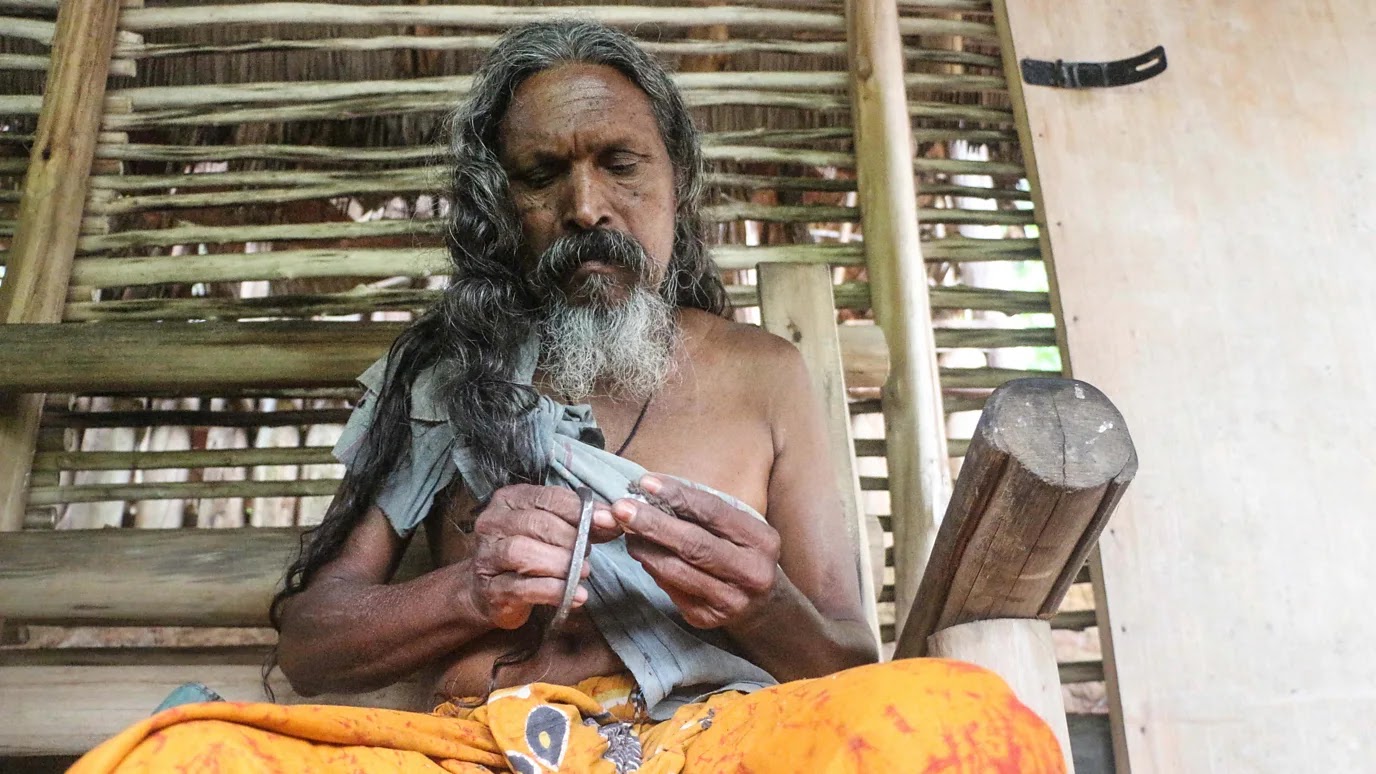
Though often marginalized in contemporary Sri Lankan society, the Adivasi retain the highest percentage of Ancient Ancestral South Indian (AASI) heritage—between 52.5% and 53.7%—much more than Sinhalese or even Sri Lankan Tamils.
This supports archaeological evidence that anatomically modern humans have inhabited Sri Lanka for over 40,000 years—and that today’s Adivasi populations may be direct descendants of these early hunter-gatherer settlers.
In contrast, the Sinhalese and Tamils show slightly lower AASI levels (around 45–47%), indicating more genetic input from later South Asian agriculturalists and possibly Indo-Aryan populations—but not enough to erase the foundational Southern ancestry.
Beyond Borders: A Regional Genetic Landscape
The study’s implications extend beyond Sri Lanka. Its findings align with a broader South Asian genetic pattern—where ancient hunter-gatherer populations mixed with incoming pastoralist and farming communities over millennia. Genetic continuity and admixture have been the norm in the subcontinent for over 10,000 years, especially since the Neolithic period. In this context, the myth of racial purity or singular origin—whether Aryan or Dravidian—becomes scientifically untenable.
A Fabricated Origin: How the Aryan Myth Was Woven into Sri Lankan History
The idea that the Sinhalese are descended from a pure Aryan lineage originating in North India is a colonial-era construct, shaped by a blend of Victorian racial theories, Orientalist interpretations, and Sinhalese nationalist aspirations, a historian explained to Jaffna Monitor.
He continued, “This theory was first systematically formulated by 19th-century British civil servants and scholars—most notably George Turnour, who translated the Mahavamsa (the Pali Buddhist chronicle) in 1837. Turnour’s work, while an important scholarly milestone, treated the Mahavamsa as literal history rather than a religious-ideological text.”
Drawing from the chronicle’s account of Prince Vijaya and his followers—said to have come from ‘Sinhapura’ in North India—colonial historians linked the Sinhalese origin story to Indo-Aryan racial stock. “At a time when European empires were obsessed with constructing racial hierarchies, the idea that the Sinhalese were Aryans, like their colonial rulers, gave them elevated status in the eyes of the British,” the historian added. “So the Sinhalese elite leadership had no problem embracing it,” another historian noted.
This racial theory was later internalized by sections of the Sinhalese elite, particularly during the late 19th and early 20th centuries as Buddhist revivalism and nationalist movements gained momentum. Figures like Anagarika Dharmapala, while fiercely anti-colonial, paradoxically reinforced the Aryan myth—claiming that the Sinhalese were “a pure Aryan people” destined to preserve Buddhist civilization.
“But in doing so, they conveniently ignored the fact that the Tamil people too had a rich Buddhist legacy, which was systematically erased through invasions, marginalization, and neglect,” a scholar pointed out.
Another academic told Jaffna Monitor that post-independence, the Aryan origin theory became deeply embedded in school curricula, official histories, and media narratives. “It was often used to draw a civilizational contrast against Dravidian or South Indian ‘others’—primarily the Tamils,” he explained. “This constructed racial distinction served clear political purposes: it justified Sinhalese-Buddhist majoritarianism, painted Tamils as outsiders, and helped legitimize policies like the Sinhala Only Act (1956)"
Despite decades of linguistic, archaeological, and now genetic evidence pointing to shared South Asian roots, the Aryan origin myth has remained culturally persistent—passed down through textbooks, sermons, and public discourse. It continues to frame the Sinhalese as the protectors of a Buddhist-Aryan legacy, thereby sacralizing the land and excluding communities who don’t fit into that imagined ancestry.
“But this new genomic study,” the scholar added, “by revealing deep genetic overlaps between Sinhalese, Adivasi, and South Indian populations, directly challenges this long-held myth—offering an opportunity to move toward a more inclusive and truthful understanding of the island’s shared past.”