

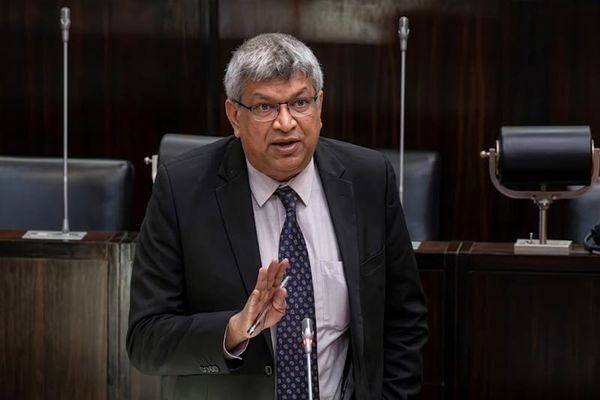
COLOMBO, Nov. 21: Sri Lanka's justice minister told Parliament on Saturday that no party in the Chemmani mass grave case had asked the court for an independent international investigation. Families of the disappeared and Tamil lawmakers have been calling for one in public for months.
The minister, Harshana Nanayakkara, said the government had not formally agreed to set up or facilitate an international investigation into the grave in Jaffna. He said no such request had been made by any stakeholder before the court.
He said the government was willing to seek international technical and forensic help, particularly for DNA analysis, identifying the remains and further forensic work, depending on what the court requires.
The families have made their demands at protests, at news conferences and through lawmakers in Parliament. On Tuesday, relatives of the disappeared marched to the grave site and said only an international mechanism could deliver justice. Last month, at a news conference at the Jaffna Press Club, families' associations called for an international DNA investigation, and Tamil lawmakers raised the demand for an international probe in Parliament.
In court, the families' lawyers have pressed for outside forensic help. M. A. Sumanthiran, a President's Counsel who represents the families, said in May that they had asked the court to begin an investigation and had suggested that it contact a well-known laboratory abroad for DNA testing.
A contested report
Mr. Nanayakkara made the remarks while answering Ramanathan Archchuna, an independent member of Parliament from the Jaffna District. Mr. Archchuna asked whether Prof. Raj Somadeva, the archaeologist leading the excavation, had the qualifications to issue a medico-legal report.
Professor Somadeva, of the Postgraduate Institute of Archaeology at the University of Kelaniya, wrote his latest interim report with Anusha Wanninayake and submitted it to the Jaffna Magistrate's Court on Oct. 19. It raised the possibility that the burials were the result of an epidemic or a natural disaster. That suggestion set off protests by Tamil families, objections from their lawyers in court and challenges from Tamil lawmakers.
Mr. Nanayakkara said the professor had no such qualifications and had never issued such a report. "He has an archaeological report," the minister said. He described it as a forensic archaeological report examining where, how and under what circumstances the remains were buried. "The cause and manner of death will be examined through medico-legal investigations in due course in accordance with the judicial proceedings," he said.
"Raj Somadeva's report is only one of the reports the Magistrate will look at," he said. "The Magistrate cannot make an order based on one report."
Mr. Nanayakkara rejected claims that the archaeological findings were aimed at the Tamil community. He called the report a professional assessment meant to give the court scientific information.
"We want to find the truth, we want justice," he said. "And it has to be done through a proper scientific evidence backed investigation. Race, religion, caste should not apply to this and the government does not think on those lines."
He asked lawmakers not to turn the investigation into a political issue. "Racial tensions being used for political gain is an old school thing," he said, adding, "You are not doing it, I'm not saying you are."
The court sets the report aside
The minister's remarks came two days after the Jaffna court said it would not depend on the report. Sitting with Additional Magistrate Hussain on Thursday, Magistrate S. Lenin Kumar ruled that there was no need to rely on Professor Somadeva's interim report in deciding how the excavation should proceed. He said no reasonable explanation had been given for why it departed from the archaeologist's earlier reports.
Mr. Nanayakkara told Parliament that after objections from lawyers for the families, the magistrate had ordered the report placed in the case record but not acted upon on its own. About 20 lawyers appeared for the families at Thursday's hearing. They included the senior counsel K. S. Ratnavale and Mr. Sumanthiran.
The minister said the excavations had recovered the remains of about 574 people over several phases. That figure matches the minimum count in Professor Somadeva's report. Tallies announced at the site during the excavation have run above 580.
He said the work had been carried out in the presence of the Jaffna magistrate, lawyers for the various parties, Criminal Investigation Department officers, scene-of-crime officers and Dr. Pranavan Selliah, the judicial medical officer at Jaffna Teaching Hospital. The magistrate has directed Dr. Selliah and his team to prepare a judicial forensic report on the remains. The Office on Missing Persons is observing the proceedings under Section 12(d) of the law that created it.
What the report says
The report covers 110 days of excavation over 16 months. It records a minimum of 574 individuals, about 41 percent of them children. No scientific dating has been carried out on the remains. Coins found at the site range up to 1994, and the report says the date a coin was minted cannot date a burial. The Criminal Investigation Department has asked the court to allow radiocarbon sampling.
The report concludes that the site more closely resembles formal burial than clandestine burial. It also says the evidence gathered is not enough, on its own, to reach a definitive conclusion about the burials. It makes no finding on cause of death.
The epidemic and disaster theory is offered as a possible explanation for why so few funerary objects were found. The report names no epidemic or disaster in Jaffna that could account for a burial site of this size. Investigators recovered feeding bottles, dolls and raincoats among the objects.
Lawyers and families say the evidence from the site contradicts the theory. In September 2025, the Human Rights Commission of Sri Lanka concluded that those buried at Chemmani were victims of unlawful or extrajudicial killings and called for international expertise. Lawyers for the families have also objected that the new report does not describe the site as a mass grave. In June 2025, Professor Somadeva told Al Jazeera that an earlier interim report of his had said the site could be identified as a mass grave and needed further investigation.
Protests in Jaffna and Parliament
On Tuesday, hundreds of people marched from Thapal Kattai junction in Ariyalai to the Sindupathi Hindu cemetery in Chemmani, where the remains have been exhumed. At the end of the march, relatives of the disappeared set fire to a copy of the report and an effigy of Professor Somadeva. The protest was organized by the Jaffna District Association of Relatives of the Enforcedly Disappeared. Members of Parliament, local council members and Velan Swamigal took part, and the Jaffna University Teachers' Association backed it. The protesters rejected the report in full.
In Parliament last month, Selvam Adaikalanathan, a Democratic Tamil National Alliance lawmaker from the Vanni District, said people once held at a former military camp in Chemmani might be among those buried at the site. Other Tamil lawmakers challenged the report and called for an international probe.
A site with a long history
Chemmani first drew national attention in 1998. During the trial over the 1996 rape and murder of Krishanthi Kumaraswamy, an 18-year-old Tamil schoolgirl, and the killing of her mother, her brother and a neighbor, Lance Cpl. Somaratne Rajapakse told the court that 300 to 400 people had been killed and buried at Chemmani. He was one of the soldiers convicted in the case. The people he described had disappeared after the army retook the Jaffna peninsula from the Liberation Tigers of Tamil Eelam in 1995 and 1996.
An excavation in 1999 recovered 15 skeletons. Twelve showed fatal injuries, several had their hands tied behind their backs and several were blindfolded.
Human remains surfaced again in February 2025, during construction work at the Sindupathi cemetery. Lawyers for the families petitioned the court, which ordered a supervised excavation. By June 2025, 19 skeletons had been exhumed, three of them infants. That month, Volker Türk, the United Nations High Commissioner for Human Rights, visited the site and called for independent forensic experts to be involved.
In 2026, Chemmani became the largest mass grave found in Sri Lanka. It passed the Sathosa site in Mannar, where 346 skeletons were unearthed in 2018.
The judicial medical officer has yet to submit his forensic report to the court.