

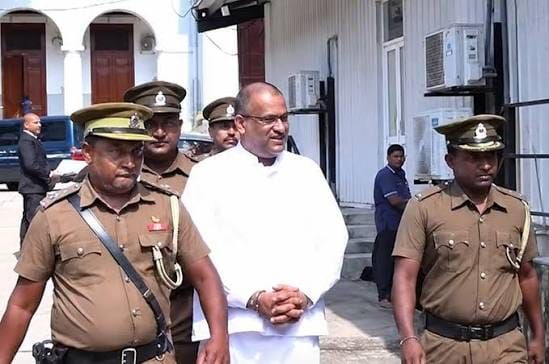
COLOMBO, Sri Lanka — On Oct. 16, Sri Lanka's cabinet spokesman said the government would neither bend nor amend the law to accommodate any individual. Four days later, the government amended the prison rules at the center of a dispute over a jailed Buddhist monk.
The changes, published in Extraordinary Gazette No. 2511/30, give Buddhist monastic chapters the deciding voice on whether an imprisoned monk is stripped of his robes. They also allow convicted monks to wear robes when taken out of prison, including to court. The rules apply, with necessary modifications, to priests of other religions.
The amendments end a two-week confrontation between the government and the country's senior Buddhist clergy over Galagoda Aththe Gnanasara Thera, a hard-line Sinhala Buddhist nationalist monk who was produced before the Colombo High Court on Oct. 6 in prison clothing. Prison officials had removed his robes under standing orders that the government at first said applied to every inmate.
What the Gazette Says
The orders were issued by the Commissioner General of Prisons under the Prisons Ordinance, with the approval of Justice Minister Harshana Nanayakkara. They were signed on Oct. 19 by R. Prasad Hemantha Kumara, who holds the post in an acting capacity.
A new Standing Order 356A requires the commissioner, when a Buddhist monk is imprisoned, to consult the Department of Buddhist Affairs about removing the robes he wore on entering prison. The department must inform the monk's Nikaya, or chapter, and report the chapter's action to the commissioner within 10 days. If no response arrives, the commissioner may act "in accordance with the relevant provisions," which the order does not specify.
An amendment to Standing Order 550 allows a monk taken out of prison as a prisoner to wear the robes he wore when imprisoned. If his chapter has not permitted it, the commissioner must take "necessary action." The commissioner must also ask the Department of Buddhist Affairs, within seven working days of a monk's imprisonment, to seek the chapter's approval.
The order does not say what a monk wears inside prison while his chapter considers the matter.
What the Government Said
On Oct. 6, the day Gnanasara appeared in court without his robes, Cabinet spokesman Nalinda Jayatissa said prison officials had acted under the Prisons Ordinance and that the same procedure applied to all 63 Buddhist monks then serving sentences. Senaka Palletenna, a prisons department spokesman, said inmates sentenced to rigorous imprisonment must wear prison clothing regardless of status.
Two days later, President Anura Kumara Dissanayake told senior monks at the Presidential Secretariat that he would not order officials to bypass prison laws, and that unsuitable provisions should be amended through the proper legal process. "My personal wishes should not become the law," he said, according to the Daily Mirror. He noted that other convicted monks were subject to the same requirement and that Gnanasara had worn prison clothing during his earlier imprisonment in 2018. In the same meeting he called the standing orders outdated and appointed a committee to rewrite them, with the justice minister given two weeks to complete the legal changes.
The committee, chaired by W. P. Senadheera, secretary to the Ministry of Buddhasasana, handed its interim report to the justice minister on Oct. 14, and Nanayakkara instructed the acting commissioner general of prisons to amend the standing orders.
On Oct. 16, as monks who had marched from Kandy to Colombo demanded Gnanasara's release, Jayatissa restated the government's position. He said voters had given the president and the government a two-thirds majority partly out of anger at the unequal application of the law under earlier administrations, and that the government could not make exceptions based on a person's identity or social standing. Agriculture Minister K. D. Lal Kantha said neither the president nor the government had the power to release the monk against a court ruling.
Rule and Exception
Government officials draw a line between the two demands. The government has refused a fresh pardon while agreeing to address the robes. Gnanasara's sentence stands, and the new orders apply to every imprisoned monk and to clergy of other faiths.
The rule had nonetheless been enforced for years, including against Gnanasara in 2018, without prompting a review. The government reopened it within two days of the clergy's objection.
Requests from other communities to change dress rules have moved more slowly. In August, Muslim health assistants at Kalmunai North Base Hospital said they had been barred from working in religious attire. Jayatissa, who is also health minister, told them to follow a 2019 circular until any change was formally considered and approved.
The Monk and the Clergy
Gnanasara was sentenced in 2018 to six years for contempt of court and for criminally intimidating Sandya Eknaligoda, whose husband, the cartoonist Prageeth Eknaligoda, disappeared in 2010. President Maithripala Sirisena pardoned him in 2019 after about nine months. The Supreme Court overturned the pardon on Sept. 10, and he was arrested several weeks later.
The chief prelates of the main chapters wrote to the commissioner general of prisons that removing a monk's robes could not be treated as an administrative matter governed by prison regulations. Gnanasara later told his lawyer that he resisted prison officials for more than two hours before giving up his robes.
The First Test
The new rules were due to be applied on Oct. 23, when Gnanasara was scheduled to appear before the Colombo High Court in a separate case over remarks allegedly insulting Islam. Buddhasasana Minister Hiniduma Sunil Senevi had said he would appear in robes under the amended regulations.
Prison authorities instead told the court he would be produced by electronic means, citing tension over the case and concern about disturbances. His counsel, Asoka Weerasooriya, said the Kotte chapter's Mahanayake had asked prison authorities for a ceremonial reinstatement of the robe. Judge Buddhika C. Ragala said the court had no authority to order it, and asked whether every imprisoned monk would then have to be robed by the prelates before being produced in court.