

COLOMBO — Sri Lanka’s dispute over a government proposal to extend the retirement age of senior judges widened this week after an opposition leader accused the administration of concealing a letter from the country’s most senior Buddhist prelates expressing concern over the plan.
Patali Champika Ranawaka, a former cabinet minister and leader of the United Republican Front, said the Mahanayake Theras had written to President Anura Kumara Dissanayake setting out their position on the proposed constitutional amendment.
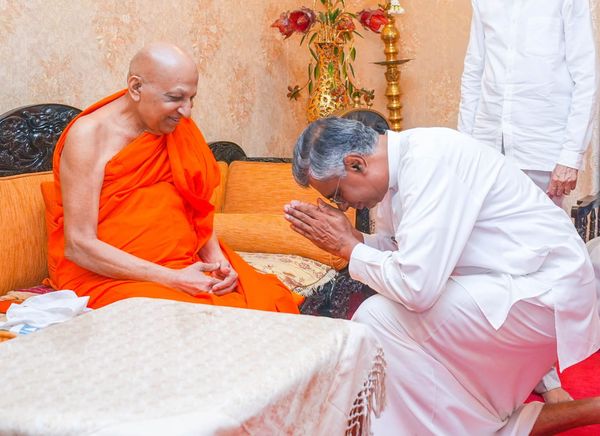
The existence of the letter has become a point of contention between the government and its critics. The Mahanayake of the Malwatte Chapter, the Most Venerable Thibbatuwawe Sri Siddhartha Sumangala Thera, has confirmed that the chief prelates wrote to the President, although he said he could not say whether the letter had reached him. Government representatives had earlier said that no such letter had been received.
Ranawaka seized on the discrepancy, accusing the government of withholding a politically sensitive intervention by the Buddhist hierarchy.
“We cannot accept claims by those in the government that such a letter was not received,” he told reporters.
He was speaking after opposition parties met under the leadership of G.L. Peiris, former foreign minister and constitutional law professor, to consider their response to the proposed 22nd Amendment to the Constitution.
The amendment would raise the mandatory retirement age of Supreme Court judges from 65 to 67 and of Court of Appeal judges from 63 to 65, extending the tenure of the judges currently serving on both courts. The proposal has drawn opposition from lawyers, opposition parties, and Buddhist religious leaders and has developed into a broader argument over judicial independence and the government’s justification for altering the tenure of sitting judges.
The government has defended the proposal in part as a response to delays in the justice system and the enormous backlog of cases before Sri Lankan courts. Opponents dispute that rationale, arguing that only a small fraction of the backlog is before the Supreme Court and Court of Appeal and that extending the careers of superior court judges would do little to address delays concentrated in lower courts.
Ranawaka sought to give the dispute a constitutional as well as political dimension, invoking Article 9 of the Constitution, which gives Buddhism “the foremost place” and requires the state to protect and foster the Buddha Sasana.
He argued that failing to acknowledge a collective representation from the Mahanayake Theras amounted not only to a constitutional affront but to “a serious blow to the culture of this country.”
Article 9, however, does not impose a specific obligation on the President or the government to disclose correspondence received from Buddhist prelates, making Ranawaka’s assertion a political and constitutional argument rather than an established breach of the Constitution.
Ranawaka also suggested that the administration would have responded differently to an intervention by leaders of another religion.
“If leaders of another religion had sent such a letter, President Anura Kumara Dissanayake would not have concealed it in this manner,” he said. “I believe he would have made it public.”
The remark appeared to be a reference to the Catholic Church and the Archbishop of Colombo, Malcolm Cardinal Ranjith.
He broadened his attack beyond the judicial amendment, accusing the National People’s Power government of operating without the transparency it had promised before taking office.
Ranawaka cited controversies involving coal procurement, the release of 323 containers, and an alleged loss of $2.5 million in Treasury funds. He presented no new evidence for those allegations at the briefing.
He also challenged one of Dissanayake’s central political messages, that no individual or institution should stand above the law, accusing the administration of selectively pursuing its opponents.
“The President says no one is above the law,” Ranawaka said. “But only the Janatha Vimukthi Peramuna appears to be above the law.”
He accused the government of pursuing political opponents under the guise of law enforcement and said that if it was serious about holding those responsible for economic wrongdoing accountable, investigations should begin with the decisions that contributed to Sri Lanka’s economic collapse.
Ranawaka ended by turning to another unresolved political issue: the long-delayed Provincial Council elections.
The councils, established under the 13th Amendment to the Constitution as part of Sri Lanka’s system of devolution, have been without elected representatives for years. Ranawaka challenged the government to hold elections if it was as confident of its public support as it claimed.
“If the people are with the government, it can hold the Provincial Council elections,” he said. “But the people are not with the government. It is because of that fear that the government is avoiding the Provincial Council elections.”