
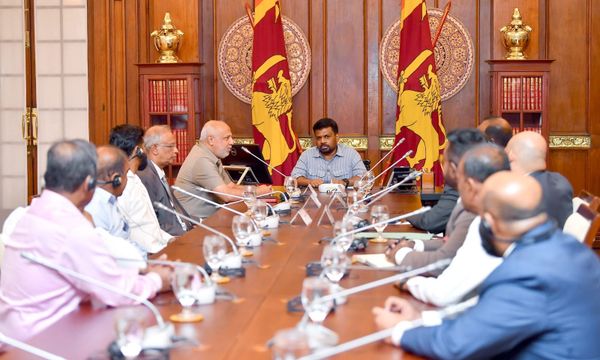
COLOMBO, Sri Lanka — President Anura Kumara Dissanayake on Monday reaffirmed his government's commitment to introducing a new Constitution and abolishing the Executive Presidency, but said constitutional reform should proceed only after building "a new national consensus," according to a statement issued by the President's Media Division following talks with representatives of six Tamil-speaking political parties.
The official account of the nearly two-hour meeting at the Presidential Secretariat broadly aligned with participants' descriptions on the subjects discussed but differed in emphasis and omitted several exchanges that delegates later described, including discussions on military-held land in the Northern and Eastern Provinces and criticism of the parliamentary committee examining Provincial Council electoral reforms.
According to the PMD, discussions covered constitutional reform, long-delayed Provincial Council elections, issues affecting the Northern and Eastern Provinces and the Malayagam community, and proposals to improve the living conditions of plantation workers.
On constitutional reform, the PMD said ITAK General Secretary M.A. Sumanthiran urged that a new Constitution should emerge through an inclusive national process rather than be rushed or introduced by a single political party, as he argued had occurred with the Constitutions of 1948, 1972, and 1978.
Responding, President Dissanayake reiterated that constitutional reform and the abolition of the Executive Presidency remain government policy. However, he said the immediate priority was to build a broad national consensus rather than introduce a hurried constitutional amendment, calling instead for an inclusive national dialogue.
The PMD also said the President argued that his administration had laid the foundation for a country in which citizens increasingly identify as Sri Lankans rather than along ethnic lines, noting that no ethnic unrest had occurred during his tenure and reiterating his preference for a system of government accountable to Parliament.
Provincial Council elections also featured prominently during the meeting. According to the PMD, the President said a Parliamentary Select Committee had already been appointed to study issues relating to the conduct of the elections and that he intended to discuss the concerns raised by the delegation with the committee.
The PMD statement, however, does not mention an exchange described by participants, who said ITAK MP R. Shanakiyan and SLMC representative Nizam Kariapper, both members of the select committee, argued directly to the President that the committee had become a mechanism for delaying the elections and urged the government to proceed under the existing electoral system.
The PMD also highlighted the government's proposal to grant legal title to 10-perch residential plots for plantation workers, plans to incorporate land ownership provisions into plantation lease agreements due for renewal before 2042, environmental protection measures in the Central Highlands, a proposed assistance programme involving the Thondaman Foundation and Nevada Foundation, and an increase in funding for the Ministry of Plantation and Community Infrastructure in the 2027 Budget.
According to the PMD, President Dissanayake also announced that funding would be allocated through the 2027 and 2028 Budgets to construct 13,000 houses in two phases for people displaced during the civil war. He further said the government would provide permanent housing for families displaced by Cyclone Ditwah while continuing rental assistance until construction is completed.
On land issues in the North, the PMD reaffirmed the government's commitment to resolving longstanding disputes, stating that land should ultimately belong to the people and noting that commissions had already been appointed to address those issues.
Participants, however, described a more detailed discussion in which the President reportedly said he had asked the military to explain why privately owned land in the Northern and Eastern Provinces remained under military occupation and reaffirmed his intention to ensure those lands are eventually released. Those details do not appear in the PMD statement.
The PMD also said representatives raised concerns about the Provincial Council electoral system, the Delimitation Commission, and the impact of what they described as outdated policies implemented by institutions, including the Department of Archaeology, the Department of Forest Conservation, and the Mahaweli Authority.
Closing the meeting, President Dissanayake thanked the alliance for presenting a united voice on issues affecting Tamil-speaking communities while encouraging its representatives to frame those concerns within the broader national interest in order to avoid misunderstanding and promote common solutions.