

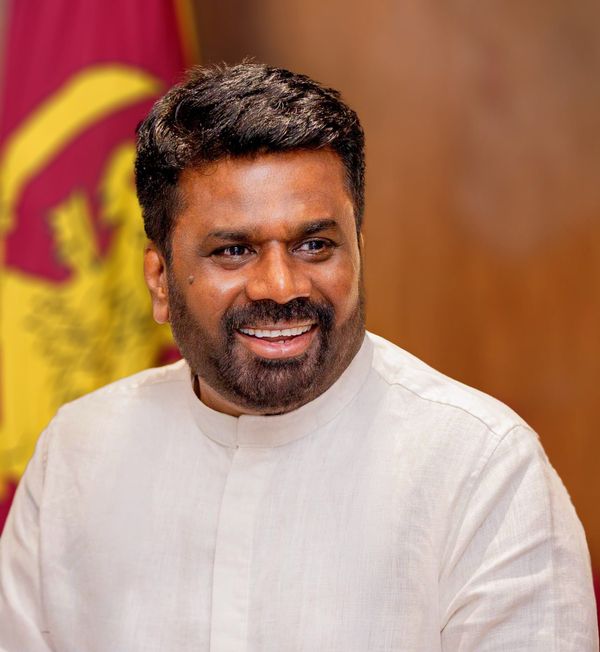
COLOMBO, Sri Lanka: President Anura Kumara Dissanayake signaled on Sunday that he would not pardon Galagoda Aththe Gnanasara Thera, the hard-line Buddhist nationalist monk who was returned to prison this month after the Supreme Court struck down a pardon he received in 2019.
Speaking at a women’s rally of his governing National People’s Power in Badulla, in Uva Province, Mr. Dissanayake did not mention the monk by name. But his remarks followed weeks of protests by Buddhist monks and opposition politicians demanding the monk’s release, and they were the president’s clearest public statement on the case so far.
“When the Supreme Court delivers a judgment, some people start shouting, demanding that it be removed,” Mr. Dissanayake said. “How can a country function with laws like that?”
“We will abide by the decisions delivered by the courts,” he added. “Beyond that, no one should expect decisions from us.”
Mr. Dissanayake told the rally that Parliament makes the laws, that the police, the Criminal Investigation Department and the anti-corruption commission investigate and enforce them, and that the courts, led by the Supreme Court, have the final word on how they are interpreted and applied. He said a country in which the law applies equally to everyone is essential to a secure future for its children.
The president’s emphasis on deference to the courts comes weeks after his government faced criticism over its own dealings with the judiciary. On Sept. 25, Parliament passed the 22nd Amendment to the Constitution, which raised the retirement age of Supreme Court judges from 65 to 67 and of Court of Appeal judges from 63 to 65. The government said the change would help retain experienced judges as part of broader justice-system reform. The Bar Association of Sri Lanka and opposition parties called it a threat to judicial independence, and some critics argued that extending sitting judges' terms could work in the government’s favor, including by keeping the current chief justice on the bench.
Gnanasara Thera is the general secretary of the Bodu Bala Sena, or Buddhist Power Force, which campaigned against Sri Lanka’s Muslim minority after the civil war ended in 2009. Anti-Muslim riots broke out in the town of Aluthgama in June 2014 after a Bodu Bala Sena rally there. His followers regard him as a defender of Buddhism. Critics have long accused him of stoking religious tensions.
In August 2018, the Court of Appeal convicted him on four counts of contempt of court over his conduct at the Homagama Magistrate’s Court, where he berated Sandya Eknaligoda, her lawyers and the presiding magistrate. Ms. Eknaligoda’s husband, the cartoonist and journalist Prageeth Eknaligoda, disappeared in 2010, and the case she has pursued over his disappearance has implicated military intelligence officers. The court imposed sentences totaling 19 years of rigorous imprisonment, to run concurrently over six years.
He had served about nine months when President Maithripala Sirisena pardoned him on May 23, 2019.
Ms. Eknaligoda and the Centre for Policy Alternatives, a Colombo research group, challenged the pardon. On Sept. 10, a three-judge bench of the Supreme Court ruled it arbitrary and inconsistent with the Constitution. In the judgment, written by Justice Janak De Silva, the court also held that a pardon does not erase a conviction; it relieves an offender only of serving the sentence to the extent the pardon specifies.
Legal analysts say the judgment does not preclude a new pardon, provided it is granted in accordance with the law and after proper consideration of the relevant material.
The ruling set off a campaign for a fresh pardon. At the launch of his book in Colombo on Sept. 20, Gnanasara Thera urged senior monks to petition Mr. Dissanayake, arguing that officials had made procedural errors and that the current president could correct them. Six days later, the chief incumbent of the Mihintale Rajamaha Viharaya, Walawahengunawewe Dhammaratana Thera, began a drive to collect five million signatures in support of a pardon.
On Friday, the campaign drew support from one of the country’s two most senior Buddhist prelates. The Mahanayake of the Asgiriya Chapter, Warakagoda Sri Gnanarathana Thera, met a delegation of prison officials in Kandy and asked the authorities to consider releasing Gnanasara Thera, saying his return to prison had caused considerable public unease. He cited the monk’s earlier release under the 2019 pardon, which the Supreme Court has since ruled invalid, and said freeing him again would be better than prolonging the controversy. The commissioner of prisons, Senaka Palletenna, told him no decision had been taken. The Asgiriya and Malwathu chief prelates were among the senior clergy who appealed to Mr. Sirisena for the monk’s release before the 2019 pardon.
The removal of the monk’s robes in prison has provoked a sharper reaction than his imprisonment. The cabinet spokesman, Nalinda Jayatissa, said prison authorities had followed the Prisons Ordinance and applied the same procedure to all 63 Buddhist monks serving sentences. Senior clergy objected, and the Janathawadi Joint Opposition, led by the former minister G. L. Peiris, condemned the decision. On Oct. 8, Mr. Dissanayake met representatives of the chief prelates and said a committee would propose rules on the treatment of monks in prison.
On Oct. 10, monks set out on foot from the Temple of the Sacred Tooth Relic in Kandy. They reached the Presidential Secretariat in Colombo on Oct. 15 and began a sit-in, vowing to stay until Gnanasara Thera was freed. Protesters said officials had told them the government would need at least a month to decide. The monks dispersed the next day after a magistrate’s court ordered them to leave the area.
Gnanasara Thera also faces a separate nine-month sentence of simple imprisonment, imposed in January 2025 over statements a court found had promoted discord between Muslims and Sinhalese. The Colombo High Court upheld the sentence in June. His lawyer has said an appeal is before the Supreme Court, which is scheduled to hear it on Feb. 23, 2027.
Article 34 of the Constitution empowers the president to pardon convicted offenders. In death-penalty cases, the president must first obtain a report from the trial judge, the advice of the attorney general and the recommendation of the justice minister.
Presidents routinely use the power to free groups of prisoners on Buddhist holidays and national occasions, and some have used it to make gestures of reconciliation. In January 2016, Mr. Sirisena pardoned Sivaraja Jenivan, a former member of the Liberation Tigers of Tamil Eelam convicted of plotting to assassinate him in 2005. In June 2021, President Gotabaya Rajapaksa pardoned 16 men convicted under the Prevention of Terrorism Act over links to the Tamil Tigers, most of whom had spent more than a decade in prison.
Other pardons have been overturned, and the Gnanasara ruling was the third time the Supreme Court has invalidated one.
The first came in January 2024, when the court voided Mr. Rajapaksa’s pardon of Duminda Silva, a former lawmaker sentenced to death for the 2011 murder of the politician Bharatha Lakshman Premachandra. Mr. Silva had been freed on the same day in June 2021 as the 16 Tamil prisoners. The court found that the required legal procedure had not been followed. During the proceedings it emerged that 117 members of Parliament had written to Mr. Rajapaksa seeking the pardon, and that the trial judge had declined to recommend one.
In June 2024, the court annulled Mr. Sirisena’s 2019 pardon of Jude Shramantha Jayamaha, who had been sentenced to death for the 2005 murder of Yvonne Johnson, 19, at the Royal Park apartment complex in Rajagiriya. The court found that Mr. Sirisena had violated the Constitution and ordered him to pay compensation to the petitioner and to the victim’s parents. Mr. Jayamaha had left the country after his release, and the Attorney General was directed to seek his extradition.
The Supreme Court has yet to rule on challenges to Mr. Rajapaksa’s March 2020 pardon of Sunil Ratnayake, a former army staff sergeant sentenced to death for killing eight Tamil civilians, including children, at Mirusuvil in Jaffna District in December 2000. The court had unanimously upheld his conviction. Tamil political parties, the Human Rights Commission of Sri Lanka and Amnesty International condemned the pardon.
Mr. Dissanayake’s own administration has faced scrutiny over the pardon power. In June 2025, the Presidential Secretariat complained to the police after W. H. Athula Thilakaratne, a prisoner convicted in a financial fraud case, was released from Anuradhapura Prison under the Vesak amnesty even though his name was not among the 388 inmates the president had approved. The commissioner general of prisons, Thushara Upuldeniya, was arrested and suspended, and the opposition leader, Sajith Premadasa, demanded that the full list be made public.
The Court of Appeal is scheduled to hear petitions challenging the removal of Gnanasara Thera’s robes on Oct. 22.