

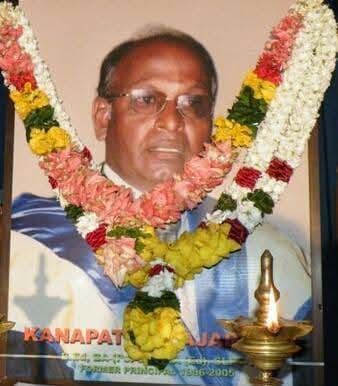
JAFFNA, Sri Lanka: A short time before he was killed, Kanapathy Rajadurai, the principal of Jaffna Central College, travelled to Kilinochchi to meet officials of the Liberation Tigers of Tamil Eelam about a threat to his life, according to University Teachers for Human Rights (Jaffna), an independent group that documented abuses by all sides in the war.
The LTTE resented the government funding that reached the college through Douglas Devananda, then a cabinet minister, leader of the Eelam People’s Democratic Party and one of the Tigers’ fiercest Tamil rivals. According to the human rights group, Mr. Rajadurai was first threatened in a leaflet issued by the Ellalan Force, which it identified as an LTTE front. A Tamil-language website linked to the LTTE’s intelligence wing then branded him an EPDP “consultant” and warned that his corpse would soon be found with a name board around its neck.
In Kilinochchi, Mr. Rajadurai met Ilamparithy, the LTTE’s political chief for Jaffna, and Arul Master, a former school principal who had become second in command of the movement’s education wing, the Kalvik Kazhagam, under Baby Subramaniam. He told them his dealings with Mr. Devananda were motivated solely by the needs of his school. Through Ilamparithy’s mediation, Arul Master consulted the LTTE’s senior leadership and assured Mr. Rajadurai that his life was not in danger. The human rights group said nearly all its sources agreed on this account.
On the afternoon of Oct. 12, 2005, Mr. Rajadurai rode his motorcycle from Jaffna Central College to Veerasingam Hall to attend a Vijayadashami celebration, which marks the culmination of the nine-day Hindu festival of Navaratri. The festival honours different forms of the divine feminine, with its final three days traditionally dedicated to Saraswati, the goddess of learning and knowledge. As he arrived, gunmen opened fire in front of his students. He was rushed to Jaffna Teaching Hospital, where he died of his injuries at about 5 p.m.
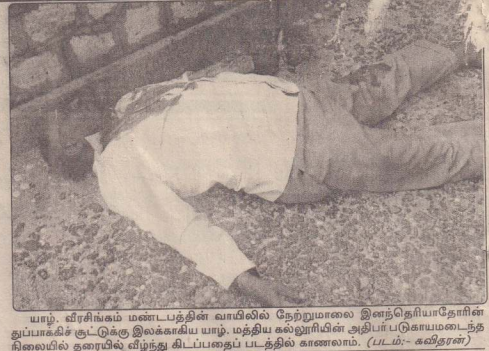
In Information Bulletin No. 39, published on Nov. 1, 2005, the human rights group concluded that there was no doubt the killers belonged to the LTTE. Few in Jaffna thought otherwise.
Former members of the LTTE’s intelligence wing told Jaffna Monitor that the killing was carried out by the movement’s pistol squad, which had deeply infiltrated the military-controlled Jaffna Peninsula and was responsible for numerous targeted killings. They said the immediate order came from Pradeep Master, who headed LTTE intelligence operations in Jaffna, and that an operation of such significance would not have gone ahead without the approval of Pottu Amman and the movement’s leader, Velupillai Prabhakaran.
Former senior LTTE members interviewed separately by Jaffna Monitor confirmed that the Kilinochchi meeting had taken place. They said Arul Master was furious and deeply disheartened that the principal had been killed despite the assurance he had personally given. In an organisation where questioning the leadership was virtually unthinkable, he kept his anger private, telling a small circle of trusted associates that the killing was wrong. Baby Subramaniam was similarly distressed, the former members said. The human rights group reported that Arul Master wrote an appreciation of the dead principal and published it in the Jaffna daily Uthayan under the name K. Sivapatham, which it read as a sign of disquiet within the movement over the growing power of Pottu Amman’s intelligence wing.
Jaffna Central College, founded by Methodist missionaries in 1816, is one of the oldest schools in Sri Lanka. Mr. Rajadurai came from one of the communities long marginalised under Jaffna’s caste hierarchy, and he was one of very few educators from such a background to rise to the leadership of one of the peninsula’s elite schools.
When he took charge in 1996, the war had left the college dilapidated and its old chapel in rubble. According to the human rights group, he lived in the principal’s house on Vembady Road although it was unfit to live in, and personally supervised the rebuilding of the school. He opened its computer centre to other schools that had none, and shortly before his death he returned from a tour abroad that raised support for the college’s development. Mr. Devananda, a former student of the college, helped direct government funds to its projects.
The LTTE regarded itself as the sole legitimate representative of the Tamil people and treated Tamil parties that worked with the government as enemies. The human rights group reported that during this period, people who used government money for educational, social or religious work were among the LTTE’s principal targets.
Mr. Rajadurai also refused to let the movement use his pupils. The group reported that he did not obstruct the LTTE, but when it asked him to send children whenever it summoned them, he declined. Like other officials in Jaffna, he attended LTTE functions when ordered to, but his dislike of the movement was well known, and his friends feared for him.
After the killing, the LTTE-linked website Nitharsanam ran a headline describing him as the Jaffna adviser to what it called the Douglas gang. Ilamparithy publicly blamed the army and the EPDP.
Mr. Rajadurai was killed less than 24 hours after another Jaffna principal. On the night of Oct. 11, Nadarajah Sivakadatcham, principal of Kopay Christian College, was shot dead at his home by gunmen who called him outside. Mr. Sivakadatcham had been a local organiser of Pongu Tamil, the LTTE-backed movement that staged mass rallies for Tamil nationalist demands. LTTE’s Jaffna political wing blamed military intelligence and the EPDP for Mr. Sivakadatcham’s killing and conferred on him the title “Tamil National Patriot.”
Many in Jaffna initially saw Mr. Rajadurai’s killing as retaliation. The human rights group questioned that explanation. It reported that Mr. Sivakadatcham appeared to recognise the gunmen who called him out and that he had recently urged his LTTE contacts to stop the killings. It said the first suspicion had been that the LTTE killed him, and that by late October many in Jaffna believed the movement was responsible for both deaths.
That account remains disputed. Several people interviewed by Jaffna Monitor, including some familiar with the political and security situation at the time, said Mr. Sivakadatcham was killed by Sri Lankan military intelligence operatives and that Mr. Rajadurai’s killing was the LTTE’s retaliation. The human rights group acknowledged that its information on Mr. Sivakadatcham’s death was inconclusive. No court has established who killed him.
Mr. Rajadurai’s death set off protests across Jaffna, which the human rights group described as spontaneous and directed against the LTTE. It reported that LTTE intelligence cadres told the college’s vice principal and head boy to keep the funeral quiet, and that students from Central and other schools blocked Hospital Road at Vembady Junction and refused to let intelligence cadres on motorcycles pass. The LTTE then mobilised its front organisations. One of them, the University Students’ Front, called a strike until Oct. 19 that praised Mr. Sivakadatcham and did not mention Mr. Rajadurai.
He was not the first principal of a leading Jaffna school to be killed by the LTTE. In June 1985, C. E. Anandarajah, principal of St. John’s College, Central’s traditional cricket rival, was shot dead in Jaffna, reportedly on the orders of the LTTE’s Jaffna commander at the time, Sathasivam Krishnakumar, known as Kittu.
By 2005, the LTTE’s recruitment of children had made the position of school principals especially precarious. Between January 2002 and the end of 2006, UNICEF received reports of 5,956 cases of child recruitment by the movement, according to figures cited by Human Rights Watch. Many of the children were in their early teens, and some were as young as 11. The practice continued through the ceasefire signed in February 2002 and grew into widespread forced recruitment and abduction after the war resumed. The ceasefire reduced conventional fighting, but targeted killings by the LTTE, and killings attributed to government forces and allied armed groups, continued throughout.
In February 2024, during a dispute over the appointment of a new principal at the college, Mr. Devananda spoke publicly about Mr. Rajadurai as a former student. He recalled how the principal had guided the school through a period of serious threats and spoke of the loss of his life.
The LTTE was defeated in May 2009, ending the civil war. Its defeat produced no judicial accounting for the civilians it killed, and many allegations against government forces and their allies also remain unresolved. In Mr. Rajadurai’s case, the threats against him, his attempt to secure his safety and the findings identifying his killers have been on the public record for more than two decades. No one is known to have been prosecuted for his murder.
On Monday, the 21st anniversary of his death, former students remembered him as the principal who restored discipline to the college after years of disorder.
“He certainly had good connections with Douglas Devananda and successive governments,” said Senthil Kumaran, 46, a former student. “But he used those connections only to secure funds and resources for the school. He gained nothing personally.”