

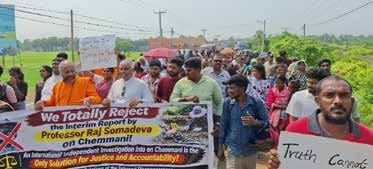
JAFFNA, Nov. 17: Relatives of people who disappeared during Sri Lanka's civil war set fire on Tuesday to a copy of a court report on the Chemmani mass grave, along with an effigy of Raj Somadeva, the archaeologist who wrote it, at the end of a protest march in Jaffna.
Hundreds of people, among them members of Parliament and local council members, joined the protest organized by the Jaffna District Association of Relatives of the Enforcedly Disappeared. It began at about 10:30 a.m. at the Thapal Kattai junction in Ariyalai, and the crowd marched to the Sindupathi cemetery in Chemmani, where human remains have been exhumed since early 2025.
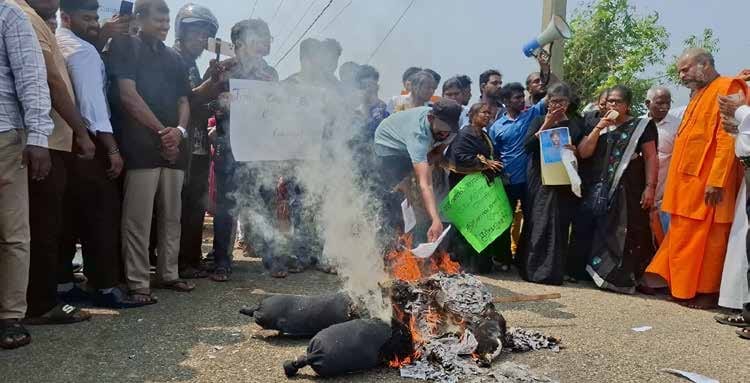
The protesters said they rejected the interim report in full and had no confidence in it. They called for an investigation that is transparent and independent, and said only an international mechanism could deliver justice to the families of the victims.
The report, the third interim report on the excavation, was submitted to the Jaffna Magistrate's Court in October by Professor Somadeva of the Postgraduate Institute of Archaeology at the University of Kelaniya, with Anusha Wanninayake. It recorded at least 574 individuals at the site, about 41 percent of them children, according to The Morning newspaper.
The report said the burials more closely resembled formal burial practices than a clandestine grave, and that the large number of remains might be explained by an outbreak of infectious disease or a natural disaster. It also said the evidence gathered so far was not enough, on its own, to support a definitive conclusion about the nature of the burials.
The findings have set the families against the excavation's lead expert. In June 2025, Professor Somadeva told Al Jazeera that an earlier interim report he had submitted said the site could be identified as a mass grave and that further investigation was needed. Families of the disappeared in the North and East decided at a coordination meeting in Jaffna this month to reject the latest report, and aggrieved parties have filed legal action against its findings, The Sunday Times reported.
On Monday, the Jaffna University Teachers' Association said it fully supported Tuesday's protest. Its statement said investigations into Chemmani and other mass graves in Sri Lanka had been dragged out through domestic mechanisms without transparency, and that confidence in those mechanisms had been lost. It said an independent inquiry with international expertise and monitoring was the only way to establish the truth, and called on the international community and human rights organizations to intervene.
In Parliament on Tuesday, P. Sathiyalingam, a member of the Ilankai Tamil Arasu Kachchi, told the budget debate that the report could not be accepted. He said there was serious doubt that the government would ensure the perpetrators were punished, and accused it of ignoring families who have protested against a domestic inquiry and asked for an external one.
Chemmani first drew national attention in 1998, when Somaratne Rajapakse, a former army corporal convicted over the 1996 rape and murder of the schoolgirl Krishanthi Kumaraswamy, told a court that hundreds of bodies were buried in the area. Remains were found there again in February 2025 during construction work at the cemetery, and the excavation has since become the largest exhumation of its kind in the country.