
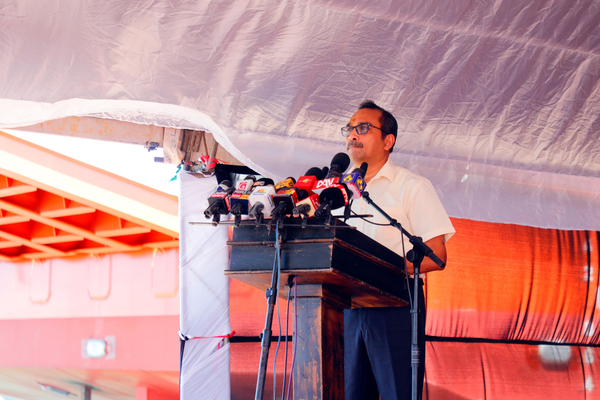
JAFFNA, Sri Lanka — Sri Lanka’s minister of transport, highways, and urban development, Bimal Rathnayake, declared on Wednesday that his government had no place for “racism” and would not indulge what he called demands from southern voters for an anti-Tamil administration — even as journalists invited to cover one of his own meetings in the northern capital were ordered out of the room.
Critics said the two episodes — unfolding just hours apart during the same ministerial visit to the Northern Province — underscored what they described as a widening gap between the rhetoric of the National People’s Power government and the lived experience of communities in Sri Lanka’s Tamil-majority north.
Bimal Rathnayake, who also serves as the NPP’s northern coordinator and Leader of the House of Parliament, used a ceremonial launch at the Kurikattuwan jetty — the gateway to Jaffna’s outlying islands — to accuse his political opponents of trading in ethnic division for electoral gain.
“Defeated parties in the North want there to be an anti-Tamil government in the South,” Mr. Rathnayake told the crowd. “We will not act in such a manner. There is no racism within us. The National People’s Power is a party for all Sri Lankans.”
The event marked the formal launch of the second phase of a 984.73 million-rupee, or roughly $3 million, rehabilitation of the Kurikattuwan jetty, a vital transport link connecting the Jaffna peninsula with Nainativu, Neduntheevu, and other northern islands. Officials said the first phase, which includes improvements to the road access to the jetty, is nearing completion, and the full project is scheduled to be completed by October 2027.
Mr. Rathnayake framed the work as overdue redress for a region long overlooked by successive administrations in Colombo. He described transport as the “choking” constraint on development in Neduntheevu, where roughly 1,400 families live and where, he said, the absence of reliable connections means that “even schools cannot start on time, and government offices close by mid-afternoon.” A contract has been signed to establish a fuel station on the island, he added, and additional public buses are planned for the peninsula and for Point Pedro and Nainativu.
“We operate on policy, not racism,” he said. “But there are groups on both sides that continue to practice politics rooted in ethnic division.”
A meeting closed to the press.
Earlier that day, at the Jaffna District Secretariat, the minister chaired a separate discussion on a proposed development plan for Jaffna city, attended by members of Parliament, the district secretary, the mayor of Jaffna, and other government officials.
According to journalists present, they had been invited to cover the meeting by the minister’s own coordinating office and had begun recording video footage before the discussion began. Shortly afterward, an official from the District Secretariat’s media division told them they would not be permitted to remain and should return after the meeting concluded.
When the journalists protested that they had been specifically invited, the official told them the invitation applied only to other events on the minister’s itinerary, not to the planning discussion itself. The reporters left the hall.
The ministry did not immediately respond to a request for comment on why the press had been excluded. The episode has drawn frustration among local journalists, who noted that the NPP came to power promising a sharp break from the opacity of previous administrations and has repeatedly cited transparency as a defining feature of its governance.
A fraught portfolio
Mr. Rathnayake’s appearance in Jaffna comes against a politically sensitive backdrop. Until a cabinet reshuffle last October, he held the Ports and Civil Aviation portfolio as well — a combination that placed the NPP’s most prominent northern organizer in charge of two projects widely seen in the North as indispensable to the region’s economic recovery: the reopening of Palaly Airport and the redevelopment of Kankesanthurai, or KKS, Harbour.
Tamil political parties had for months accused him of personally obstructing both projects, which are underwritten in part by an Indian government grant valued at roughly $61 million and carry no repayment obligation. Mr. Rathnayake stated on the record that his government would not develop KKS Harbour — a position that drew sharp condemnation from ITAK, the TNPF and other Tamil parties.
After his removal from the ports brief, the ITAK parliamentarian Shanakiyan Rasamanickam publicly welcomed the reshuffle. Associates of other Tamil legislators said privately that the decision reflected unease within the government itself over Mr. Rathnayake’s handling of the Indian-backed projects. The ports portfolio was reassigned to Anura Karunathilaka.
The minister has rejected that characterization, describing the reshuffle as a routine redistribution of responsibilities and casting his new portfolio — which, unlike ports, involves direct engagement with the public — as the more demanding of the two.
Small projects, large silences
A person familiar with regional infrastructure planning said the pattern of Mr. Rathnayake’s engagement with the North had become hard to ignore: the government appeared willing to advance smaller, highly visible projects — local road improvements, the Kurikattuwan jetty upgrade, expanded bus services — while showing persistent reluctance toward the larger initiatives that would most reshape the region’s economy.
Fully operational, the Kankesanthurai Harbour and a reopened Jaffna International Airport would reduce the North’s dependence on Colombo-based hubs, including Bandaranaike International Airport and the Port of Colombo, while opening direct trade and passenger links across the Palk Strait to southern India. They could also allow members of the Tamil diaspora to travel directly to Jaffna from abroad, bypassing the capital.
“They are comfortable with schemes that create the appearance of progress,” the person said. “But when it comes to projects that could shift economic power toward the North, there is hesitation.
That hesitation, the person argued, carries its own implication. To oppose the KKS and Palaly projects on the grounds that they might draw activity away from facilities in predominantly Sinhala regions is, in effect, to treat the North’s development as a threat rather than a national gain — a posture indistinguishable, in outcome, from the ethnic politics Mr. Rathnayake says his party rejects.
For residents and reporters in Jaffna, the day’s two events offered a study in contrast. A minister long accused of blocking the North’s most consequential infrastructure projects was inaugurating a smaller one while denouncing ethnic politics. And a government that has made openness a centerpiece of its identity was, at the same moment, asking journalists to wait outside.