
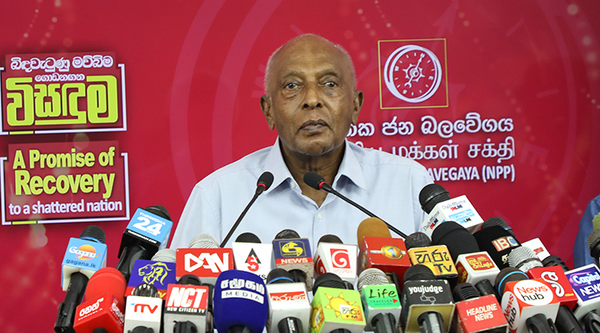
COLOMBO — A senior lawyer who sits on the governing National People's Power's leadership council and executive council has publicly broken with the government over its bid to extend the retirement age of judges, saying neither body ever took such a decision — and that he was told to keep his mouth shut when he raised the question internally.
Speaking at a media briefing attended by President's Counsel and senior members of the Bar, Attorney-at-Law Lal Wijenayake, a veteran of the country's left and one of the NPP's own council members, said the proposal had never come before the party organs on which he serves.
"I am a member of the NPP Leadership Council and Executive Council. No decision of this nature to extend the retirement age of judges has been taken at any NPP Executive Council or any other council that I am part of," he said. When he pressed the matter, he said, "I was told to keep my mouth shut."
Wijenayake, who said he had practised law for 55 years and been part of the left movement for around 60 years, framed his objection as a matter of principle. "My politics is built on a vision, on a policy, for a civilised society," he said. He said he had fought for the independence of the judiciary under earlier administrations and that his opposition now was a continuation of that commitment. "I will continue to fight for it today. This is an arbitrary and uncivilised decision," he said.
Political observers said Wijenayake's intervention is significant because it comes from within the ruling coalition itself, making it one of the first public challenges to the NPP leadership from a senior figure inside the alliance.
A veteran political analyst, speaking on condition of anonymity because of the sensitivity of the issue, told Jaffna Monitor that the episode has exposed tensions over how decisions are made within the NPP.
"Although the NPP presents itself as a broad political coalition, this controversy suggests that key policy decisions may, in practice, be taken by a small group within the Janatha Vimukthi Peramuna's (JVP) Central Committee before being presented as decisions of the wider alliance," the analyst said.
The government is weighing a constitutional amendment to raise the retirement ages of superior court judges, reported to be from 65 to 67 for the Supreme Court and from 63 to 65 for the Court of Appeal, with some accounts suggesting the extension could be widened to cover High Court judges, who currently retire at 61, and district judges and magistrates, who retire at 60. Because the tenure of judges is fixed in the Constitution, any change requires a constitutional amendment; the NPP commands a two-thirds majority in Parliament.
Justice and National Integration Minister Harshana Nanayakkara has told Parliament that no Cabinet approval has been granted and that the idea remains at a conceptual stage, with the stated aim of retaining judicial experience and easing case backlogs. Critics note that no such measure appeared in the NPP's 2024 election manifesto.
Opposition to the plan has hardened across the legal establishment. The Bar Association of Sri Lanka has urged the President to abandon it and sought consultations with the Justice Minister; the Judicial Service Association of Sri Lanka, representing district judges and magistrates, has formally opposed it; and the Law Association for Asia and the Pacific has warned against an ad hoc change. The Communist Party, itself part of the governing bloc, has cautioned of "far-reaching and devastating" consequences, while former justice ministers G.L. Peiris and Wijeyadasa Rajapakshe have argued the move, coupled with unfilled vacancies on the top courts, amounts to interference with the judiciary.
Wijenayake's account adds a new dimension to those concerns: an assertion, from inside the ruling party, that a measure being advanced in its name was never endorsed by the councils meant to sanction it.