
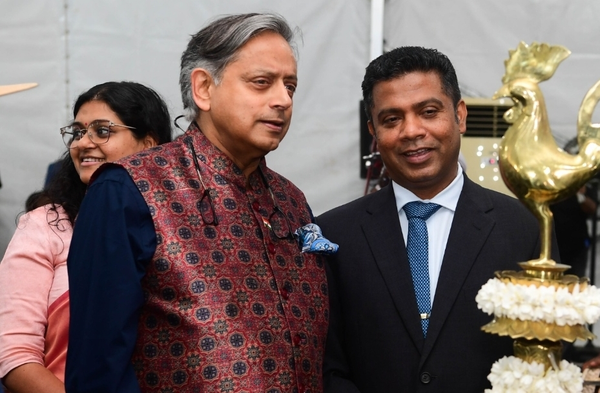
COLOMBO, Sri Lanka — Literature can build bridges where politics sometimes cannot, Indian parliamentarian and author Shashi Tharoor said on Friday as he inaugurated the first Colombo Literary Festival, urging India and Sri Lanka to strengthen their ties through books, translation, and cultural exchange.
Addressing an audience at Arcade Independence Square, Tharoor described the launch of the festival as “an act of optimism,” saying it affirmed that books, ideas, and meaningful conversations continued to matter in an increasingly fragmented world. He congratulated Sri Lanka’s independent publishers for working together to establish the event, calling their collaboration a model for strengthening literary culture.
“Literature flourishes best not when it is divided into rival camps, but when everyone invested in books works together to expand the community of readers,” he said.
Tharoor said literary festivals served a purpose far beyond celebrating books, providing spaces where writers and readers from different countries could exchange ideas and develop lasting relationships.
“Stories continue to unite us in ways that politics sometimes cannot,” he said, arguing that literature fostered understanding across borders through empathy and shared human experience.
Reflecting on his lifelong relationship with books, Tharoor said reading had shaped his thinking from childhood, exposing him to diverse cultures and traditions. While acknowledging the rise of digital media, he argued that sustained reading offered intellectual and emotional rewards that technology could not replace, including patience, empathy, and critical thinking. He urged publishers and booksellers to focus not only on selling books but also on creating new generations of readers.
Turning to South Asian literature, Tharoor rejected suggestions that the region lacked global recognition, saying its writers had already earned international acclaim. The greater challenge, he argued, was ensuring wider access to literature written in South Asia’s many languages through increased translation, publishing, and distribution.
He said too many outstanding works remained confined to their original languages and noted that South Asians themselves often failed to read one another’s literature.
“Before asking why the world has not fully discovered us, we should also ask whether South Asia has fully discovered itself,” he said.
Tharoor also highlighted the deep literary and cultural connections between India and Sri Lanka, describing the ancient Mahavamsa and Dipavamsa chronicles, together with the Ramayana, as part of a shared civilisational and literary heritage linking the two countries.
The Mahavamsa and Dipavamsa, however, remain deeply contested in Sri Lanka. Many Tamil historians and scholars have argued that successive Sinhala-Buddhist nationalist movements have relied on interpretations of the chronicles to advance majoritarian narratives and to justify policies that marginalized Tamil and other minority communities.
Concluding his address, Tharoor expressed hope that the Colombo Literary Festival would become an annual institution attracting increasing international participation. He also called on foreign diplomatic missions to support the festival by bringing authors, poets, and translators from around the world to Colombo.
“Books have always travelled farther than armies and endured longer than treaties,” he said, adding that literature remained one of the most enduring means of building understanding between nations.