
COLOMBO — Sri Lanka's weather authority says an unusually powerful El Niño is likely to develop by the end of the year, arriving just as reservoirs across the country are running low.
The Department of Meteorology now puts the probability of a "very strong" El Niño at about 90 percent, said Ajith Wijemanna, the department's director general. He said there was roughly a 70 percent chance the event would exceed the intensity of any El Niño recorded since 1950.
The forecast tracks closely with recent international assessments. The U.S. Climate Prediction Center said last week that the probability of a very strong El Niño had also passed 90 percent, and put the odds of a historically exceptional event at about 69 percent. The World Meteorological Organization warned in late July that the phenomenon was strengthening steadily and would likely shape global temperature and rainfall patterns through the rest of the year.
El Niño is a recurring climate pattern marked by unusually warm water in the central and eastern Pacific. It forms thousands of kilometres from Sri Lanka but can still shift atmospheric circulation enough to disrupt rainfall across much of the world.
Its local effects are harder to predict than its global strength suggests. Meteorologists caution that a record-strength El Niño will not necessarily bring record drought or rainfall to Sri Lanka specifically. The department has studied roughly 75 years of historical data and found that rainfall in El Niño years can vary widely from typical monthly patterns, and it has urged the public and government agencies to rely on its seasonal forecasts rather than assume a fixed relationship between El Niño and local weather.
The forecast arrives as the country's reservoirs are already stressed. Water stored in the 74 major reservoirs run by the Irrigation Department has dropped to about 37 percent of capacity amid the dry spell, irrigation officials said.
H.N.P.S.D. Herath, the director of irrigation, said current reserves should still be enough to finish the remaining Yala season cultivation and carry the country through to the rains expected in November and December. He asked the public to use water carefully in the meantime.
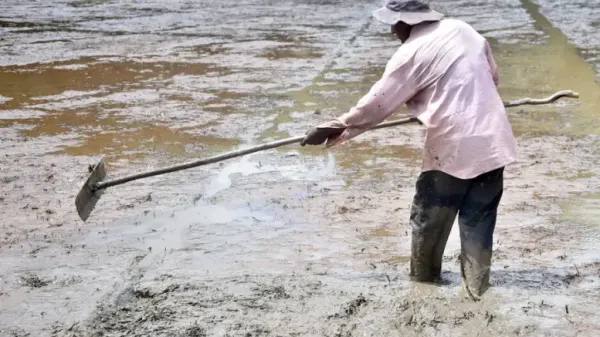
Rice cultivation is especially exposed to a prolonged dry spell, since large areas depend on reservoirs replenished by the seasonal monsoons. A sustained shortfall could force officials to weigh competing demands for irrigation, drinking water and other uses.
Drinking-water supplies have not been affected so far. Chandana Bandara, chairman of the National Water Supply and Drainage Board, said treatment plants nationwide were running at full capacity despite dry conditions in several districts. "There is no problem with the water supply," he said, adding that distribution had not been cut even though some reservoirs had fallen below 56 percent.
Even so, the strengthening El Niño adds uncertainty to the months ahead. The World Meteorological Organization has told governments that a powerful event raises the risk of extreme heat and significant swings in rainfall, and has urged early preparation across agriculture, water management and other climate-sensitive sectors.