

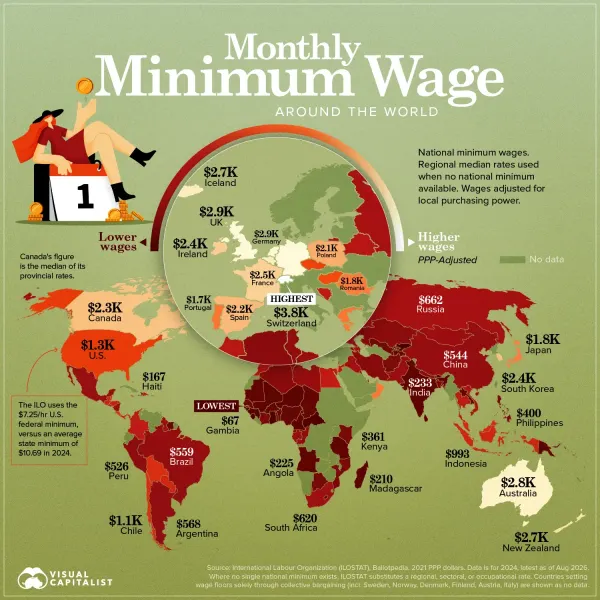
COLOMBO, Sri Lanka — Sri Lanka has been placed 120th out of 130 countries in a global comparison of minimum wages, near the bottom of a ranking that has drawn attention in the country but is based on wage data from two years ago.
The comparison, published on Aug. 26 by Visual Capitalist using 2024 data from the International Labour Organization, puts Sri Lanka’s monthly minimum wage at $200 after adjusting for purchasing power.
That does not mean Sri Lankan workers were paid $200 a month. The figure is expressed in purchasing power parity-adjusted U.S. dollars, which takes account of differences in local prices to give a better indication of what a minimum wage can buy within each country.
Even after that adjustment, Sri Lanka ranked close to the bottom.
Switzerland topped the table at $3,804 a month, followed by Germany at $2,928, Britain at $2,902 and the Netherlands at $2,876. South Korea, at $2,362, had the highest figure in Asia and ranked 11th, while Japan was 16th at $1,839.
The United States ranked 25th at $1,257, based on the federal minimum wage of $7.25 an hour.
Ten countries were below Sri Lanka: Niger, Bhutan, Haiti, Guinea, the Central African Republic, Sierra Leone, Ghana, Kyrgyzstan, Guinea-Bissau and Gambia.
Some reports in Sri Lanka have described the country as having the lowest minimum wage in South Asia. The Visual Capitalist table does not support that claim.
Bhutan, a member of the South Asian Association for Regional Cooperation, ranked 122nd, two places below Sri Lanka, with a PPP-adjusted minimum wage of $180. Afghanistan was 88th at $393 and the Maldives 67th at $587.
Among Sri Lanka’s other South Asian neighbors, Pakistan recorded $570, Nepal $490 and Bangladesh $379. India ranked 111th at $233.
There is also an important qualification to Sri Lanka’s position in the table: the underlying figures are from 2024, before two increases in the country’s statutory minimum wage.
Sri Lanka’s national minimum monthly wage had stood at 12,500 rupees since 2021, a period that included the country’s severe economic crisis and a surge in inflation.
Legislation passed in September 2024 raised the statutory monthly minimum to 17,500 rupees and the daily minimum to 700 rupees. Workers were also entitled to budgetary relief allowances totaling 3,500 rupees, bringing the effective monthly floor to 21,000 rupees.
The minimum wage has since risen further.
Legislation enacted in 2025 increased the monthly minimum to 27,000 rupees from April 1, 2025, and to 30,000 rupees from Jan. 1, 2026. The daily minimum is now 1,200 rupees.
The latest increase means Sri Lanka’s current statutory wage floor is substantially higher than the one reflected in the 2024 international comparison.
It does not, however, establish where Sri Lanka would rank today.
Other countries have also changed their minimum wages since 2024, while inflation and purchasing-power estimates have changed. A current ranking would require updated figures for all 130 countries.
Rising prices could also erode some of the gains Sri Lankan workers received from the higher wage floor. Year-on-year inflation measured by the National Consumer Price Index reached 7.2 percent in July, after a period of low inflation and falling prices.
Visual Capitalist also cautions that minimum-wage systems differ substantially between countries.
Switzerland, for example, has no single nationwide minimum wage. Canada’s figure represents the median of provincial rates, while the United States figure uses the federal minimum even though many states require higher wages. Several European countries where wages are largely determined through collective bargaining were listed as having no comparable data.
The purchasing-power figures also do not account for taxes or benefits and can conceal differences in living costs within individual countries.
The comparison therefore does not show that Sri Lanka currently ranks 120th in the world. It shows where the country stood in a standardized comparison using 2024 wage data.
Sri Lanka’s minimum wage has risen substantially since then. Whether those increases have been enough to lift the country significantly in an updated global ranking will not be known until comparable data for other countries become available.