

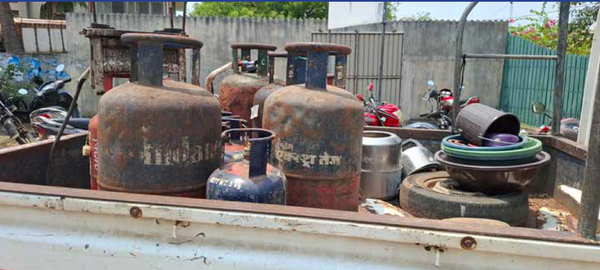
JAFFNA, Sri Lanka — April 7, 2026 — The Sri Lankan government auctioned gas cylinders, cooking stoves and batteries seized from Indian fishing boats on Tuesday, drawing large crowds to a public sale in Jaffna that offered a rare glimpse into how the state disposes of assets taken during maritime enforcement operations in the Palk Strait.
The auction, organized by the Department of Fisheries and Aquatic Resources, featured equipment confiscated from both Sri Lankan and Indian vessels — some of it held in official custody for years as legal proceedings over maritime violations moved slowly through the courts. Officials declined to disclose the total revenue raised but described the proceeds as “significant,” saying the sale helped clear long-held inventory.
Buyers from across the Jaffna peninsula gathered early, many bidding competitively for equipment they said would otherwise be unaffordable at market prices. “Even a used cylinder is useful for us,” one bidder said, clutching a receipt — a small moment that reflected the economic strain in a region still rebuilding after decades of conflict.
Under Sri Lankan law, boats and gear confiscated following rulings on illegal fishing or maritime boundary violations can be vested in the state and later auctioned. The practice has become more visible in recent years as arrests in northern waters have increased.
More than 500 Indian fishermen were detained in 2024 alone, according to Sri Lankan government data, as naval patrols intensified in the Palk Bay and Palk Strait — narrow, fish-rich waters separating the island’s Northern Province from the Tamil Nadu coast, sustaining fishing communities on both sides of a maritime boundary formally demarcated in the 1970s.
The dispute has emerged as one of the most persistent irritants in relations between New Delhi and Colombo, featuring regularly in high-level diplomatic exchanges. Rights groups and fishing unions in Tamil Nadu have raised concerns about the treatment of detained fishermen, citing allegations of assault, prolonged detention and heavy fines. Sri Lankan authorities maintain that enforcement measures are necessary to protect marine resources and safeguard local livelihoods.
For Tamil fishing communities in Jaffna, Kilinochchi, Mannar and Mullaitivu, the consequences run deeper than occasional auctions of seized equipment. Field studies in northern Sri Lanka indicate that more than 95 percent of local fishers believe incursions by Indian mechanised trawlers have directly reduced catches, damaged nets and eroded incomes — forcing some families to abandon fishing or fall into debt.
At the centre of the dispute is bottom trawling, a method widely used by segments of the Tamil Nadu fleet that drags weighted nets along the seabed. Northern Sri Lankan fishers say it devastates coral ecosystems, marine habitats and breeding grounds critical to small-scale coastal fishing. To avoid confrontation, many restrict themselves to near-shore waters, intensifying pressure on already depleted stocks.
Researchers who have studied the conflict caution that it reflects deeper structural asymmetries than the familiar framing of “big India versus small Sri Lanka” suggests. Northern Tamil fishers often struggle to secure consistent enforcement against foreign trawlers or obtain compensation for damaged gear — reinforcing a sense of marginalisation among communities still recovering from war.
Fishing communities in Tamil Nadu, in turn, argue that declining catches, climate pressures and decades of dependence on trawling have made crossing the maritime boundary a necessity rather than a choice.
Without a negotiated, time-bound transition away from bottom trawling — supported by alternative gear, economic assistance and sustained dialogue between communities on both sides — seizures, arrests and auctions like the one held in Jaffna on Tuesday are likely to continue, not as solutions, but as recurring symptoms of a crisis neither country has yet meaningfully resolved.