

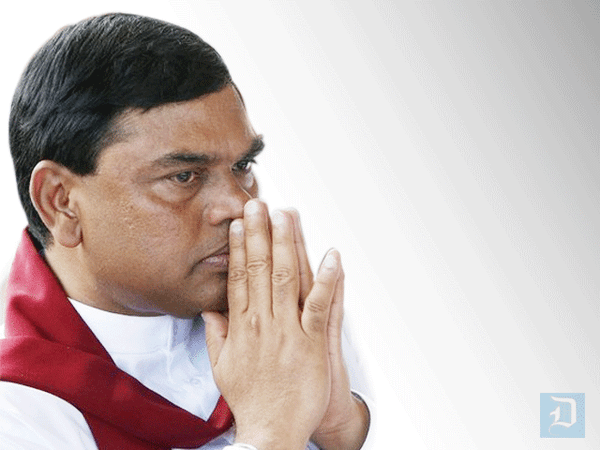
COLOMBO, Sept. 19 — Sri Lankan authorities have asked Interpol to help locate Basil Rajapaksa, the former finance minister and founder of the Sri Lanka Podujana Peramuna, who has remained overseas for more than a year while two magistrates’ courts have ordered his arrest.
Public Security Minister Ananda Wijepala said a Blue Notice had been issued in respect of Rajapaksa, enabling international law enforcement agencies to obtain information about his identity, location or activities in connection with the criminal investigations against him.
A Blue Notice is a request for information about a person’s identity, location or activities in relation to a criminal investigation. It is distinct from a Red Notice, which seeks the location and arrest of a person wanted for prosecution or to serve a sentence. Wijepala said a Blue Notice is used when a suspect’s foreign address or country of residence is known, while a Red Notice is sought for fugitives whose whereabouts are unknown. Sri Lanka’s Interpol bureau operates through the Criminal Investigation Department, which requests and processes the notices.
Two warrants, two courts
Basil Rajapaksa is the subject of arrest orders from separate benches.
The Matara Chief Magistrate’s Court reissued a warrant in July over the alleged purchase of a 1.5-acre property at Brown’s Hill, Eliyakanda Road, Matara, for 60 million rupees, roughly $200,000 at current rates. The case, filed by the Police Financial Crimes Investigation Division, alleges the land was bought with illegally acquired funds. Prosecutors have told the court that Rajapaksa, named as the third suspect, has continuously avoided appearing by submitting medical reports, and the Chief Magistrate has warned the four sureties who posted his bail to show cause why the money should not be confiscated. The prosecution has alleged that he avoided court appearances for nearly a year, relied repeatedly on the same medical report, and cancelled airline bookings made for his return. His counsel, President’s Counsel Anil de Silva, has told the court that his client has no intention of evading proceedings and is receiving treatment abroad.
The second case concerns 7.8 million rupees in funds belonging to the Sri Lanka Tourism Promotion Bureau. The Criminal Investigation Department told the Colombo Fort Magistrate’s Court that about 12,000 T-shirts were printed in 2014 using bureau funds, purportedly for tourism promotion. Investigators said the shirts instead carried an image of then-President Mahinda Rajapaksa on one side and the name of a political party on the other, and were distributed at a political rally in Monaragala District during the Uva Provincial Council election campaign.
Fort Magistrate Pasan Amarasena ordered the arrest of Mr. Rajapaksa, along with Bhashwara Gunaratne, a former chairman of the Tourism Promotion Bureau, and Rumy Jauffer, its former managing director, after investigators told the court that officers had searched for the suspects at their known residences but could not find them. The court also imposed a foreign travel ban and ordered that immigration authorities be notified. The case was brought under Sri Lanka’s Public Property Act.
Jauffer, who had been remanded, was released on bail and barred from leaving the country. Counsel for a third suspect told the court his client was willing to give a confidential statement under Section 127 of the Code of Criminal Procedure, suggesting investigators may be building testimony from within the bureau’s former management.
In June, the Fort magistrate told the CID’s Illegal Assets Unit that if an international warrant was required, an affidavit should be filed and the necessary steps taken. That instruction is the procedural seed of the Interpol request now under way.
The strategist offshore
Basil Rajapaksa built the SLPP after the family’s 2015 electoral defeat and helped propel it to power in the presidential election of 2019 and the parliamentary election the following year. He has long been regarded across Sri Lanka’s political spectrum as the family’s chief electoral strategist and as a central architect of the party’s formidable political machinery.
Even as he resigned from Parliament in June 2022, amid the economic crisis that was rapidly eroding the Rajapaksas’ political standing, Mr. Rajapaksa made clear that he was leaving office, not politics. “From today, I will not be involved in any government activities but I cannot, and will not, step away from politics,” he told reporters at the time. He later relinquished his position as the SLPP’s national organizer, saying he wanted to make way for younger politicians.
Rajapaksa left for the United States during the 2022 crisis after an earlier attempt to depart through the VIP terminal at Colombo airport failed in a standoff with immigration staff, and returned to the country that November. He left again in September 2024, days before the presidential election, with the SLPP saying he had gone for a medical checkup and would return to lead the party’s general election campaign. He has not appeared in a Sri Lankan courtroom since.
The party he built is now close to extinguished as a parliamentary force. At the November 2024 general election the SLPP won three seats and 3.14 percent of the vote, down from the 145 seats it held after 2020, while the National People’s Power took 159 seats and the Samagi Jana Balawegaya became the main opposition with 40.
A family under investigation
The Interpol request lands two weeks after the arrest of Rajapaksa’s nephew. Namal Rajapaksa, the SLPP national organiser and a member of Parliament, was arrested on September 4 by the Commission to Investigate Allegations of Bribery or Corruption after several hours of questioning over the Airbus transaction involving SriLankan Airlines. He has been further remanded until September 29 over allegations that he accepted a 100 million rupee bribe connected to the aircraft procurement, with the Colombo Chief Magistrate also directing that a decision on his bail application be announced that day.
The bribery commission told the court that it had conducted a joint investigation with the CID, assisted by authorities in Australia, Singapore, France and the United States, and that Airbus officials had visited the commission several times, with a delegation in Colombo as recently as August. Yoshitha Rajapaksa, another son of the former president, was arrested by the CID in January 2025 under the Prevention of Money Laundering Act.
The SLPP has framed the proceedings as political. The party called Namal’s arrest “very questionable,” said it came as preparations were under way for a major rally in Anuradhapura, and insisted the rally would go ahead. The United National Party, once the family’s principal adversary, condemned the arrest as an attempt to sabotage the rally, and Ranil Wickremesinghe said the government was weakening the opposition and threatening the democratic system.
The formal opposition has been quieter. The SJB made no statement on the arrest, and NPP sources have indicated they regard Namal Rajapaksa and Wickremesinghe, rather than the SJB, as their political challenges. With Namal in remand custody and Basil beyond the reach of a domestic warrant, the party that governed Sri Lanka for most of the past two decades is left without either of the figures capable of running a national campaign.
Some political observers have argued that corruption cases pursued against members of the Rajapaksa family during the previous Yahapalanaya administration ultimately faltered amid political calculations and a reluctance to pursue former leaders to the fullest extent of the law. They say the NPP, which came to power outside the traditional parties that had dominated Sri Lankan politics for decades, faces a different test: whether its anti-corruption drive can withstand the political pressures that undermined previous attempts to hold powerful figures accountable.
For now, the Blue Notice is intended to help locate Mr. Rajapaksa and does not authorize his arrest. Mr. Wijepala has said Sri Lanka would need to seek a Red Notice for that purpose, after which the matter would also depend on the laws and authorities of the country where Mr. Rajapaksa is found.