
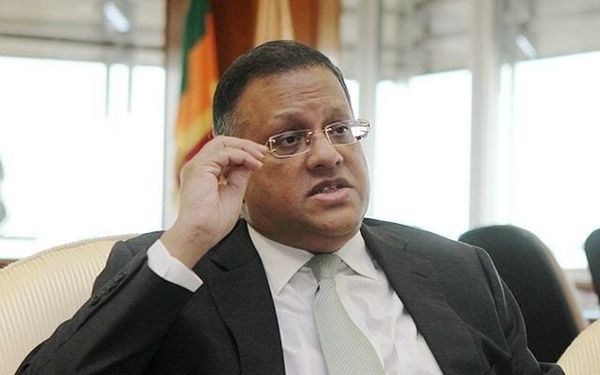
COLOMBO, Sri Lanka — Sri Lanka is examining alternative legal avenues to bring Arjuna Mahendran, the former Central Bank governor at the center of the country's long-running Treasury bond scandal, back from Singapore to face criminal proceedings, the public security minister said, acknowledging that earlier efforts to secure his return had run into legal obstacles.
Ananda Wijepala, the minister of public security and parliamentary affairs, said in an interview with a private television channel that Mr. Mahendran's status as a Singaporean citizen had complicated efforts to arrest and return him. He added, without elaborating, that Mr. Mahendran had also changed his name since settling in Singapore.
"There are legal complications in bringing former Central Bank Governor Arjuna Mahendran back to the country because he is a Singaporean citizen," Mr. Wijepala said. "He is currently not a Sri Lankan citizen. Therefore, under Singaporean law, there are legal complications in arresting a citizen of that country and bringing him back here."
Mr. Wijepala said the government was giving "special attention to alternative legal avenues," but did not explain what those options were.
The minister's account, however, describes only part of a more complicated legal picture.
Singaporean citizenship alone does not appear to bar extradition outright. Singapore is among the Commonwealth countries that Sri Lanka's own extradition law treats as eligible for such requests, but any request must still satisfy Singapore's Extradition Act — establishing that the conduct alleged amounts to an extraditable offense and supplying evidence sufficient for Singaporean authorities to determine whether the legal conditions for surrender have been met.
That test has already proved difficult to meet.
Sri Lanka submitted an extensive extradition request to Singapore in 2019, with supporting documentation reported at the time to run to about 21,000 pages, including warrants issued by Sri Lankan courts and material relating to the criminal case against Mr. Mahendran. Singapore did not act on it. Singaporean authorities later indicated that the material did not satisfy the requirements of their Extradition Act.
An Interpol notice or a Sri Lankan arrest warrant does not, by itself, compel Singapore to hand someone over. Sri Lanka must persuade Singaporean authorities, through the legal process available there, that the requirements for extradition have been fulfilled — and the government has not said publicly what deficiency in the earlier request it now hopes to overcome, or what alternative mechanism it is considering.
Who Is Arjuna Mahendran?
Lakshman Arjuna Mahendran is a Sri Lankan-born, Oxford-educated economist who became a Singaporean citizen before he was appointed the Central Bank of Sri Lanka's 13th governor in January 2015, shortly after President Maithripala Sirisena and Prime Minister Ranil Wickremesinghe took office.
He was not new to the institution. Mr. Mahendran joined the Central Bank as a staff officer in 1983 and later worked in its Economic Research Department. After leaving in 1995, he built an international banking career, holding senior posts at Credit Suisse Private Bank, Emirates NBD and HSBC Private Bank, and later served as chairman of Sri Lanka's Board of Investment. His appointment as governor was controversial from the outset, in part because he did not hold Sri Lankan citizenship. He left the post in June 2016, by which point his tenure had become closely associated with one of the biggest financial scandals in Sri Lanka’s recent history.
What Was the Bond Scandal?
Governments borrow by selling Treasury bonds, and the interest rate they pay matters enormously: even a small increase can add substantial costs when billions of rupees are at stake.
The controversy erupted over a Treasury bond auction on Feb. 27, 2015, barely a month into Mr. Mahendran's tenure. The Central Bank had advertised Rs. 1 billion in 30-year bonds but ultimately accepted bids worth Rs. 10 billion, 10 times the amount offered, at yields that drew immediate scrutiny. The chief beneficiary was Perpetual Treasuries Ltd., a primary dealer linked to Arjun Aloysius, Mr. Mahendran's son-in-law, raising immediate questions about conflicts of interest.
The controversy spread to other bond transactions in 2015 and 2016 and eventually prompted parliamentary inquiries, forensic audits and a presidential commission of inquiry, which found that Perpetual Treasuries had made improper profits and identified conduct by Mr. Mahendran and others warranting further legal action. He has not been convicted of any of the allegations against him and has denied wrongdoing; the criminal case remains before the courts.
How Much Did Sri Lanka Lose?
Different investigations examined different transactions, making a single figure for the total loss elusive. But the presidential commission, whose findings President Sirisena announced in January 2018, calculated that Perpetual Treasuries reaped an undue profit of Rs. 11.145 billion from secondary-market bond transactions — of which more than Rs. 8.5 billion came from the Employees' Provident Fund and other state institutions.
The Employees' Provident Fund holds the retirement savings of millions of Sri Lankan private-sector workers, accumulated through decades of employee contributions. The commission's findings meant that public institutions, including a fund built from ordinary workers' savings, had suffered heavy losses while a dealer connected to the governor's own family reaped extraordinary profits. When Mr. Mahendran was indicted in June 2019 before the Permanent High Court-at-Bar, prosecutors separately charged him with causing the state losses of more than $11 million, a narrower figure tied to the specific counts in that indictment rather than the commission's broader estimate.
There may also have been a wider economic cost: elevated government bond yields can push up borrowing costs across an economy, with taxpayers ultimately covering the difference. But untangling that effect from the many other forces buffeting Sri Lankan interest rates at the time is difficult, and it would be an overstatement to trace the country's 2022 economic collapse, driven by years of fiscal imbalances, heavy debt, and depleted foreign reserves, to the bond affair alone.
What the scandal damaged most clearly was public trust. The idea that a dealer connected by family ties to the central bank's own governor had profited from transactions the bank oversaw became a defining controversy for the government then in power.
Why Can't Sri Lanka Simply Arrest Him?
A Sri Lankan warrant has no force inside Singapore. Once a wanted person is in another sovereign country, Sri Lanka must work through that country's legal system, and extradition is the formal channel for doing so.
Singapore's Extradition Act allows for judicial scrutiny: a Singapore magistrate may need to be satisfied that a prima facie case exists — one that would justify a trial had the alleged conduct occurred in Singapore itself. That is a considerably higher bar than simply informing Singapore that a Sri Lankan court has issued a warrant, and it helps explain why the sheer volume of Sri Lanka's earlier submission — about 21,000 pages — did not, by itself, secure Mr. Mahendran's extradition.
Mr. Wijepala's emphasis on citizenship, in other words, describes only part of the obstacle. The deeper question is whether Sri Lanka can build a case that meets Singapore's legal requirements — something it has not yet managed to do.
A Case That Has Outlasted Governments
The scandal has now followed Sri Lanka through several administrations and years of unmet promises. Mr. Mahendran was indicted in 2019 along with other defendants, and Sri Lankan authorities have sought international assistance in locating and returning him ever since; court proceedings have continued in his absence.
Mr. Wijepala placed the effort within a broader government campaign, targeting suspects he said were concentrated especially in narcotics trafficking and organized crime, to repatriate fugitives from overseas. Sri Lankan authorities, he said, have obtained 236 Interpol Red Notices in such cases, 110 of them since the current government took office, and have identified the locations of 39 wanted individuals. Sixty-six suspects have already been returned to the country, he said, while investigations into 97 others continue, and one more suspect was expected to be brought back within “another day or two.”
The minister went further, suggesting that testimony gathered from suspects already returned was unsettling some politicians. "Following this, we can observe that some politicians become agitated," he said, adding that opposition figures had grown unusually vocal after being questioned by the Criminal Investigation Department over allegations involving corruption and killings. "Following the investigations, they know very well what could happen next," he said. He also said investigations into the 2019 Easter Sunday bombings were being accelerated, including scrutiny of whether officials who had received advance intelligence had failed to act for political reasons.