

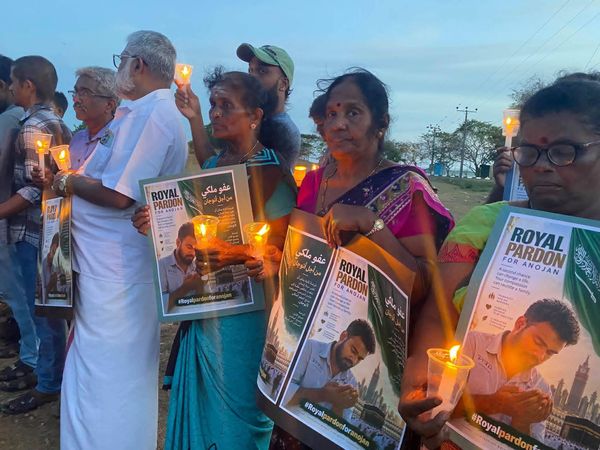
COLOMBO, Sri Lanka — Sivarasa Anojan, the Sri Lankan migrant worker sentenced to death in Saudi Arabia over a Facebook comment about the Prophet Muhammad, has told Saudi authorities that he is willing to convert to Islam in an effort to avoid execution, a Tamil-language newspaper in Jaffna reported on Friday.
The report could not be independently verified, and Tamil politicians involved in efforts to save Mr. Anojan’s life said they could not confirm it. Neither the Sri Lankan Foreign Ministry nor the Saudi authorities have commented publicly.
Mr. Anojan, 24, a Tamil from Natpiddimunai, near Kalmunai in the Eastern Province, was sentenced to death on Sept. 17 by a Saudi appeals court. A criminal court in Al-Ahsa had sentenced him in July to five years in prison and a fine of three million riyals. The appeals court rejected a defense request to reduce that sentence and instead granted a prosecution request to increase it to death.
The case grew out of a local dispute in Kalmunai, where a video of a man kicking a dog that had accompanied a Tamil pilgrimage to Kataragama caused public anger. During the controversy, Mr. Anojan, who was working in Saudi Arabia, posted a comment about the Prophet on Facebook. He later deleted it and apologized, but the comment was reported to Saudi authorities.
In Friday’s column, the newspaper’s writer said he had independently confirmed the information about the conversion. According to the column, Sri Lankan representatives who traveled to Saudi Arabia to seek Mr. Anojan’s release met with Saudi officials and with Mr. Anojan, and then contacted Tamil political leaders in Sri Lanka.
The representatives wanted to know whether Tamil politicians would object to a conversion or turn it into a political issue, according to the column, which said the leaders had agreed to cooperate in view of the gravity of Mr. Anojan’s situation. Citing unnamed sources, the columnist wrote that a conversion could lead to a pardon and the revocation of the death sentence.
The columnist said he had withheld the information for a day because of its sensitivity, and he urged politicians, the public and social media users to avoid public criticism that might complicate the effort to free Mr. Anojan.
Three Tamil political figures involved in that effort told Jaffna Monitor they could not confirm the account. One said he did not believe it.
Shanakiyan Rasamanickam, the parliamentary group leader of the Illankai Tamil Arasu Kachchi and one of the politicians most closely involved in the campaign for Mr. Anojan’s release, said he had not previously commented on the matter and did not wish to do so now.
Mano Ganesan, leader of the Tamil Progressive Alliance and also a campaigner for Mr. Anojan’s release, said the report was news to him and that he did not believe it was true.
A third Tamil politician involved in the effort, who asked not to be identified, said he did not doubt the columnist, given his seniority, but did not know whether the report was accurate. He accused some Tamil politicians of acting irresponsibly by leaking such information.
Reports of this kind, he said, were certain to provoke a backlash within the Tamil community and could set off a war of words between Tamils and Muslims. Everyone involved, he said, should be working constructively to secure Mr. Anojan’s release.
Attempts to reach Rajkumar Rajeevkanth, a social activist who has been handling matters on behalf of Mr. Anojan’s family, were unsuccessful.
What the Law Says
Whether a conversion would spare Mr. Anojan is far from certain, under either classical Islamic jurisprudence or Saudi practice.
Saudi Arabia has no written penal code. Its judges apply Islamic law directly, drawing mainly on the Hanbali school of jurisprudence, and have wide discretion in defining offenses and setting punishments. In Mr. Anojan’s case, prosecutors sought to have the matter decided under Islamic law rather than the kingdom’s cybercrime statute, which provides for prison terms and fines.
Classical jurists were divided over a non-Muslim who insults the Prophet and then converts. Scholars of the Hanafi and Shafi’i schools generally allowed repentance or conversion to remove the death penalty. The Maliki and Hanbali schools took a harder line.
The 13th-century Hanbali jurist Ibn Taymiyya, whose writings remain influential in Saudi religious scholarship, argued that anyone who insulted the Prophet, Muslim or not, had committed a capital offense that conversion could not erase. He wrote his treatise on the subject after a Christian in Damascus accused of insulting the Prophet was spared in 1293 by converting, an outcome Ibn Taymiyya publicly opposed.
Much depends on how the Saudi court classified the offense. If it was treated as a hadd crime, a category of fixed punishments that Islamic jurists regard as a right of God, the king’s authority to pardon is traditionally limited. If the sentence was discretionary, known as ta’zir, Saudi law allows a case to be dropped by royal pardon. The European Saudi Organization for Human Rights, a monitoring group, has noted that the kingdom’s annual royal pardons have not extended to prisoners facing the death penalty.
Death sentences for blasphemy are relatively rare in Saudi Arabia compared with those for drug offenses and murder. Before the appeal, legal advice obtained by the Sri Lankan Embassy in Riyadh had rated the chances of overturning or reducing the original sentence as very low.
A four-member Sri Lankan legal team led by Additional Solicitor General Azard Navavi has traveled to Saudi Arabia to prepare an appeal to the kingdom’s Supreme Court. Foreign Minister Vijitha Herath has said he would ask his Saudi counterpart to commute or reduce the sentence. Sri Lanka has until Oct. 17 to file its challenge.