

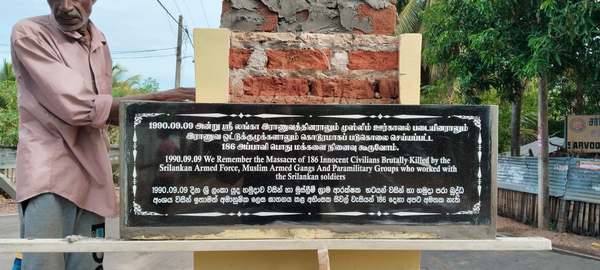
On the 35th anniversary of one of Sri Lanka’s most horrific wartime atrocities against Tamils—where 42 children under the age of ten, including five infants less than a year old, were among the victims—justice remains elusive. The Sathurukondan massacre of September 9, 1990, claimed the lives of 184 Tamil civilians, yet three and a half decades later, accountability has still not been achieved.
Marking the anniversary, families of victims and civil society leaders filed a fresh complaint demanding an independent investigation. The Sathurukondan Massacre Commemoration Committee, led by Vairamuthu Kulanthai Vadivel, submitted formal petitions to the Senior Deputy Inspector General (DIG) of Police for the Eastern Province and to the Kokkadichcholai Police Station. Their demands include excavation of the former army camp site, scientific examination of human remains, and international oversight to ensure accountability. But despite repeated calls, 35 years have passed without justice.
The Massacre: A Night of Horror
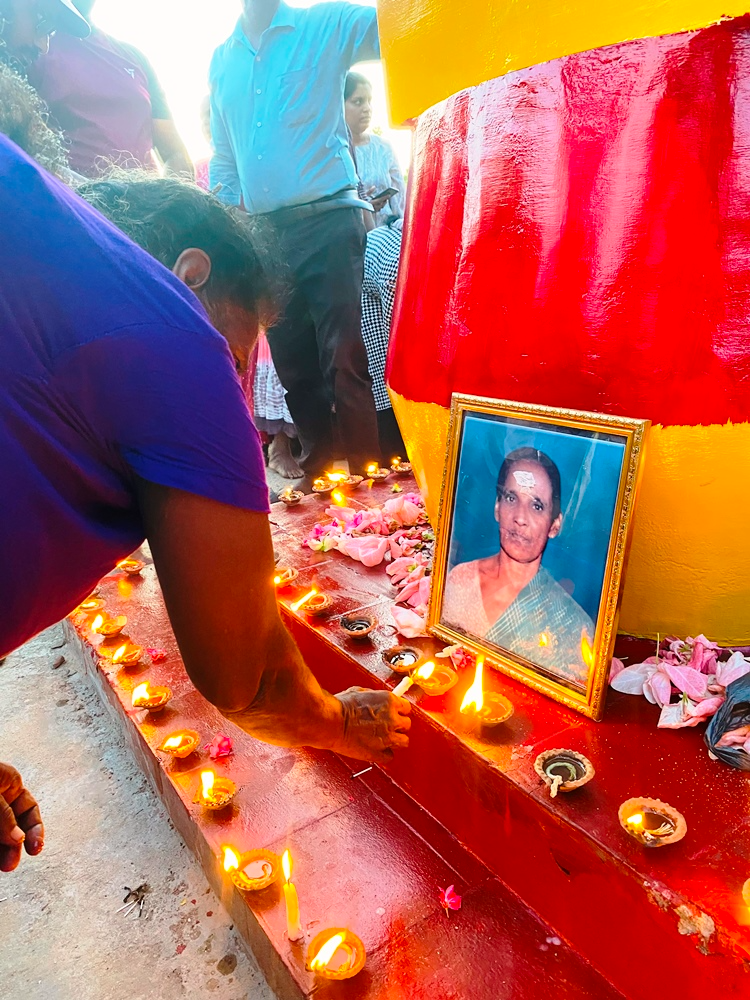
A Tamil mother killed in the Sathurukondan massacre of September 9, 1990
Residents of the area told Jaffna Monitor that at around 5:30 p.m. on September 9, 1990, armed personnel in military uniform, accompanied by members of a Muslim paramilitary group dressed in civilian clothing, entered several Tamil villages in the Batticaloa district—including Sathurukondan, Kokkuvil, Panichchaiyady, and Pillayaradi. Under the pretext of routine questioning, they ordered residents to assemble and march to the nearby Sathurukondan army camp, assuring them that they would be released afterward.
Instead, what followed was one of the most brutal single-day massacres of the Sri Lankan civil war. Of the 184 people killed, 85 were women, 42 were children under ten years old, five were infants under one year, and 28 were elderly persons over 60. The breakdown by village was: 38 from Sathurukondan, 47 from Kokuvil, 37 from Panichchaiyady, and 62 from Pillayaradi.
The sole survivor, 21-year-old Kanthasamy Krishnakumar—who was brutally hacked but miraculously escaped death—has provided chilling testimony that now stands as the primary eyewitness account of the atrocity. In his recorded statement, he described how about 150 civilians were forced to march to the camp by roughly 50 commandos, arriving between 7:00 and 8:00 p.m.
“Four were separated from the rest, attacked with swords and kris knives, and were pulled away out of the camp. All were then taken to one place, attacked and burnt with tyres," Krishnakumar testified. Wounded but conscious, he managed to roll out of sight in the semi-darkness and escape to safety.
Dr. Kingsley Swampillai, who was then the Bishop of the Trincomalee–Batticaloa Diocese and a member of the Batticaloa Peace Committee, later recounted the horrific events. He stated that he visited the site of the massacre the following day with the assistance of the army. “The entire area had been set on fire. Yet, among the ashes, there were heads and body parts that had not been completely burnt,” he recalled. On that visit, the army colonel who accompanied him, Percy Fernando, admitted: “We are deeply troubled. It was our men who carried this out. Therefore, I must apologize.”
Official Investigations, No Prosecutions
The massacre occurred during the presidency of Ranasinghe Premadasa and came just four days after another mass killing at Eastern University, where 158 Tamil civilians seeking refuge were arrested by Sri Lankan soldiers and never seen again.
Despite the gravity of the crimes, no prosecutions have ever taken place. A Special Presidential Commission of Inquiry appointed by President Chandrika Kumaratunga in 1997 was headed by retired Supreme Court Judge K. Palakidnar. The commission's final report documented the massacre in detail and identified three Sri Lankan Army captains—Warnakulasooriya, Herath, and Wijenaike—as bearing responsibility for the killings.
Judge Palakidnar's report contained strong evidence for the massacre and urged the President to take legal action against the perpetrators. However, despite these official findings, the government took no action to pursue criminal charges.
Contemporary Tensions and Memorial Disputes
During this year's 35th anniversary commemorations, tensions arose when local organizers attempted to install a memorial plaque acknowledging the massacre and naming the military as responsible. Army and police personnel reportedly photographed the memorial and questioned organizers about the text, with officials allegedly indicating they would remove the plaque if the military was named.
The incident reflects the ongoing sensitivity surrounding memorialization of wartime atrocities in Sri Lanka, where Tamil communities have faced restrictions and harassment when attempting to commemorate victims of state violence.
International Calls for Justice
Committee leaders expressed profound skepticism about domestic judicial mechanisms, citing decades of unfulfilled promises following the 1997 inquiry. "We do not believe justice will be delivered by national mechanisms alone," said Vairamuthu Kulanthai Vadivel, echoing sentiments shared by many in the Tamil community.
The committee has called for an international mechanism to carry out a full investigation, arguing that only outside oversight can ensure genuine accountability for what human rights organizations have documented as part of a broader pattern of mass killings and enforced disappearances in Eastern Sri Lanka during 1990.
Human rights activists estimate that more than 6,000 Tamils were murdered by Sri Lankan security forces and paramilitaries between August and December 1990 in the Batticaloa-Amparai districts alone, making it one of the bloodiest periods of the three-decade civil war.
Broader Context of Impunity
Observers note that the Sathurukondan massacre remains emblematic of Sri Lanka’s broader failure to confront wartime accountability. Organizations such as the University Teachers for Human Rights (Jaffna) and Amnesty International have documented the case as part of a systematic pattern of mass killings, enforced disappearances, and war crimes committed during the armed conflict.
Despite multiple commissions of inquiry over the years, the absence of prosecutions has only reinforced perceptions of impunity for state security forces, they told Jaffna Monitor. “If there is the will to bring justice, it can be done—but the reality is, they do not want to,” one observer remarked. This culture of evasion, they stressed, is not confined to a single government or political party; rather, successive administrations, regardless of party affiliation, have behaved in the same way.
The lingering question is whether the NPP government, which came to power with unprecedented Tamil support in the last election, will finally break with the legacy of silence and deliver justice to the victims and their families—or whether it too will follow the path of its predecessors.