

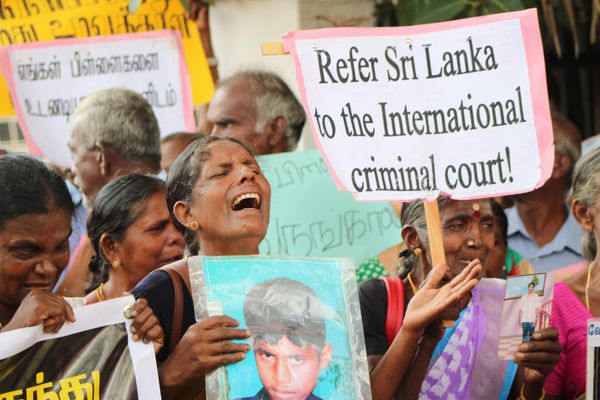
By: Sidhartha Thamby
Part I: The Phenomenon of Disappearances
What Counts as a Disappearance
The legal meaning of "enforced disappearance" is narrower than everyday usage. The main treaty — the International Convention for the Protection of All Persons from Enforced Disappearance — applies only when the state is involved: an arrest, detention, or kidnapping by state agents or with state approval. Disappearances by non-state groups like the LTTE or JVP fall outside this legal definition, though the treaty still requires the state to investigate them, and Common Article 3 of the Geneva Conventions allows such acts to be prosecuted as war crimes regardless.
A disappearance rarely happens as a single isolated act: war provides cover for making someone vanish, impunity lets security forces act unchecked, and emergency law lets secret detention slide into disappearance, since most constitutions allow habeas corpus to be suspended during a declared emergency. International law still draws a line even then — under the ICCPR, the right to life, freedom from torture, and recognition as a person before the law can never be suspended, so enforced disappearance stays illegal even during a state of emergency.
How Big Is the Problem
Sri Lanka's disappearances span 1971 to 2009, though most documented casework concentrates from 1980 onward — no comparable commission of inquiry was ever set up for the earlier 1971 JVP insurrection, so that period is far less thoroughly investigated than 1987–89 in the available sources. There is no single agreed total — different organisations counted different things at different times, over different mandates, and the numbers don't match. The spread below reflects different time periods, different geographic coverage, and different thresholds for what counts as a documented case, not one figure simply being wrong.
National mechanisms on disappearances — figures at a glance
Mechanism | Period | Scope | Complaints Received | Cases Established / Key Finding |
1991 Presidential Commission (Premadasa) | From Jan 1991 | Only new disappearances after the Commission's creation | ~15,000 reports reached the UN Working Group by 1991; 4,932 transmitted to government | Excluded 1988–90 (JVP uprising's deadliest years) entirely; no overall total given for the period it did cover |
Three Zonal Commissions (Kumaratunga) | Jan 1995 – Sep 1997 | Province-by-province: Central/NW/NC/Uva; Northern/Eastern; Western/Southern/Sabaragamuwa; disappearances from Jan 1988 | 27,526 | 16,800 established as enforced disappearances (one estimate: ~16,500); perpetrators identified in 1,681 cases |
All-Island Commission (follow-up) | 1998 – 2000/2001 | Complaints the Zonal Commissions couldn't complete | 10,135–10,136 forwarded | 4,473 additional cases established; 16,305 further complaints ruled outside mandate and referred to the Human Rights Commission |
UN Working Group on Enforced or Involuntary Disappearances | Since 1980 | National, cumulative | — | 12,000+ cases recorded; ~6,000 unresolved |
OHCHR investigation | Jan 1983 – May 2009 | National | — | 13,378 cases documented |
ICRC tracing requests | Since 1990 | National, family-initiated | 16,000+ | ~5,200 from families of missing military/police personnel |
Paranagama Commission (PCICMP) | Aug 2013 – 2016 | North & East, 10 June 1990 – 19 May 2009 | 21,000+ (June 2015) → 23,000+ (18,000+ civilian, 5,000+ security forces) → 24,000+ (2016) | Public hearings reached evidence stage for ~2,700 complaints by mid-2015; final report never made public |
Office for National Unity and Reconciliation (ONUR) | Since 1994, cumulative | National | 65,000+ | Broadest umbrella count of any body |
Red Cross (2003 snapshot) | To 2003 | National | 20,000 | 9,000 resolved; 11,000 under investigation |
EVE 2011 household census | Survey: Jun–Aug 2011; covers 2005–2009 | Five Northern Province districts only; self-reported, no independent check | — | 4,156 "untraceable" persons recorded (63% from 2009 alone); 22,329 total deaths 2005–2009; ~8,000 deaths in the first five months of 2009 |
None of these counts, on their own, amounts to legally proven truth, which requires a judicial process — and Sri Lanka's own domestic mechanisms have been widely reported, including by the UN's human rights office, as failing to deliver that process. Fewer than 500 indictments have followed more than 20,000 documented cases, roughly a 1.8–2.5% rate.
The Zonal and All-Island Commissions ran province-by-province from 1994 to 2001 rather than as a single national inquiry. Within its area, the North East Zonal Commission's final report attributed roughly 90% of enforced disappearances to the Sri Lankan military and police, and roughly 10% to paramilitary groups, including the LTTE. In the south, the Western/Southern/Sabaragamuwa and Central/North Western/North Central/Uva Provinces Commissions investigated disappearances linked to the JVP's second uprising (1987–89), treating them as a separate track from the ethnic-conflict disappearances of Tamils in Colombo; among the perpetrators they identified were 27 Members of Parliament, 14 provincial council members, 20 police superintendents, and 12 army captains. One of these commissions found that criminal investigations at the time were often distorted "to conceal more than to reveal" — and even where someone was identified, it rarely led to an actual charge.
Patterns differed by region. In Tamil-speaking areas, young men were taken during military "clearing" operations, checkpoints, or round-ups and never seen again; others vanished from displaced-persons camps after surrendering or screening late in the war, and paramilitary groups, often state-backed, added a third pattern in the east. Journalists, aid workers, and civil society figures disappeared after criticising the government or the LTTE. In the south, security forces instead targeted people branded as JVP sympathisers, whose names were passed by local officials to police and the armed forces "for elimination," per the zonal commissions' findings.
Sources vary sharply in how deeply they investigated, rather than simply recording a complaint. A complaint made to a Commission of Inquiry means someone reported an allegation — it does not by itself mean the Commission checked what happened. The Human Rights Task Force (HRTF), led by Justice J.F.A. Soza, is the strongest source: its reports involved named-case investigation, on-site inquiry, and identification of specific units and officers. University Teachers for Human Rights, Jaffna (UTHR(J)) sits close behind, documenting abuses from 1988 until it largely stopped publishing by 2010. The Paranagama Commission, by contrast — formally the Presidential Commission of Inquiry into Complaints of Abductions and Disappearances (2013–2016) — mostly took in complaints without investigating them: its own Second Mandate report describes the First Mandate's investigative work as still ongoing (figures above). Sri Lanka's 2011 household census, EVE 2011, ranks lowest of all: "untraceable" was just one checkbox on a self-reported form, with no attempt to say who was responsible, and it does not differentiate civilians from combatants or assign responsibility to either the LTTE or government forces.
One case illustrates how this documentation gap plays out. On 5 September 1990, soldiers surrounded the Eastern University refugee camp at Vantharumoolai, near Batticaloa; masked informants pointed people out, and 158 people were tied up and bused away after being told they'd be released after questioning. None were ever seen again and no bodies were found. The HRTF inquiry named four officers based on witness interviews, but no one was ever prosecuted — one of the largest single mass-disappearance events of the conflict, and a template for how documentation, naming, and impunity have coexisted throughout this history.
The Human Cost
The case for reform rests on real, measurable harm, not just legal principle. The key concept is ambiguous loss, coined by psychologist Pauline Boss: loss with no official confirmation of life or death, and so no closure — the most stressful kind of loss, since there's no proof it's really over. Ordinary bereavement brings legal and social clarity — a death certificate, mourning, burial — none of which ambiguous loss offers. Families of the disappeared often suffer chronic depression, anxiety, complicated grief, and sometimes PTSD, since standard PTSD models don't fully capture this mix of hope, despair, and prolonged uncertainty. Even those who return aren't spared: captivity and torture leave survivors struggling with trust and hypervigilance, and reappearing itself can bring unwanted suspicion and stigma.
Women bear the heaviest and most lasting burden: a disappeared male relative is often the family's main earner, and women usually lead the search for truth — exposing them to abuse, extortion, and manipulation. Many legal systems require formally declaring a disappeared person dead before relatives can access bank accounts or property, which many women resist; in some cultures, wives of the disappeared are considered neither "wife" nor "widow" — the "half-widow" limbo documented in Kashmir and present in Sri Lanka too. At the community level, unresolved disappearances pass trauma down through generations and deepen mistrust in state institutions.
The Risk of Revenge and New Violence
Being a victim of crime raises the risk of later committing violence, sometimes driven by revenge — itself harmful to a victim's mental health. In New York, 42% of homicides in 2012 were revenge-motivated, and an estimated 61% of US school shootings are thought to be as well. This isn't a feeling that fades quickly: a follow-up study of Kosovo Albanians found feelings of revenge were no lower a full year after the trauma than right after it, when nothing had been resolved.
Johan Galtung's structural violence framework casts violence as a triangle of direct, structural, and cultural forms, where unaddressed structural and cultural violence — such as built-in impunity — tends to erupt into new direct violence. Collier, Hoeffler and Söderbom found a similar feedback loop in civil wars: conflict creates grievance, grievance creates more conflict, and nearly half of all civil wars restart an earlier one, with risk highest in the first post-conflict decade.
This cycle isn't fixed. Sikkink and Kim's cross-national study of the "justice cascade" found that countries pursuing human rights prosecutions later show lower repression than similar countries that don't, especially when paired with a truth commission — a probable risk shaped by institutional choices, not a fixed fate.
The chain runs like this: a disappearance creates ambiguous loss that's never grieved. No accountability means injustice builds instead of easing. Injustice plus no legal remedy means revenge sticks around instead of fading. At scale, this creates a pool of grievance armed groups can recruit from, or that can spark fresh violence on its own. And because no investigation means no deterrence, the same conditions repeat — producing new disappearances even in supposedly "post-conflict" periods.
What Sri Lanka's Own Systems Have Done
Sri Lanka has tried several mechanisms to give families practical relief without full accountability. Getting a death certificate meant formally declaring you believed your relative was dead — closing off the possibility they were still alive in detention; roughly 15,000 were issued under this route between 1995 and 1999. The 2016 Certificate of Absence fixed that problem, giving access to bank accounts, property, and pensions without requiring that declaration — introduced against the backdrop of ONUR's cumulative count above, the largest of any single national tally. Compensation payments had reached 16,324 families by 2002. The 1990s commissions made roughly 26 recommendations covering truth, justice, reparations, and prevention — but only certificates and modest compensation were ever delivered. Later frameworks said certificates would follow "necessary investigations," but that investigative machinery remained the weakest link: administrative paperwork stood in for real judicial accountability, and indictments never followed.
Commemoration itself has been uneven. This isn't only a Tamil civilian story: when LTTE forces overran an army camp at Mullaitivu on 18 July 1996, an estimated 1,300–1,500 soldiers were lost, most listed as missing in action, and 207 who were later taken prisoner were killed in captivity. Yet Sri Lanka's military has no formal "missing" category in public commemoration — the National War Memorial's 28,619 names group all fallen soldiers together, and the Army has tended to reclassify long-missing soldiers as presumed killed, even as the Office on Missing Persons keeps a separate missing-in-action list for the Navy. A family's right to know shouldn't depend on which side their relative fought for; in 2026, Tamil and Muslim war-hero families were invited to the national commemoration for the first time in its 17-year history — a welcome step, though only partly acted on.
Several groups are often lumped in with "the disappeared" even though they don't technically fit the definition — for example, roughly 200 children from the north never accounted for after the LTTE claimed to release its underage recruits in 2007. The overall principle: "disappeared" is a narrow term for cases where fate and whereabouts were actively hidden and never resolved, not a catch-all for any unaddressed conflict loss. Eligibility should rest on the loss itself and the lack of an answer, not on which side caused it.
Part II: A Path to State Recognition
Time Is Running Out
The people who can identify the missing are elderly. Urgent needs include collecting DNA from ageing relatives, providing trauma-informed healthcare for older survivors, and delivering closure while they are still alive. Enforced disappearance is treated as an ongoing crime, meaning the statute of limitations doesn't start until the person's fate is disclosed — so even ageing perpetrators can still be reached, through command-responsibility rules, reduced sentences in exchange for disclosure, and by recording testimony now, before it is lost. This supports a dedicated intake track, running alongside the main justice process, for perpetrator, witness, and informant testimony — modelled on South Africa's Truth and Reconciliation Commission, where disclosure ran as its own stream. This protects survivors and witnesses while still incentivising disclosure, an incentive Sri Lanka's OMP Act already half-builds through a clause that stops OMP findings from directly triggering legal liability.
A Four-Stage Plan
What a state owes survivors is a chain of obligations, each depending on the one before it, matching four recognised pillars of transitional justice.
Stage 1 — The right to know. Testimony is collected in a form investigators can use, and search and investigation run alongside this, funded and active whether or not prosecution follows — modelled on the International Commission on Missing Persons' DNA-led search programmes.
Stage 2 — The right to justice. This starts with state recognition: an interim legal status granted on the strength of the complaint alone, as in Argentina's system and Sri Lanka's own Certificate of Absence. This gives a case legal standing and opens the door to reparations. Accountability follows — prosecution where courts can reach the people responsible, and truth commissions where they can't — drawing on the Velásquez Rodríguez case, which shifted the burden of proof onto the state.
Stage 3 — The right to reparation. Legal status and practical relief come first: inheritance, custody, pensions, and bank access, released without a death declaration. Reparations and identity restoration follow, including for children who were taken and raised elsewhere. Memorials and healing complete this stage — ideally a living institution families keep returning to, not a monument they walk past once.
Stage 4 — Guarantees of non-recurrence. This means real institutional reform: vetting, oversight, and structural change. Unresolved loss is a documented driver of future violence — both the JVP and the LTTE recruited from communities shaped by exactly this kind of grievance. It doesn't have to go that way: Argentina's Grandmothers of the Plaza de Mayo channelled similar grief into decades of nonviolent advocacy, closely tracking whether truth, accountability, and reparation were actually delivered, not just promised.
Two obligations cut across all four stages: the search continues indefinitely, and psychosocial support runs the whole way through, rather than arriving only after everything else.
How This Should Be Built and Run
Right now, each stage is its own separate institution, with no single body responsible for a case across all four. A dedicated authority — an expanded Office on Missing Persons or a new body — should own the relationship with families throughout, carrying a sunset clause rather than assuming indefinite existence, following Colombia's Unidad para las Víctimas, whose fixed ten-year term Congress has actively chosen to renew rather than let lapse.
Comparative practice also supports positive discrimination: extra education, healthcare, housing, and livelihood support for registered families, based strictly on documented loss and available equally to families of state security forces, LTTE combatants, and civilians — not restricted by ethnicity, as Rwanda's comparable FARG fund is.
Finally, the plan needs to fit the people it serves: home visits and simpler renewal for ageing survivors; power-of-attorney provisions so an adult child can pursue a case; intake in Sinhala, Tamil, and English on equal terms regardless of which side a relative fought for; and diplomatic missions abroad as intake points for a diaspora holding much of the remaining testimony and DNA.