
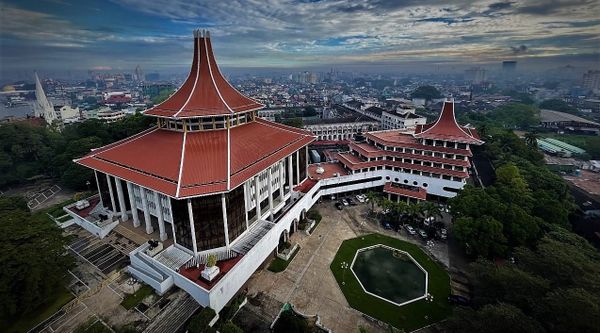
COLOMBO — There were men in the hall on the morning of 29 July who have spent much of the past decade attacking one another in public. Ali Sabry, justice and then foreign minister under Gotabaya Rajapaksa. Udaya Gammanpila, a minister of the same period who has fought much of Colombo’s political class in court and on air. M.A. Sumanthiran of the Ilankai Thamil Arasu Katchi, who spent a career litigating against the governments the other two sat in. And Lal Wijenayake, of the National People’s Power leadership council, publicly said that his own party had got this one wrong.
They had come to the Bar Association of Sri Lanka to vote on a single resolution. Some three thousand members were in the building, with hundreds more joining from the ninety-three branches, in what the association called the largest gathering in its history. When the resolution was put, not a single vote was cast against it.
Two days earlier, the Cabinet had approved a proposal from Justice Minister Harshana Nanayakkara, listed as item twelve and titled “Make the Judicial Process More Efficient and Formal.” On 7 August, the Bill went into a Gazette Extraordinary. It is now a matter for Parliament, and after that, in all likelihood, the Supreme Court.
What the Bill would do
The Twenty-Second Amendment amends Article 107(5). Supreme Court judges would retire at 67 rather than 65, Court of Appeal judges at 65 rather than 63, and their permitted number rises from nineteen to twenty-four. A Chief Justice would leave on reaching 67 or after six years in the post, whichever came first. A companion Judicature (Amendment) Bill lifts the High Court age to 63 and the Magistrates’ to 62.
Almost nobody has argued that 67 is an unreasonable age to leave the Supreme Court. Indian judges retire at 65, British judges at 75, and Sri Lanka’s ages have not moved since 1978. The objection is to applying the change to judges already sitting, and to the month the government has chosen to do it.
Why December matters
Preethi Padman Surasena was sworn in as the 49th Chief Justice on 27 July last year, succeeding Murdu Fernando. He turns 65 late this year. As the Constitution stands, he goes home before the year is out. Should the amendment be enacted first, he stays until the end of 2028.
The six-year cap is offered as a guard against any one judge holding the office too long. Applied to the incumbent it guards nothing. Six years from his appointment would carry him to July 2031; the new age ceiling stops him in late 2028, and the earlier date governs.
The judge who would ordinarily follow him is Yasantha Kodagoda, President’s Counsel, the senior puisne justice, who took oaths as Acting Chief Justice in December. He went to the Supreme Court in February 2020, a few months into Gotabaya Rajapaksa’s presidency, after three decades in the Attorney General’s Department. That timing has attached a label to him in political conversation. Lawyers who worked alongside him dismiss it as lazy shorthand.
Seniority is not a binding rule; the Constitutional Council vets names, and the President recommends. But the Bar has defended the convention for decades, because it has usually been set aside when politicians wanted to reward or punish somebody.
The Bar’s case
The resolution is carefully drafted. The association “unequivocally opposes” raising the retirement age of superior court judges “while those judges are still in office.” It then sets out the proposition carrying most of the weight of the opposition case: “Public confidence in the administration of justice depends not only upon the actual independence of the judiciary but also upon the appearance of that independence.”
The government’s own Justice Sector Assessment and Strategic Action Plan, prepared under the Ministry of Justice with Asian Development Bank assistance, lists a long series of reforms the courts need. Raising the retirement age is not one of them.
Rajeev Amarasuriya, President’s Counsel, who has led the campaign, calls the move extremely unwise and says the opposition is well over 97 percent of the profession. He has also pointed out a fact the government has ignored: eight seats on the Supreme Court and the Court of Appeal have been vacant for months. Filling them requires no gazette and no two-thirds majority.
Where the cases actually are
Some 1.1 million cases are pending across 293 courts, and Nanayakkara has told Parliament that litigants have died waiting. The trouble is the distribution. More than 800,000 sit in the Magistrates’ Courts and roughly 260,000 in the District Courts. The two courts whose retirement ages are locked into the Constitution account for a small share of the whole. Nobody in government has explained why a ministry facing congestion at the base of the system reached first for the one remedy requiring a constitutional amendment.
The judges object
The Judicial Service Association, which speaks for District Judges and Magistrates, met on 11 July and voted by secret ballot, unanimously, against extension at every level. It wrote to President Anura Kumara Dissanayake and, again on 22 July, to the Justice Minister.
The reasoning is administrative. Extend everyone’s tenure by two years and promotion within the service stops for two years. Judicial officers already wait twelve to seventeen years for elevation to the High Court. A service in which nobody moves, the association warned, will lose its best young lawyers.
These are the judges the reform is said to be for. Their letters arrived when confidence within the service was already thin. The transfer of a High Court judge out of Jaffna earlier this year drew formal protest from lawyers in the North, and is still raised there as evidence that judicial independence weakens with distance from Hulftsdorp.
Who decides, and who hears it
Changing Article 107(5) requires two-thirds of the whole membership of Parliament. The National People’s Power has the numbers.
Article 83 is the harder question. It requires a referendum for amendments touching an entrenched list that includes Article 3, the sovereignty of the people. Cabinet spokesman Nalinda Jayatissa says no referendum is needed, and that reading has support: in 2020 the Supreme Court declined to import India’s basic structure doctrine.
Opposition Leader Sajith Premadasa put a different authority to Parliament on 4 August, citing a 2022 determination which he quoted as holding that any change to the retirement age of incumbent judges impinges on the independence of the judiciary and violates Article 3. Amarasuriya has taken the same view.
Where a Bill is described as a constitutional amendment, Article 120 confines the Supreme Court to that single question, and Article 121(3) gives it three weeks to answer.
It also leaves a difficulty nobody has yet addressed. Every judge available to hear the challenge is one whose own tenure the Bill would extend, and recusal offers no escape, because no bench exists that the Bill does not touch. Nothing in that reflects on any individual judge. The problem was made by the drafters, and prospective application would have avoided it.
The manifesto test
Opposition has run well past the profession. The Chief Prelates of all four Nikayas wrote jointly to the President. The Church of Ceylon said the backlog justification was undermined by the unfilled vacancies. The Commonwealth Lawyers Association, LAWASIA and the French National Bar Council have all backed the Sri Lankan Bar.
The government is not friendless. A group called Lawyers for Public Mandate says the administration is delivering an election commitment, and that the extension runs from Magistrates upward.
The first of those claims will not survive contact with the document. The 2024 manifesto on which the National People’s Power was elected criticised ad hoc amendment of the Constitution and promised a new one drafted through broad consultation. It promised to rebuild public trust in a judiciary damaged by allegations of undue influence. It said nothing about judicial retirement ages. A government that asks to be judged by its mandate cannot claim one for a measure the mandate never mentioned.
Government sources expect the Bill in Parliament by early October. Nanayakkara met a Bar delegation on the evening of 29 July, hours after its members had voted against his Cabinet paper. The meeting lasted an hour and produced only an undertaking to study the objections. The Bar also asked him to arrange a meeting with the President. It is still waiting.