

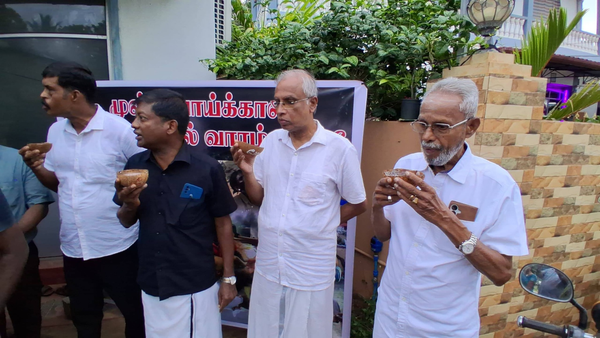
Sumanthiran Invokes Mullivaikkal to Renew Calls for War Crimes Accountability

Sumanthiran Invokes Mullivaikkal to Renew Calls for War Crimes Accountability


Share this post

POINT PEDRO, Sri Lanka — M.A. Sumanthiran, acting general secretary of the Illankai Tamil Arasu Kachchi, used a Mullivaikkal remembrance ceremony to renew calls for accountability over the final stages of Sri Lanka’s civil war, telling mourners that the mass killing of Tamil civilians must remain at the center of Tamil political consciousness.

“We will never forget, and we will never forgive,” Mr. Sumanthiran said at the gathering in Munai, Point Pedro, the fifth event of ITAK’s annual Mullivaikkal Remembrance Week.

Mr. Sumanthiran, a former parliamentarian, said the Sri Lankan state had falsely reported only 70,000 civilians trapped in Mullivaikkal during the war’s final offensive in 2009, when the actual number exceeded 400,000. He described the blocking of food supplies and the shelling of civilians as constituting a war crime.

“Amid shelling and siege, our people suffered from hunger and starvation,” he said. “That itself was a grave war crime.”

The event included the symbolic distribution of Mullivaikkal Kanji — a plain rice porridge associated with the extreme deprivation civilians endured during the army’s final push against the Liberation Tigers of Tamil Eelam. Mr. Sumanthiran said the ritual was meant to sustain historical memory across generations.

The ceremony drew former Northern Provincial Council member S. Sugirthan, local council chairpersons, representatives from Vadamarachchi South-West and Point Pedro, party activists, and members of the public.

Across Sri Lanka’s Tamil-majority Northern and Eastern provinces, Mullivaikkal Remembrance Week is observed through memorials, public gatherings, and acts of mourning. For many Tamils, the events of May 2009 remain a symbol of wartime loss and unresolved demands for justice.

A Shift in Tone
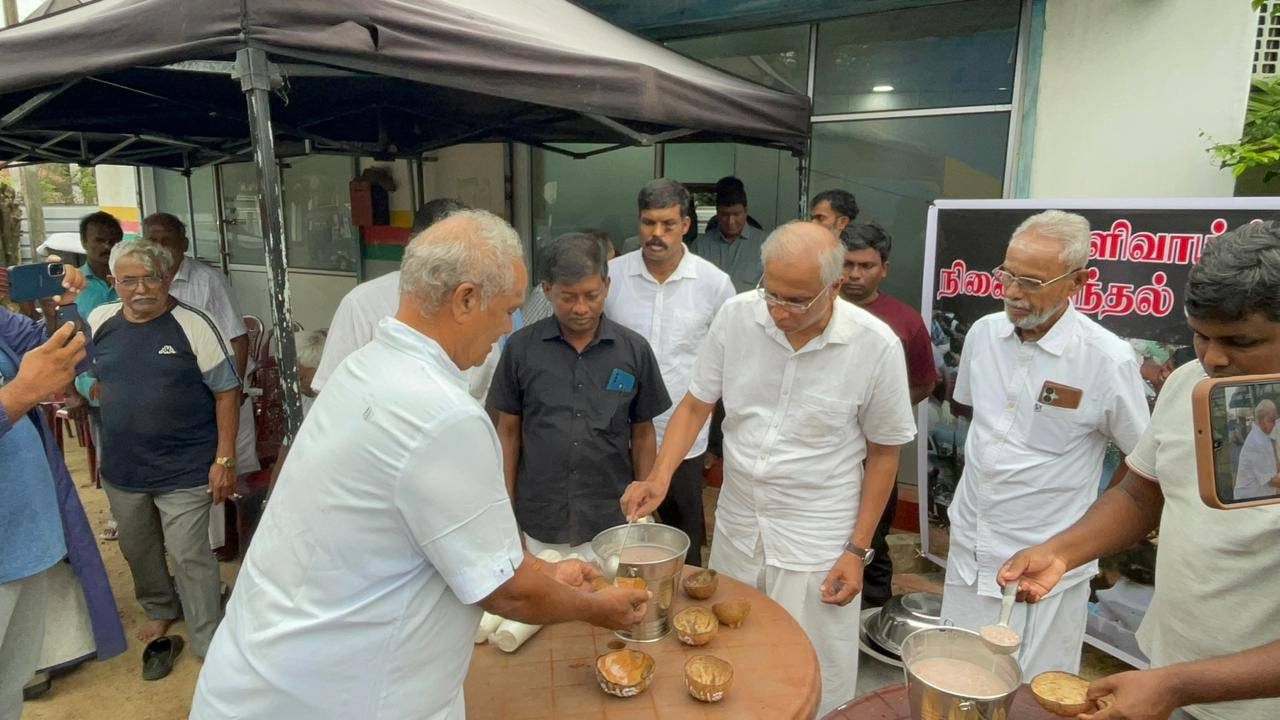
M.A. Sumanthiran distributes symbolic Mullivaikkal Kanji during a remembrance event in Point Pedro

Mr. Sumanthiran’s rhetoric drew scrutiny from political observers, who said his posture has hardened noticeably in recent years — a shift they attributed in part to his significant electoral losses in the last parliamentary election and to an intensifying leadership contest within ITAK against rival parliamentarian S. Sritharan.

He had been widely recognized for publicly addressing contentious aspects of the LTTE’s wartime conduct — including the use of Tamil civilians as human shields, the killing of Tamils who attempted to flee the conflict zone, and the forced conscription of children.

Observers say he now appears less willing to revisit those positions publicly.

“He is becoming just another Tamil nationalist leader — but we already have many,” one political observer told Jaffna Monitor. “He did not need to become one.”


Share this post

Be the first to know

Join our community and get notified about upcoming stories

Subscribing...
You've been subscribed!
Something went wrong
The Real Battle for Credibility

The Real Battle for Credibility

This month, I was invited to speak at the second Sri Lanka–India Media Friendship Association (SLIMFA) Media Fest in Colombo, on the theme “Trust, Truth and the Battle for Credibility.” Illness prevented me from attending. I have chosen instead to publish the thoughts I had prepared as this month’s editorial, because the issues they address extend far beyond a conference hall. Where I Stand I come from Northern Sri Lanka, a region devastated by nearly three decades of civil war. My entire chi


Aruliniyan Mahalingam

Aruliniyan Mahalingam

Rights Group Accuses Sri Lanka of Obstructing Chemmani Mass Grave Investigation

Rights Group Accuses Sri Lanka of Obstructing Chemmani Mass Grave Investigation

For three decades, the state’s answer to the families of Jaffna’s disappeared has been that it does not know. A report released this week argues that it has always known — and has spent thirty years making sure that nothing could be done about it. The report, published by the International Truth and Justice Project (ITJP), a London-based group that has documented Sri Lankan war crimes since 2013, lands as excavators returned to the Chemmani salt flats on Tuesday to resume a dig that has already


Our Reporter

Our Reporter

Should Sanctions Extend to a General's Memoir?

Should Sanctions Extend to a General's Memoir?

By M.R. Narayan Swamy Realising that the war for Tamil Eelam would need a constant supply of weapons, Velupillai Prabhakaran set up in 1985 Kadal Pura, a modest sea wing in the Liberation Tigers of Tamil Eelam (LTTE). Over the years, it grew into the formidable Sea Tigers, which threatened to overwhelm Sri Lanka’s navy. Once the fourth and final Eelam War resumed in August 2006, it became payback time. The Sri Lankan Navy rapidly sank in 2007 the LTTE’s awesome warehouse ships, left and right.


M.R. Narayan Swamy

M.R. Narayan Swamy

The Missing Half of Sri Lanka's Post-War Recovery

The Missing Half of Sri Lanka's Post-War Recovery

By Jeevan Thiagarajah Seventeen years after Sri Lanka's civil war ended, the country has run one of the world's more closely studied reintegration experiments — and left another almost entirely undone. On one side, 12,196 former LTTE combatants passed through a state-run rehabilitation programme that concluded in 2021. On the other, hundreds of thousands of state security personnel — soldiers, sailors, airmen, and police who fought the same war — returned home to no equivalent programme at all.


Jeevan Thiyagaraja

Jeevan Thiyagaraja