

For generations, the Tamil communities of Sri Lanka’s central highlands have done much of the physical labour that keeps one of the country’s most prized export industries alive. They pick the tea. They tend the estates. And yet, by nearly every measure of human welfare — housing, land ownership, mortality — they remain among the most marginalised people in the country.
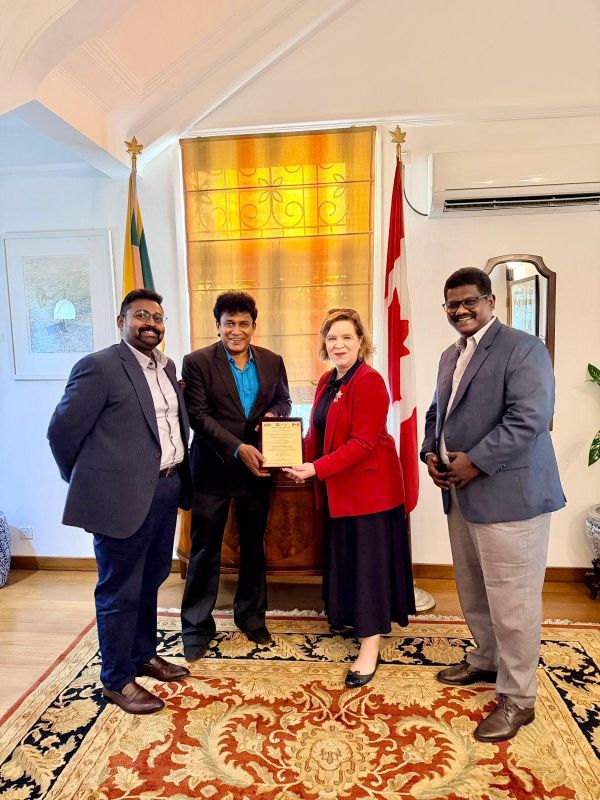
That contradiction was the animating argument when Mano Ganesan, the leader of the Tamil Progressive Alliance and a member of Parliament, sat down with Canada’s High Commissioner to Sri Lanka, Isabelle Martin, at Canada House in Colombo.
“The Malaiyaha Tamil community is no longer a labour identity,” he told the ambassador. “It is a distinct and dignified ethnic community whose future is tied to land, education, and economic mobility.”
The meeting was attended by the party’s general secretary, Paraneetharan, and its vice president for international affairs, Barath Arullsamy.
A SECTOR WORTH BILLIONS, COMMUNITIES WORTH LITTLE
Sri Lanka’s tea industry generates roughly $1.2 billion to $1.3 billion in foreign exchange annually, making it one of the country’s principal sources of hard currency, Mano Ganesan told the Canadian High Commissioner. Unlike the apparel sector — valued at more than $5 billion a year but heavily reliant on imported raw materials, with a significant share of earnings flowing back out of the country — the tea industry operates largely as a domestic value chain. “The soil, the labour, the processing — nearly all of it is Sri Lankan,” he said.
Yet the communities at the base of that chain have historically seen little of the wealth it generates. The plantation system, established under British colonial rule and largely preserved in its structural essentials after independence, concentrated land and capital at the top while tethering workers to estate-bound lives with limited legal title to the ground beneath their homes.
Mr. Ganesan argues that this is no longer primarily a question of wages, though wages remain a persistent grievance. The deeper issue, he contends, is one of civic standing — of whether the Malaiyaha Tamil community is treated as a community of citizens with rights, or as a labour pool with needs.
“What we are witnessing is not a failure of resources, but a failure of political will,” Mano Ganesan said, adding that despite repeated policy announcements, no meaningful progress had been made in land allocation or permanent resettlement.
DISASTER DATA THAT CANNOT BE IGNORED
To underscore his argument, Mr. Ganesan cited data from the 2025 floods and landslides that affected several parts of Sri Lanka.
Plantation communities, though they constitute less than one percent of the total affected population, accounted for approximately 11 percent of disaster-related deaths and 28 percent of missing persons. More than 158,000 people were displaced nationally, with thousands still lacking permanent housing nearly four months after the event.
The disproportion, Mr. Ganesan told the ambassador, is not accidental. It reflects decades of underinvestment in infrastructure, housing, and early-warning systems in plantation areas — a pattern that successive governments have acknowledged and that none have meaningfully reversed.
Barath Arullsamy, who spoke during the meeting, noted that the Kandy District had seen a particularly heavy concentration of displaced plantation families, and said that the urgency of the situation required more than humanitarian handouts. He referenced a recent visit to affected communities by Canadian MP Juanita Nathan and said he hoped Canada would consider a more direct and sustained role, including through partnerships with the Sri Lankan diaspora in Canada.
AN IDEOLOGICAL CRITIQUE, CAREFULLY PHRASED
Among the more pointed aspects of Mr. Ganesan’s presentation was a critique aimed squarely at the governing coalition in Colombo. The current administration came to power on a platform rooted, in part, in Marxist and left-populist political theory, with rhetoric centred on economic justice and the upliftment of working people.
Mr. Ganesan suggested that rhetoric had not translated into results.
“If this were truly a class-driven framework, the working class would be at the centre of economic upliftment,” he said. “Instead, what we see is stagnation.”
A CANADIAN MODEL, A LOCAL PROPOSAL
Alongside his criticism, Mr. Ganesan proposed the creation of a Non-Territorial Community Council — a cross-provincial governance mechanism designed to represent Malaiyaha Tamils across Sri Lanka and provide a structured institutional voice on issues such as land, housing, education, and economic development.
The proposal is designed to address a core complexity of the community’s situation: plantation Tamils are dispersed across multiple provinces of Sri Lanka, which means that geographically bounded political structures often fail to capture or represent their collective interests. A non-territorial council, the argument runs, would provide coordination without requiring territorial consolidation.
The model, Mr. Ganesan suggested, draws inspiration from Canada’s approach to managing diversity within a federal framework. Bilateral trade between the two countries reached approximately USD 540 million in 2025, with Sri Lanka holding a favourable trade surplus, giving the relationship a commercial as well as a diplomatic dimension.
“Diversity is not a weakness, it is a strength,” he told the ambassador. “Canada has demonstrated this to the world.”
A PERSONAL HISTORY
Writing on social media after the meeting, Mr. Ganesan gave the encounter a dimension that had not appeared in any official readout. Canada House, he recalled, was not simply a diplomatic address to him. During the final phase of Sri Lanka’s civil war, he said, it had provided him a measure of refuge at a moment when he faced what he described as threats connected to the “white van” abductions that had terrorised political activists and journalists in Colombo — the extrajudicial disappearances that became one of the most sinister emblems of that era.
He added that he had pressed the High Commissioner to ensure that international assistance, humanitarian engagement, and human rights monitoring mechanisms reach these communities more directly — not as a peripheral concern but as a central one. Ms. Martin, he said, had demonstrated a clear understanding of what was raised.
Diplomacy and Domestic Realities
The meeting with the Canadian High Commissioner is one in a series of diplomatic engagements the Tamil Progressive Alliance has pursued as it tries to build international support for structural reforms that have found limited traction domestically.
Those efforts are now extending inward as well. President Anura Kumara Dissanayake is scheduled to meet a TPA delegation on Wednesday, April 2, for discussions on the plantation community’s concerns and the country’s broader political situation — a meeting understood to have been arranged following a telephone conversation between the President and Mr. Ganesan in which both sides agreed to hold formal talks.
The TPA delegation is expected to include deputy leaders Palani Digambaram and V. Radhakrishnan, as well as members of the alliance’s political committee.
A political observer, speaking to Jaffna Monitor, succinctly described the plight of the Malaiyaha Tamil community: the land plantation workers stand on, in most cases, is not theirs; the houses they live in sit on soil they do not own; and the tea they harvest feeds a global export economy whose benefits have largely bypassed them.