
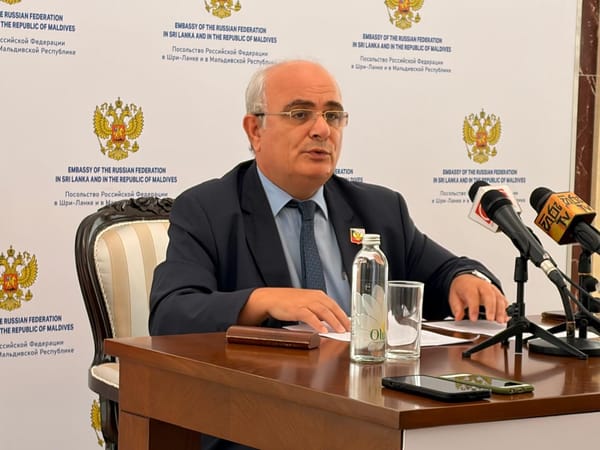
COLOMBO — Russia's Ambassador to Sri Lanka, Levan Dzhagaryan, delivered a detailed review of Moscow's foreign policy at a press briefing held at the Russian Embassy in Colombo this week, dismissing Ukrainian President Volodymyr Zelensky as an illegitimate leader whose mandate had long expired.
Responding to a question from Jaffna Monitor regarding potential Russian investment in Sri Lanka, the ambassador said, “Where should we invest? Unfortunately, we have no projects here to invest in.”
The briefing, attended by media outlets including Jaffna Monitor, was held in the context of the 69th anniversary of Russian-Sri Lankan diplomatic relations. But it quickly evolved into a 2-hour tour of geopolitical grievances, in which L.Dzhagaryan turned nearly every question, including the situation in Ukraine. The Ambassador talked about the Ukrainian crisis, Western hypocrisy, double standards, and what he repeatedly called the systematic use of sanctions as collective punishment against ordinary people.
Speaking with the argumented logic of a career diplomat who has little left to prove — he has served in Afghanistan, Tajikistan, Iran, and now in Sri Lanka and the Maldives, he was never at a loss for a word, even joking that the EU would blame Russia if it snowed in winter in Europe.
"Ukraine is not a democratic country now. It is a collective concentration camp. We do not want to see threats from this fascist regime close to our border."
'No Ceasefire'
On the war in Ukraine, Dzhagaryan was unequivocal. Russia would not agree to an unacceptable ceasefire, he said, because Kyiv would use any pause in fighting merely to rearm and regroup. "We do not trust them. They are asking for a ceasefire to gain time for strengthening their military capabilities," he said.
He listed Russia's conditions — the demilitarisation and denazification of Ukraine, formal recognition of Crimea, Sevastopol, Donetsk, Lugansk, Kherson, and Zaporozhia as Russian territory, and the lifting of all Western sanctions. "Ukrainians should accept our demands, or we will continue our Special Military Operation. No way otherwise," he said.
Russia considers Zelensky's presidency constitutionally invalid. His five-year term ended in May 2024, and no election has been held since — a situation Kyiv attributes to wartime conditions and Ukrainian law, which prohibits elections during martial law. L.Dzhagaryan rejected that framing entirely. "He is an illegitimate, expired president," he said. "We can talk about democratic countries. Ukraine is not one now."
He also drew on Cold War history to frame NATO's eastward expansion as an existential provocation, recalling assurances he said were given to Moscow after German reunification in 1989. "From the very beginning, we believed them. We wanted to have good relations with them. And what happened?" He compared the placement of Western missiles near Russian borders to the 1962 Cuban Missile Crisis, asking why the same logic of threat proximity did not apply to Russia.
The Ambassador reserved a sharp language for Washington's policies toward Cuba and Venezuela. The humanitarian crisis in Cuba, he said, was the direct result of decades of systematic American sanctions and economic blockade — a policy he described as neither targeted at its government nor defensible as opposition to authoritarianism.
"It is not against the leaders of Cuba — it is against the Cuban people," he said. "It is a big tragedy. It is very inhuman." He expressed frustration that no country had been willing to publicly condemn Washington's stance. "No countries have the spine to criticise it," he said fairly.
L.Dzhagaryan said that Russia would send humanitarian aid to Cuba, including oil shipments, when Jaffna Monitor asked him, noting that the Ambassador had himself acknowledged a humanitarian crisis in Cuba but that no Russian aid had yet arrived.
"We will send humanitarian aid to Cuba soon and some oil also," he said.
On Venezuela, L.Dzhagaryan was equally forceful. The capture of President Nicolás Maduro and his wife, Cilia Flores, by United States special forces in a military operation in Caracas on January 3 — and their subsequent detention in a Brooklyn federal jail on narco-terrorism charges — was "illegal and outrageous," he said. The operation, which drew widespread international condemnation and comparisons to the 1989 US seizure of Panamanian leader Manuel Noriega, has been defended by Washington as a law enforcement action. He challenged Western governments that had criticised Russia's conduct in Ukraine to explain their silence over what he characterised as a brazen American violation of sovereignty. "Where are they now? Why are they silent?" he asked.
Iran: 'A Friendly Nation'
When asked what Russia's response would be if the United States were to attack Iran, L.Dzhagaryan was unambiguous about Moscow's alignment. "This problem should be solved by negotiations," he said. "We support Iran, and we extend our solidarity with Iran. Iran is our friendly nation."
He pointed to deepening institutional ties, including a Joint Economic Commission and the recent opening of a Russian Cultural Centre in Tehran. L.Dzhagaryan spent eleven years as Russia's Ambassador to Iran, from 2011 to 2022, during which he was closely involved in negotiations that produced the 2015 Joint Comprehensive Plan of Action (JCPOA) nuclear agreement.
Pushing Back on Trump: 'Indian Officials Did Not Confirm It'
One of the briefing's more pointed exchanges came when Dzhagaryan was asked about President Donald Trump's recent claim that India had agreed to stop purchasing Russian oil as part of a broader diplomatic realignment.
"We have a very good relationship with India. We have a good, privileged partnership," he said. "Regarding Trump's announcement — Indian officials did not confirm it. First of all, India has sovereign rights to decide. And I believe Indian businessmen are wise enough and flexible enough to choose the very right decision, which suits them."
His remarks align with India's own consistent public position: that New Delhi makes energy procurement decisions based on national interest, not external pressure. Russia has become one of India's largest oil suppliers since Western sanctions triggered a dramatic discount in Russian crude prices following the 2022 Special Military Operation in Ukraine.
'Unfortunately, No Projects, No Investment'
A fair passage came when L.Dzhagaryan turned to the subject of Russian investment in Sri Lanka. There was none, he said.
"No investments, as far as I know," he said. "If it comes from the private sector, it is up to them. We are ready to invest, but there are no replies regarding our project proposals." He noted that Russia had explored ideas for economic cooperation but that none had progressed to implementation, partly because the sanctions architecture made financial transfers between the two countries effectively impossible. "We had some ideas, some proposals, but we understand that it is a problem for your side because of the sanctions," he said.
When Jaffna Monitor asked whether anyone was systematically blocking Russian investment in Sri Lanka — or whether it was simply a matter of sanctions — L.Dzhagaryan's answer was careful but frank. "No, I don't see anyone blocking it. But where to invest? Unfortunately, we have no project here to invest."
Russia had proposed introducing its MIR payment card system in Sri Lanka as a mechanism to facilitate financial flows, he said, but acknowledged that any country implementing MIR risked being subjected to secondary Western sanctions, making it unworkable in practice. Russia currently conducts trade with China, Vietnam, and Iran using national currencies; a similar arrangement with Sri Lanka has not been possible.
"Russian tourists come to Sri Lanka, but the Maldives are a little bit more attractive," he said, adding that Russian direct flights to the Maldives operate on a regular schedule. He stopped short of explaining precisely why, but the implication was clear: the tourism environment in the Maldives is more accommodating.
On a proposed Russian nuclear energy collaboration, which Moscow had formally raised with Colombo, L.Dzhagaryan said Sri Lanka had yet to offer a response. "We have several proposals for enhanced economic cooperation with Sri Lanka. However, there are challenges due to the sanctions imposed on Russia," he said.
Central Bank Talks, Blocked Cards, and the Cost of Collective Punishment
On the practical consequences of financial sanctions, L.Dzhagaryan was very specific. Russian credit and debit cards — removed from international payment networks following the 2022 events — do not function in Sri Lanka. Russian tourists must carry cash or use cards issued in third countries.
"My personal cards are also blocked in Sri Lanka," he said. "It is a collective punishment of Russian citizens. They say it is against Russian leadership — it is not. It is against the Russian people."
He disclosed that Russia has suggested direct talks with Sri Lanka's Central Bank to explore mechanisms that would allow Russian tourists to spend more freely in the country. A letter from a Deputy Governor of the Russian Central Bank had been delivered to Sri Lankan monetary authorities to initiate that process, he said. "The ball is in your court now," he added.
The stakes are not trivial. Russian tourism to Sri Lanka has grown substantially in recent years, and the inability of visitors to use their cards represents a direct drag on tourism revenue. L.Dzhagaryan noted that the coal — another Russian export — had previously been shipped to Sri Lanka by a private company, but that volumes had declined sharply due to sanctions. He described the entire pattern as emblematic of a broader problem: Western financial infrastructure was being weaponised in ways that harmed ordinary people and third-country economies, not just the governments targeted.
Domestic Affairs: 'You Are Wise Enough to Settle It Yourselves'
At the very opening of the press briefing, before any substantive questions had been posed, L.Dzhagaryan pre-empted the room by declaring that he would not comment on Sri Lanka's internal affairs — including questions about the Prevention of Terrorism Act, Tamil issues, and minority rights.
"We do not comment on the domestic affairs of independent countries," he said. "I will not comment because it is your domestic issue. And you are wise enough to settle it yourselves."
Seventy Years of Ties — and a Relationship Under Outside Pressure
The press briefing was held to mark the 69th anniversary of Russian-Sri Lankan diplomatic relations — established on February 19, 1957 — with the 70th anniversary approaching next year. L.Dzhagaryan said Russia was planning celebrations and was keen to deepen engagement across multiple sectors, including tourism, education, and labour cooperation.
He flagged active discussions about bringing Sri Lankan workers to Russia to help address labour shortages, similar to arrangements already in place with India, and described plans to expand Russian language classes across the island, including in Jaffna, Trincomalee, and other provinces.
On United Nations Security Council reform, he restated Russia's support for India's bid for a permanent seat, while explicitly opposing permanent membership for Japan or Germany.
The underlying picture is following: a global sanctions architecture and geopolitical posture defined by confrontation on behalf of the West has complicated bilateral friendly relations, from credit card payments to nuclear energy deals.