
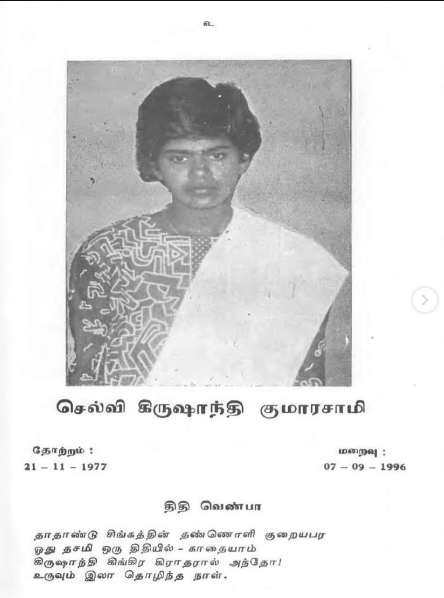
JAFFNA, Sri Lanka — Groups organising a memorial for Krishanthi Kumaraswamy on Monday, 30 years after the schoolgirl was raped and murdered by soldiers at an army checkpoint outside Jaffna, said the event will also launch a campaign to identify suspected mass graves across the Northern and Eastern Provinces and to press the courts for their excavation.
The organising committee announced the plans at a news conference. The main event begins at 3:30 p.m. on Monday, Sept. 7, and will open with a floral tribute to Krishanthi, followed by speeches by politicians, researchers and activists, and theatrical performances.
Organisations working on disappearances and human rights will be formally invited to join the initiative in the coming days, the committee said. It aims to set up a common coordinating mechanism within 45 days and, through that body, to agree a shared policy and set of procedures for identifying suspected burial sites and seeking court authorisation to excavate them.
Krishanthi, an 18-year-old student at Chundikuli Girls’ High School, was cycling home from her final Advanced Level examination on Sept. 7, 1996, when she was stopped at the Kaithady army checkpoint on the Jaffna-Kandy road. Her mother, Rassammah, her 16-year-old brother, Pranavan, and a family friend, Kirupakaran, went looking for her and were also killed. All four bodies were later recovered from shallow graves in the Chemmani area.
Six soldiers were sentenced to death over the killings in 1998 and three others were given 20-year terms. It remains the only publicly known case in which Sri Lankan soldiers have been convicted of raping a Tamil civilian during the war. No officer above the rank of those directly involved was investigated.
The case acquired its wider significance in July 1998, when Lance Corporal Somaratne Rajapakse, facing the death sentence, told the court he knew of mass graves in the Jaffna Peninsula holding the bodies of people who had disappeared in earlier years. He put the number at 300 to 400. Fifteen sets of remains were exhumed at Chemmani in 1999. The investigation then stalled.
The anniversary falls at a point when Chemmani is again under judicial scrutiny. Human remains surfaced at the Chemmani-Sindhubathi cremation ground in February 2025 during trenching work by the Nallur Pradeshiya Sabha, and the Jaffna Magistrate’s Court ordered an excavation that began that May. The third phase ended on Aug. 19, bringing the total recovered over 110 days of digging to 583 sets of human remains, among them 51 clusters of bodies buried together. The site is now the largest mass grave recorded in the North-East, surpassing Mannar Sathosa.
Little has been established about who the dead were or when they were buried. Archaeological, forensic and carbon-14 testing is still pending. Professor Raj Somadeva, the archaeologist supervising the dig, is due to report on Sept. 30 on the likely period of the artefacts recovered, including material from 14 test pits opened outside the main burial area. An administrative meeting on Oct. 14 is expected to decide how the investigation proceeds, and the judicial medical officer is expected to seek approval for a further 28 days of excavation, which would then require the Ministry of Justice to release funding.
The Criminal Investigation Department told the Jaffna Magistrate’s Court in July that it had not yet established whether a crime had taken place at the site.