
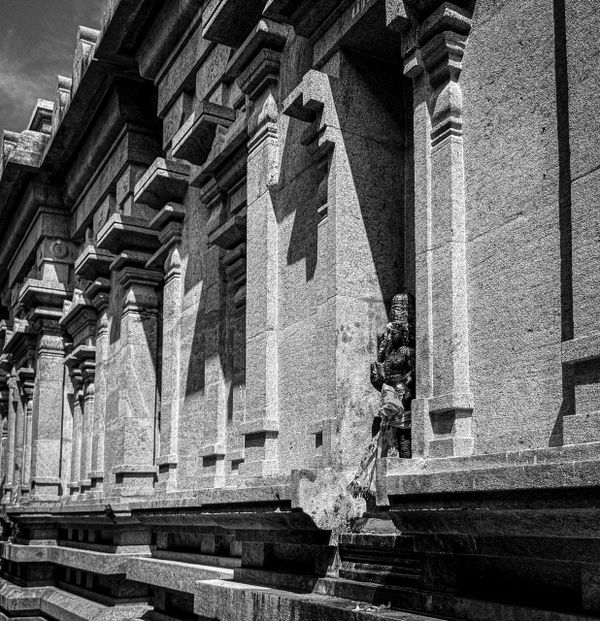
There’s a dry wind that blows through Mannar, the kind that tastes like salt and history. It howls over lagoons thick with flamingos, nudges the rusted skeletons of colonial forts, and settles like incense among the stone pillars of a temple that refuses to die.
This is Thiruketheeswaram, one of the five ancient Iswarams of Lord Shiva in Sri Lanka. For thousands of years, pilgrims have whispered mantras here. Armies have marched past it, priests have anointed it, colonizers have desecrated it, and time—relentless, unforgiving time—has tried to erase it.
But the temple still stands.
Barefoot on its sun-scorched floor, you don’t just walk into a place of worship—you walk into a war memorial, an archaeological site, a love letter to Tamil Saivite identity, and a stubborn, living prayer carved from stone and survival.
An Ancient Flame in a Forgotten Corner
They say the lingam here was first installed by Sage Bhrigu, one of the Saptarishis—immortal seers of Hindu mythology. Some say Ravana, the demon-king of Lanka himself, worshipped here, making offerings at a time when Lanka was a mythical kingdom of gold and flying machines. Others whisper that it was Vishwakarma, the celestial architect, who laid the foundation stone.
Scholars may debate the dating, but even archaeology admits: this place is old. Inscriptions and Sangam-era texts make reference to a temple at Thiruketisvaram—the “Lord of the Fortunate Eye”—that was already flourishing by the 6th century BCE. Greek geographer Ptolemy marked nearby Mahatittha (modern Mannar) as a port of great commercial significance, connecting India, Persia, and Rome. In other words, while Jesus walked in Nazareth and Confucius taught in Lu, Thiruketheeswaram already echoed with the sound of bells.
But this temple wasn’t just sacred. It was strategic.
It lay near Mahatittha, one of the island’s most vital ancient ports. Pearls were harvested here, as were elephants, ivory, cinnamon, and camphor. Indian kings funded its upkeep. So did Arab traders. For centuries, the spiritual met the material here. Shiva danced over salt pans while merchants offloaded Persian pottery on the shores nearby.
And then, like so much in Sri Lanka, the world came crashing down.
The Cross and the Sword
Enter the Portuguese.
By the 1500s, they had muscled their way into the island, trading pepper for blood. Catholic zeal met colonial ambition, and Thiruketheeswaram was in their way. In 1575, the Portuguese army razed the temple to the ground. Not looted. Not desecrated. Razed. Stone by stone.
Some of the very pillars from the inner sanctum were carted off to build the Mannar Fort, a military outpost to guard the colonial pearl trade. The temple tank—Pavithra Kundam—was poisoned. Statues were smashed. The sacred lingam was broken.
But the worst wasn’t the destruction. It was the silence that followed.
For nearly 300 years, Thiruketheeswaram remained a ghost—its ruins choked by weeds, its songs forgotten. A temple that once echoed with 108 names of Shiva now echoed only with the wind.
But Tamil memory is long.
They kept the temple alive in kolams etched onto thresholds in Jaffna. In lullabies. In whispered puranas told to children by oil lamp light. Women still fasted on Pradosham. Men still chanted verses of Thevaram facing west, toward the ruins. It was devotion without architecture. Religion without a roof.
And then, in the 19th century, came the rebellion—not of arms, but of faith.
Revival in the Age of Empire
While the British busied themselves laying down railway tracks and tea estates, a quiet spiritual revolution was taking root. Tamil Saivite scholars, galvanized by the Bhakti revival sweeping across Tamil Nadu, set out to rebuild what the Portuguese had tried to wipe off the map.
Among them was Arumuga Navalar, a fiery reformer from Jaffna who published Saiva scriptures, translated Sanskrit hymns into Tamil, and lobbied the colonial administration for temple rights. His disciples raised funds from across the Tamil diaspora—in Malaya, South Africa, and India. Stone masons from Tamil Nadu were brought in. Craftsmen from Madurai and Kumbakonam worked in the searing heat of Mannar to restore Shiva’s lost home.
By 1903, a new temple rose from the ashes. Not as large as the original. Not yet complete. But sacred once more. The lingam was reconsecrated. The theertham flowed again. Pilgrims returned.
But history, in this island, is a wheel. And it turns fast.

Bhakti in a Warzone
When the Sri Lankan Civil War exploded in the 1980s, Mannar once again became a frontline. The LTTE controlled much of the North. The Sri Lankan Army held the rest. And in between, civilians prayed not to be caught in the crossfire.
Thiruketheeswaram found itself once again in crossfire—literally. Shelling scarred its walls. Pilgrims vanished. Armed checkpoints surrounded the temple. For years, it stood eerily empty, save for the occasional caretaker or whispering widow.
Yet even in war, the temple breathed.
Soldiers—Tamil, Sinhala, even Muslim—were said to secretly offer oil lamps before going on patrol. Mothers snuck past barbed wire with camphor in their fists and prayers on their tongues. The Nandi, Shiva’s sacred bull, was cracked by shrapnel. But no one dared remove it. To do so, locals believed, would curse a generation.
After the war ended in 2009, Thiruketheeswaram slowly came back to life. The bullet holes were patched. The gopuram was painted. And during Maha Shivaratri, the temple saw tens of thousands again, murmuring hymns, ringing bells, and reclaiming history with every barefoot step.
The Sound of a Place Refusing to Fade
Today, Thiruketheeswaram doesn’t get the same attention as Koneswaram in Trincomalee or Rameswaram across the sea. It doesn’t make postcard covers. But maybe that’s the point.
Here, faith isn’t about spectacle. It’s about survival.
It’s about the old man who walks 15 kilometers each full moon to light a single ghee lamp. It’s about the widow who lost three sons in the war and still makes curd rice every Pournami to feed pilgrims. It’s about the temple drummer whose left hand was blown off by a landmine, but who still plays the melam with his wrist stump, because “Shiva doesn’t care how it sounds—only that it’s offered.”
It’s about the palmyrah trees, spiny and defiant, that line the road like sentries. About the mangoes in the courtyard, planted by a devotee who died long ago. About the old bell that rings slightly off-tune—because it remembers being buried during the war to save it from looters.
And above all, it’s about memory.
A Temple Beyond Religion
Thiruketheeswaram is not just a Hindu temple. It is a monument to Tamil endurance. To colonial resistance. To diasporic longing. It is the scar that became a shrine.
When I last visited, a young boy was tracing the temple’s stone carvings with his fingers. “Is this new?” he asked his grandmother, pointing to a weathered pillar.
“No,” she said, her voice soft. “It just came back.”
And that’s the miracle of this place. It comes back. Again. And again. And again.
Every time it is desecrated, it is rebuilt. Every time it is silenced, it finds a new song. It has been erased from maps, burned from memory, and shot at by men in uniform—but it refuses to disappear.
Because some places are more than buildings.
Some places are promises.

FACT BOX:
- Name: Thiruketheeswaram
- Location: Mannar, Northern Province, Sri Lanka
- Founded: Believed to be pre-Christian era; earliest references date to the 6th century BCE
- Deity: Lord Shiva (Ketheeswarar)
- Key Events:
- – Destroyed by Portuguese in 1575
- – Revived in the late 19th century by Tamil Saivite movements
- – Damaged during Sri Lanka’s civil war (1983–2009)
- Significance: One of the Pancha Ishwarams of Lanka; a sacred site for Tamil Hindus worldwide