

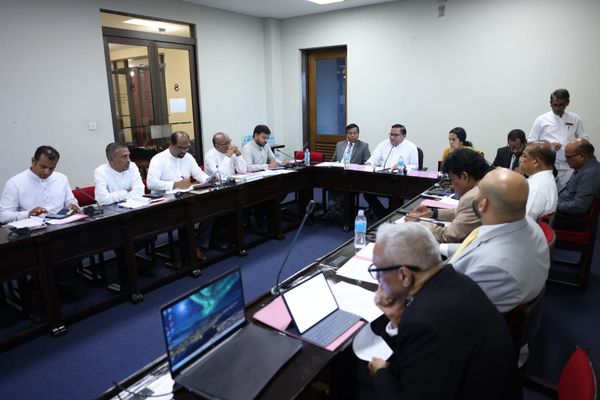
COLOMBO, Sri Lanka —Four opposition lawmakers, three of them representing minority communities, plan to withdraw from a parliamentary committee set up to break the long deadlock over Sri Lanka’s provincial elections, accusing the government of using the panel to further delay elections that have not been held in any of the country’s nine provinces since 2014.
The lawmakers, Mano Ganesan, Shanakiyan Rasamanickam, Nizam Kariapper and Ranjith Madduma Bandara, are expected to notify the committee’s chairman, Foreign Minister Vijitha Herath, of their decision when Parliament meets on Tuesday. The move follows Parliament’s decision to extend the committee’s mandate to Dec. 17.
The provincial councils were created in 1987 through the 13th Amendment to the Constitution, after an accord between India and Sri Lanka, to devolve power to the Tamil-majority north and east during the country’s ethnic conflict. The councils have authority over education, health and local administration, among other areas. Since their terms expired between 2017 and 2019, all nine have been run by governors appointed by the president. Tamil parties have long argued that the arrangement has emptied the devolution system of its purpose.
President Anura Kumara Dissanayake’s National People’s Power coalition, which won a two-thirds majority in Parliament in November 2024, had pledged to hold the elections.
The legal obstacle dates to 2017, when Parliament amended the election law to replace proportional representation with a mixed system combining constituency seats and proportional seats. The new system required electoral boundaries to be drawn, but Parliament rejected the delimitation report in 2018, and no replacement was approved. Under the amended law, no election can be held until boundaries are in place.
The select committee, chaired by Mr. Herath, began meeting in March and sought advice from the Attorney General’s Department and the Election Commission. The Attorney General’s Department told the committee that returning to the old proportional system would be the fastest way to hold elections, according to a parliamentary statement. The Election Commission said it was ready to conduct a vote once Parliament provided a legal framework.
Mr. Rasamanickam, the parliamentary group leader of the Ilankai Tamil Arasu Kadchi, the main Tamil party, said the committee had produced nothing to justify staying on it.
“The committee has not taken any meaningful decision to resolve the legal complications surrounding the Provincial Council elections and hold them quickly,” he said. “What is happening instead is a process of dragging out the matter.”
He said the government had ignored the recommendations to hold the vote under the old system. “Instead, it is extending the process and continuing to postpone the election,” he said.
Under the resolution that created it, the committee was required to report to Parliament within three months of its first meeting, a deadline Parliament was permitted to extend.
“That is why we decided there was no purpose in continuing to participate in the committee,” Mr. Rasamanickam said.