
COLOMBO, Sri Lanka — In November 1994, a surgeon from Colombo boarded a Red Cross ship at Trincomalee and sailed overnight to the jetty at Point Pedro, into territory held by the Liberation Tigers of Tamil Eelam. He had been asked to examine final-year medical students at the University of Jaffna, and he stayed two weeks. The photographs he brought back form one section of an exhibition that opens in Colombo on Friday.
'Beyond the Scalpel' runs from Sept. 25 to 27 at the auditorium of the College of Surgeons of Sri Lanka, at 6 Independence Avenue in Colombo 7. It is open from 9 a.m. to 8 p.m., and entry is free.
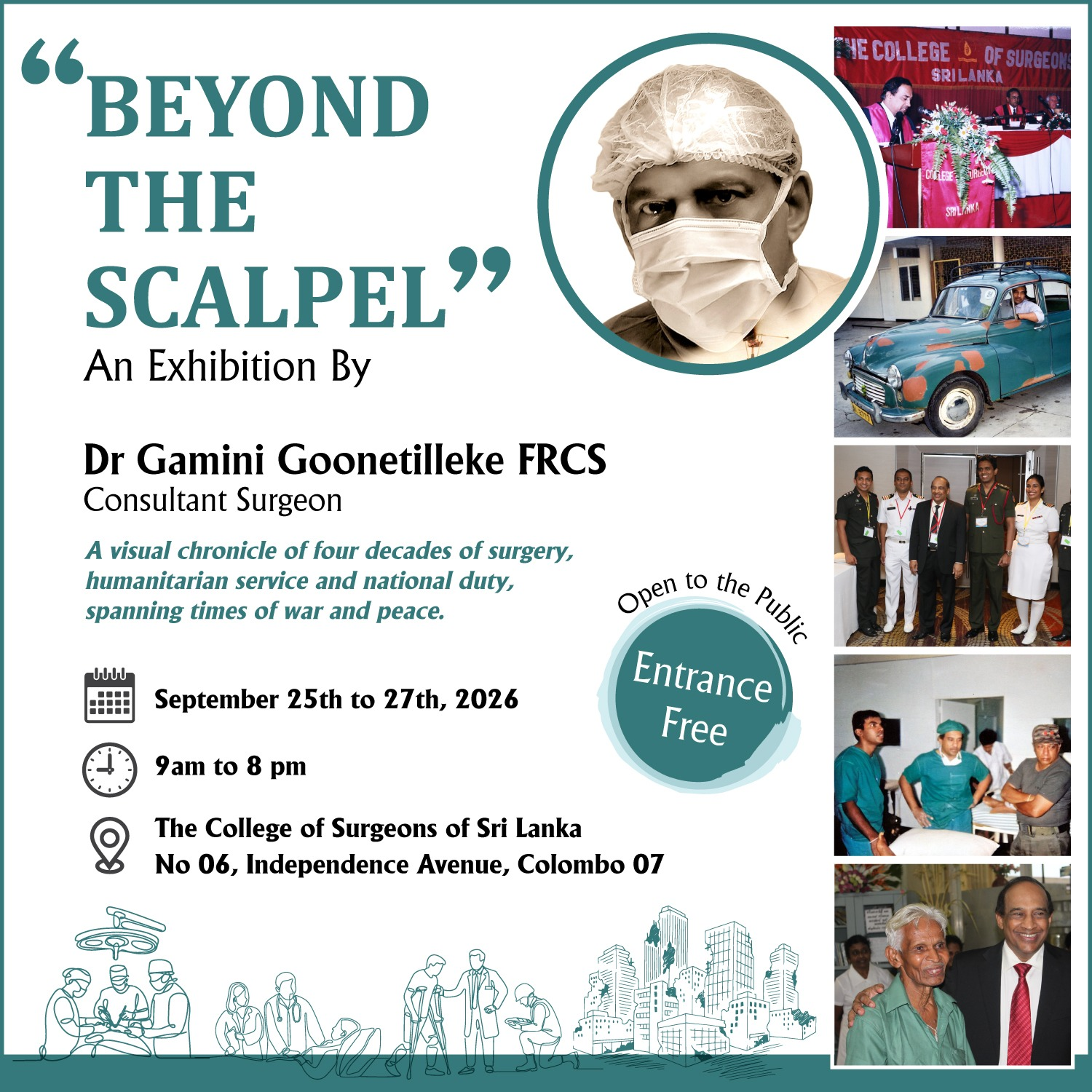
The exhibition covers four decades of Dr. Gamini Goonetilleke's working life, a general surgeon who spent much of his career in hospitals far from the capital. It is built around more than 50 panels holding over 500 photographs, newspaper articles, historical documents, medical illustrations, clinical material, awards, publications and personal memorabilia, arranged chronologically and by theme.
Dr. Goonetilleke trained in Manchester and returned to Sri Lanka in 1982. He took the consultancy at the Base Hospital in Polonnaruwa, where he was the only surgeon for a population of more than 260,000. He moved his family with him and enrolled his children in local schools. The hospital had three consultants then. It has 45 today, he said in an interview with the Jaffna Monitor last year.
He had bought his first camera, an Olympus Trip 35, while training in Britain. In Polonnaruwa he began photographing conditions he could not find in the textbooks, using rolls of 35mm film carried up from Colombo. When the fighting in the north and east intensified, he turned the same camera on war wounds. Many of the images on the panels date from those years.
A large part of the exhibition deals with injuries caused by landmines, blast explosions and high-velocity weapons, and with how their management differed from the civilian trauma Sri Lankan surgeons had been trained to treat. Newspaper reports, research papers and clinical material document the shift. Several panels argue for a national trauma control programme. Others cover the rehabilitation of the wounded and campaigns to ban antipersonnel mines and to clear those already laid.
The 1994 journey came at the invitation of Dr. M. Ganesharatnam, then the only consultant surgeon at Jaffna General Hospital, who asked him to serve as an external examiner. Dr. Goonetilleke said his first concern was his own safety, and he put it to his friend before agreeing.
"Gamini, when I invite you to Jaffna for an important official purpose, it's done with the full approval of the SUPREMO," he recalled Dr. Ganesharatnam saying. "Once he gives his blessing, your safety is guaranteed." The peninsula was under LTTE control at the time. He said he understood the reference and did not ask for details.
The International Committee of the Red Cross made the arrangements. His wife, Shelendra, saw him onto the bus in Colombo. He travelled by road to Trincomalee and then by ship to Point Pedro, and was put up at the Subhas Hotel in Jaffna, the only guest in a building of 30 rooms. "I was the only Sinhalese man in a rebel stronghold, unable to speak Tamil," he said of that first night.
At the jetty, two female cadres met him and pointed him to a sign forbidding photographs. Officials at the movement's immigration desk issued him a pass without questions, and two junior doctors drove him to Jaffna in an old Austin running on kerosene. Days later, the hotel receptionist showed him his name in the LTTE newspaper Eelanatham, which he said identified him as the first Sinhalese doctor from the south to enter the peninsula in 12 years.
His visit coincided with Maaveerar Naal, the movement's commemoration of its dead. He was formally invited to the main event at the war cemetery in Kopay, where Pottu Amman, the LTTE intelligence chief, gave the address. He believes he was the only Sinhalese civilian to attend such a commemoration in territory the movement controlled.
At the hospital he found generators running in place of destroyed power lines, shortages of fuel, drugs and surgical equipment, and a faculty thinned by the departure of staff to safer places. The hospital was the only tertiary centre for the peninsula and was permanently overcrowded.
During the same visit, he met two fishermen from Chilaw who were being held after their boat drifted into rebel waters off Mullaitivu, and who had been brought to the hospital for treatment while in custody. He said he pressed their case through the Red Cross, and that the LTTE released them.
Dr. Goonetilleke also treated wounded soldiers at the Palaly base hospital while caring for civilians at Jaffna General Hospital. He has described that dual role as unprecedented. "I remained neutral throughout," he said of those years.
Other panels cover his flights to the north during the years when the A9 highway was closed, and military aircraft were the only way in, on transport planes and helicopters carrying troops, ammunition and supplies. On the return legs, the same aircraft carried the wounded and the dead.
Teaching and research occupy a substantial section, with photographs spanning several decades of medical students, postgraduate trainees and younger surgeons. His three books, 'In the Line of Duty,' 'The Extra Mile' and 'The Healing Cut,' are displayed alongside journal papers and newspaper articles. He said doctors owe it to the profession to keep such records. "It is your responsibility to document these experiences truthfully," he said.
Asked about the state of surgical services in the country, he said they had improved considerably since 1982 but that access remained uneven. He called for a national health policy agreed across party lines, wider training for surgery in rural settings, and mobile surgical units to shorten waiting times.
The last panels cover life outside the hospital: his sporting career, professional leadership, family life, community work, and retirement. The closing displays carry messages from former patients and students.