

JAFFNA, Sri Lanka— Kavindran Kodeeswaran told Parliament on Thursday that the archaeologist’s new report on the Chemmani excavation dates the dead to about 50 years ago, rather than to 1995 and 1996.
The report gives no date for any burial.
He also said the shoes and sandals recovered from the grave, and the photographs taken of them, had been left out of the report. A photograph of a shoe from the grave is printed on page 13.
Mr. Kodeeswaran, the Ilankai Tamil Arasu Kachchi member for Ampara District, and Gajendrakumar Ponnambalam, leader of the Tamil National People’s Front and a member for Jaffna District, spoke during the debate on the Poisons, Opium and Dangerous Drugs (Amendment) Bill. Both accused Professor Raj Somadeva of distorting the evidence. We take their remarks from Tamil-language accounts of the speeches.
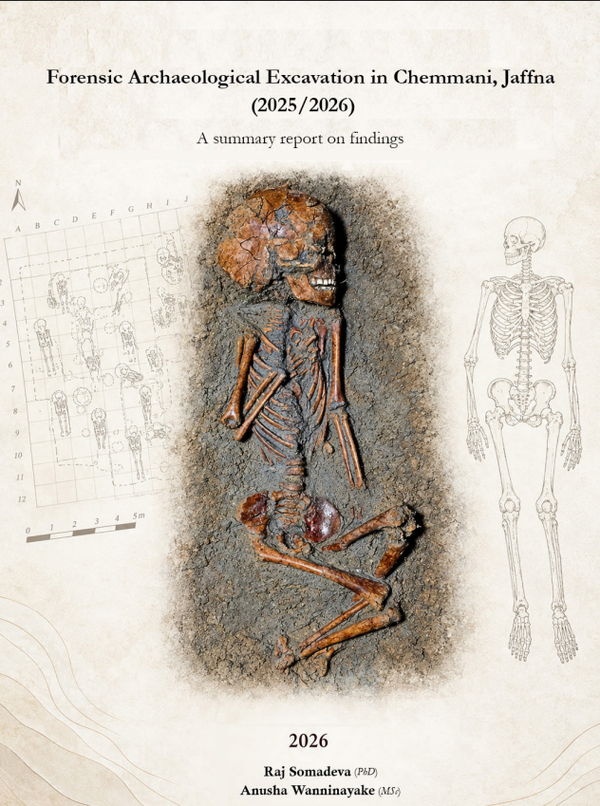
The report, “Forensic Archaeological Excavation in Chemmani, Jaffna (2025/2026): A summary report on findings,” by Professor Somadeva and Anusha Wanninayake, covers the excavation at the Sittupatti cemetery. Professor Somadeva sent it on Oct. 15 to Dr. S. Pranavan, the chief GMO at the Base Hospital in Jaffna.
The MPs described important parts of the document inaccurately. The document, in turn, draws conclusions its evidence does not fully carry.
Fifty years
“Raj Somadeva’s report states that these were not buried in 1995 and 1996, and may be bodies buried 50 years ago,” Mr. Kodeeswaran said, according to the account of his speech. “How can this be true?” Later he put the figure at 40 to 50 years.
The report assigns no date to any burial. It discusses a coin minted in 1870 and others dating from 1920 to 1994. Section 16, on page 15, says straight away that “the minting date of a coin does not establish the date of the burial with which it is associated,” since coins stay in circulation or are kept for years. Nothing in the report dates the burials to 40 or 50 years ago.
Mr. Kodeeswaran also said coins from 1995 and 1996 had been found and that Professor Somadeva “did not mention that in the report.” The legible coins listed on page 16 came from a layer of ash near the cremation platform, dated between 1920 and 1994. None is from 1995 or 1996. Most coins found with the skeletons were too corroded to read, so the report cannot rule out coins from those years. The account of the speech does not say where his information came from.
The photograph on page 13
“Their shoes and sandals were recovered. Photographs of them were also taken. But they are not seen in the report,” Mr. Kodeeswaran said. A school bag and the children’s clothes had been found as well, he added.
Section 15.4 lists a plastic bag, cloth “cut and prepared for sewing,” socks and shoes, and a metal anklet chain, all found with Skeleton 25. Figure 8 shows a blue bag with a shoulder strap and letters of the alphabet printed on it, and a shoe decorated with a cartoon bear.
The authors call it a plastic bag, not a school bag, and do not give the age or sex of Skeleton 25. They use the find as their main example of “a relatively formal burial,” pointing to small nails nearby that may come from a coffin.
On clothing, Section 14 says no skeleton “yielded direct, preserved evidence of clothing attached to the skeletal remains.” Nothing in the report records that the children’s clothes were recovered.
Words that are not in the report
Mr. Ponnambalam told Parliament that on page 17 Professor Somadeva found the site “consistent with” deaths from a public health disaster and said there was “no reason to reject such a possibility,” according to the account of his speech.
Neither phrase appears in the report. The passage reads: “If the concentration of burials resulted from an epidemic or another form of natural catastrophe, a limited assemblage of associated material culture would not necessarily be unexpected.” Two sentences later the authors add that scarce artefacts “should not be regarded as conclusive evidence for any burial context.” The scenario is offered to explain why so few objects were found. The report makes no finding about how anyone died.
Mr. Ponnambalam also said the same paragraph blamed “limitations in expertise.” It says the material evidence “is insufficient, in isolation, to support a definitive conclusion.” It says nothing about anyone’s expertise.
Mr. Kodeeswaran said the report states the skeletons “may have died from a natural disaster and an epidemic.” Later in the same speech he called it “a speculation,” which is closer to the text.
On one point Mr. Ponnambalam was right. “Nowhere in his 17-page report has he presented any evidence relating to such a disaster,” he said. The report names no epidemic, cites no record of one and finds no sign of disease in the bones. Its only other mention of illness is a provisional remark, in Section 15.2, about protective coins tied to the bodies of the sick.
A fourth report, 1,200 bodies
Both MPs miscounted the reports. Mr. Kodeeswaran called this the fourth. Mr. Ponnambalam said there had been three before it. Professor Somadeva’s covering letter calls it “the Third Interim Report.”
Mr. Kodeeswaran said 572 bodies had been recovered. The report records a minimum of 574 individuals.
He also said 65 percent of the site had been dug and that more than 1,200 bodies might lie in the rest. Mr. Ponnambalam said another 600 remained. Neither attributed these figures to the report, and none appears in it. Its radar survey found “numerous subsurface anomalies,” some “consistent with additional burials,” with no count and no estimate.
Mr. Kodeeswaran said the new report no longer calls the site a mass grave. Its prose does not. The phrase appears only as a label on a satellite map on page 3, and the report reaches no conclusion on the question either way. The preamble still describes an investigation into “suspected human rights violations.”
He also said Professor Somadeva wrote “as if he had performed a post-mortem examination.” The report makes no finding on cause of death and credits its age estimates to “forensic professionals.”
Mr. Ponnambalam called Professor Somadeva a Sinhala-Buddhist nationalist with an agenda. The report cannot settle that. As reported, he cited page 17 to support his allegation, but his description attributes a conclusion to the archaeologists that the document does not make.
Where the report goes too far
Pointing out the MPs' mistakes is not the same as endorsing the report. Its main conclusion, underlined on page 17, covers the whole site, but the evidence the authors present supports only part of it.
The conclusion reads that the site shows "greater similarities to contexts characterized by formal burial practices than to clandestine burial sites."
The reasoning behind it is familiar in cemetery archaeology. Graves that cut through earlier graves, and heaps of loose bone pushed aside by later gravediggers, are what a burial ground used over many years looks like. So are bodies laid on their backs with the hands at the sides or over the stomach, objects placed with the dead, and nails from coffins. The report finds all of these at Chemmani. Skeleton 25, buried with a bag, shoes, and an anklet beside what may be coffin nails, is a reasonable example of a formal burial.
The difficulty is how far the argument is carried. The report makes its case through examples. Table 1, captioned as showing objects found with “some of the skeletons,” lists 39 individuals, and the text names others, including Skeletons 25 and 367, that do not appear in it. Nowhere does the report say how many of the 574 were buried with objects, how many with coffin fittings, and how many with nothing. Without that count, a reader cannot tell whether the formal burials it describes are typical of the site or exceptions to it. The conclusion applies them to the whole site.
The report also treats the question as one or the other. A cemetery in use for decades and a clandestine burial episode can occupy the same ground, and a working cemetery is an obvious place to hide bodies. The report does not test for that.
Its own observations complicate the conclusion. Page 2 says the site served as “a dumping ground for various disposable items including human remains as well.” Page 9 allows that some burials “may have resulted from more rapid or expedient acts of deposition.” The epidemic passage speaks of “the rapid disposal of the deceased.” A single cemetery can hold careful burials and hurried ones, and the report may be describing both. Its conclusion does not say so.
The comparison with clandestine graves has little behind it. The authors say irregular limb positions are common “in many cases of clandestine or irregular burial documented in forensic contexts,” but cite no forensic case and list no study of modern mass graves among their references. The one example they show is the Phaleron Captives, an Archaic-period grave near Athens, illustrated with an image from a newspaper website. The report gives no count of how many skeletons showed each hand position, and it does not say whether any were examined for signs of binding. Without that, hand position alone cannot separate a body laid out by mourners from one placed in a grave by others.
On orientation, Section 10 says the skulls “do not exhibit a uniform pattern.” Figure 4 shows 72 percent facing north-west. Seventy-two percent is not uniform, but in burial archaeology a figure that high is read as a strong pattern. It is a pattern that would, if anything, support the authors’ case, since a shared orientation usually points to a burial custom. It could equally follow the long axis of the pits the bodies were placed in, which the report does not examine. Describing it as no pattern is a mistake.
On dating, the authors are right that a coin’s minting date does not date a burial. A coin gives what archaeologists call a terminus post quem, the earliest date at which the grave could have been dug. The same reasoning applies to manufactured objects, and the report does not use it. The excavators recovered a plastic bag, plastic buttons and studs, two polythene garlands and pieces of rubber, and the report links several of them to particular skeletons. If those objects went into the ground with the bodies, the graves cannot be older than the materials. Showing that requires checking each object’s context and when such items came into use. The report does not attempt it, and describes coins as “the only datable material evidence.” It lists the ash-layer coins, running to 1994, without establishing how that ash relates to the burials. One coin in that list is marked “Sk. 172,” a skeleton number, with no explanation.
On clothing, the authors argue that cloth decays in this soil, which they record as alkaline, above pH 8, and that plastic fasteners show some of the dead were dressed. Both points hold as far as they go, and the report claims only “at least some.” The absence of fasteners does not prove nakedness either, since a veshti, sarong or sari has none. But the report does not say how many individuals had fasteners, and it does not identify the cloth that did survive. Fragments on copper coins are commonly preserved by the corrosion of the metal, which would explain those. The socks and cut cloth with Skeleton 25 are a different matter. If they are synthetic, they help date that grave. If natural fibre survived there, the argument that cloth everywhere else simply rotted is weaker. The report does not say which.
Table 1’s caption says the objects suggest “the intentional motive of the burials.” Every burial is intentional, including a clandestine one, so the phrase does not separate the two possibilities the report is meant to weigh.
The report’s most striking figure goes undiscussed. By its own preliminary estimate, 41 percent of the dead were children and 22 percent infants. Nearly two in three were children or infants, and the authors offer no explanation.
The count of the dead is also incomplete. The report gives 574 as a “minimum number of individual” skeletons and records 51 heaps of loose bone separately, without saying whether those heaps add anyone to the total. A minimum number of individuals is normally worked out across all the bone recovered.
The document also shows signs that it was not finished. The distance of the main trench from the cremation platform is given as “[insert number] meters.” The coordinates, N 9°66′26″ and E 80°59′66″, cannot exist, because minutes and seconds of arc stop at 59. The age categories add up to 98 percent, and the report does not account for the rest. Section 15.5 cites two skeletons and then says there is only one example. The soil profile in Figure 2 carries the caption of the site map. The report contains no scientific dating and no analysis of injuries.
Its final paragraph of findings reads: “The available evidence should therefore be evaluated cautiously before drawing conclusions about the circumstances, purpose or historical context of the burials.”