
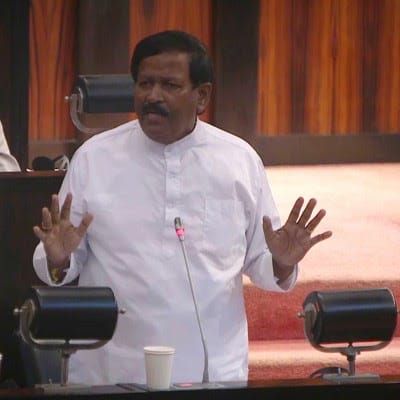
COLOMBO, Sri Lanka: A Tamil member of Parliament warned on Saturday that if the government kept stripping power from the provincial councils, Tamils would “again demand Tamil Eelam.” Tamil Eelam was the independent state the Tamil Tigers fought for in Sri Lanka’s civil war, which ended in 2009.
Thurairasa Ravikaran, a Vanni District MP for the Ilankai Tamil Arasu Kachchi, or ITAK, made the remark during the second day of debate on the 2027 Budget. The Budget, presented on Thursday by President Anura Kumara Dissanayake, proposes taking four district general hospitals in the Northern Province out of provincial hands and placing them under the central government.
“If the Anura Kumara government snatches provincial powers through anti-Eelam-Tamil micro-politics that absorbs the Provincial Council’s power structures into the central government, we will again demand Tamil Eelam,” Mr. Ravikaran said, according to a Tamil-language report of the speech.
The words carry weight. Sri Lanka’s Constitution has banned advocating a separate state since the Sixth Amendment of 1983, and members of Parliament take an oath under it. Mr. Ravikaran framed his remark as a warning of what would follow, not as a demand. It was still unusual coming from ITAK. Founded in 1949, the party has for decades sought a federal settlement within a united Sri Lanka.
It also came as ITAK closed ranks with two of its rivals. The party’s general secretary, M.A. Sumanthiran, said ITAK, the Tamil National People’s Front and the Democratic Tamil National Alliance had agreed to fight the hospital transfer together, inside and outside Parliament.
“Rivers of honey and milk”
Mr. Ravikaran accused the government of “anti-Eelam-Tamil micro-politics” and gave three examples. The merged North-East was split into two provinces. Those provinces were run for eight years on orders from Colombo, with no elected councils. And the public frustration this caused was used to weaken the councils and take over their powers.
He mocked the case for moving the hospitals. The government might say the transfer would strengthen administration, regularize staffing, fill gaps in resources and bring in intern doctors, he said. “If so, are rivers of honey and milk now flowing in all the national schools you absorbed from the province to the center?”
He called on the government to abandon what he described as “a structured genocide agenda under the cover of development” and to work in good faith for a political solution alongside development in the North and East.
Rivals close ranks
The Budget proposes that the central government take over six district general hospitals now run by provincial councils: Mannar, Mullaitivu, Vavuniya and Kilinochchi in the North, and Gampaha and Avissawella in the Western Province. Presenting the Budget, the President said residents had asked for the change and that it would give them care “at the level of national hospitals.”
Mr. Sumanthiran said the move went against ITAK’s founding policy. He said it also broke the government’s promise to leave the provincial council system untouched until an acceptable political solution was reached. He said the President had told reporters in Jaffna, after meeting ITAK members, that the councils would continue in their present form.
“But now, through the Budget, he has openly announced that hospitals in Mannar, Vavuniya, Kilinochchi and Mullaitivu will be brought under central administration,” Mr. Sumanthiran said.
He also pointed out that the Budget sets aside no money for provincial council elections. To him, that confirmed there would be none next year. Last year’s Budget had included funds for the polls.
Other opposition members pressed the same point. Selvam Adaikalanathan, a Vanni MP for the Democratic Tamil National Alliance, said only 45 percent of this year’s allocation for the North and East had been spent. Rauff Hakeem, leader of the Sri Lanka Muslim Congress, challenged the government to say whether it would hold provincial elections at all.
Provinces without a voice
The provincial councils were established in 1987 under the 13th Amendment to the Constitution, following the Indo-Lanka Accord. They were meant mainly to answer Tamil demands for self-rule in the North and East. The two provinces were governed as one merged unit until the Supreme Court ruled in October 2006 that the merger was void. They were formally separated on Jan. 1, 2007.
The Northern Provincial Council held its first election in September 2013. Its term ended in 2018, and since then the province has been run by a governor appointed by the President. No provincial council in the country has faced voters in more than a decade.
In May, Tilvin Silva, general secretary of the Janatha Vimukthi Peramuna, the main party in the governing coalition, said the elections could not be held this year. The Budget suggests they will not be held next year either.