

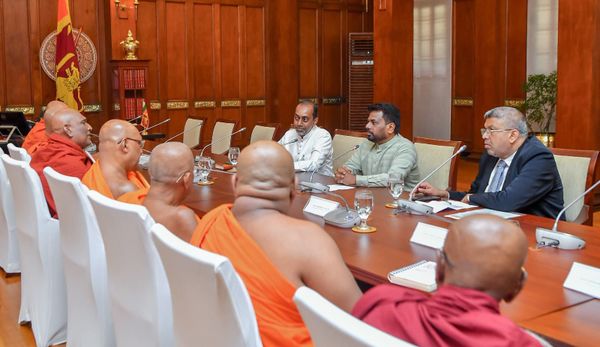
COLOMBO, Sri Lanka — President Anura Kumara Dissanayake told senior Buddhist monks on Thursday that he understood the distress caused by seeing a revered monk brought before court in prison clothing, but insisted that he would not intervene to set aside prison regulations for an individual, declaring that his personal preferences must never become the law.
Speaking at a meeting convened after senior Buddhist prelates protested the treatment of Galagoda Aththe Gnanasara Thero, the president defended prison officials for following existing procedures and proposed an urgent review of the regulations governing the clothing and treatment of imprisoned monks. He called for a committee to be appointed that day and instructed it to recommend amendments within two weeks.
His remarks, delivered over approximately 12 minutes, offered a detailed explanation of the legal framework governing Sri Lanka's prisons while drawing a distinction between acknowledging the religious significance of a monk's robes and exercising presidential power to override established rules.
Mr. Dissanayake said the controversy arose primarily because a monk previously treated with religious reverence was seen outside the prison in prison clothing, where his appearance became visible to journalists and the public.
"When we see a monk whom we previously worshipped and paid our respects to appearing in a different manner today, I think it creates a shock among ordinary Buddhists," he said, acknowledging that the Mahanayake Theros had expressed similar concerns in their letter to the Commissioner General of Prisons.
But he rejected the suggestion that prison officials should be blamed.
"There is no point in blaming prison officials for this," he said. "They are following the existing rules and legal framework."
The president explained that the prison system operated under the Prisons Ordinance of 1877, regulations made under that law and standing orders issued by prison authorities with ministerial approval. He said those provisions generally addressed ordinary prisoners, with few rules specifically concerning Buddhist monks.
He distinguished between monks held on remand, who had not been convicted and could continue wearing their robes, and convicted prisoners serving sentences. According to his explanation, prisoners serving sentences involving hard labour were required to wear prescribed prison clothing, while those serving sentences involving light labour could select their clothing with the prison superintendent's agreement.
Mr. Dissanayake said other convicted monks were subject to the same requirements and recalled that Gnanasara Thero himself had worn prison clothing during an earlier period of imprisonment in 2018. He also said that imprisoned monks brought before courts in connection with additional cases had previously appeared without their robes.
The president's central argument was that any change should be made through the legal and regulatory framework rather than through an exceptional presidential order.
"I do not want to issue an order saying that, although the law stands as it is, something different should be done because I personally prefer it," he said. "Then the law would be set aside, and my preference would become the law."
"My personal preference must not become the law," he added.
He warned that allowing a ruler's likes and dislikes to determine how the law was implemented would undermine consistent legal standards.
"If the law becomes my will, it will be interpreted and implemented according to what I like and dislike," he said. "That is not appropriate."
At the same time, he acknowledged that laws and regulations could become outdated. He cited provisions dating to 1947 prescribing clothing for prisoners upon release, including descriptions associated with different communities, as an example of rules that no longer reflected contemporary society.
The president proposed that representatives of the Attorney General, the ministries responsible for justice, public administration and Buddhist affairs, and senior prison officials examine the existing regulations and standing orders. He said proposed changes concerning Buddhist monks should be discussed with the senior clergy.
He initially suggested appointing the committee during the week, then called for its appointment that same day. Its task, he said, would be to study the regulations and submit recommendations within two weeks. He did not announce that any amendments had already taken effect.
In another notable passage, Mr. Dissanayake suggested that the scarcity of prison rules specifically addressing Buddhist monks might reflect an earlier assumption that monks would not ordinarily be imprisoned.
He then spoke of what he described as a broader deterioration in society.
"To some extent, our monks too have become victims of that deterioration," he said.
He concluded by emphasizing that the solution should establish consistent procedures for imprisoned monks generally, including how they were treated inside prisons and when taken outside, rather than create an exception for Gnanasara Thero alone.
"I do not think it would be appropriate to say that we should do one thing for this particular monk and something different for other monks," he said.
Full text: English Translation of President Dissanayake's Remarks to the Maha Sangha
Delivered at the Presidential Secretariat, Colombo, on October 8, 2026. Translated from Sinhala by Jaffna Monitor.
I am very grateful to our venerable monks for accepting my invitation and attending this discussion.
The main purpose of convening this discussion is, first, that our Mahanayake Theros have sent a letter to the Commissioner General of Prisons. There is also a controversy that has arisen in society surrounding these incidents. We have therefore gathered to discuss the steps we should take to ease this situation and prevent similar situations from arising in the future.
Let me begin with an explanation. Our prisons are governed by the Prisons Ordinance enacted in 1877. That ordinance has been amended from time to time. Under Section 94 of the ordinance, the minister has the authority to make regulations from time to time. The regulations were also amended in 2022. Similarly, subject to the minister's approval, the Commissioner General of Prisons can issue standing orders governing the day-to-day administration of prisons. Therefore, the prison system is governed by three things: the ordinance, regulations made by the minister, and standing orders issued by the commissioner with the minister's approval.
Generally speaking, except in one or two instances, these provisions have been framed with ordinary prisoners in mind. It is only in Regulation 216 that specific reference is made to Buddhist monks. These laws and regulations were not specifically designed around Buddhist monks, other religious dignitaries or particular categories of people.
There are two categories of people held in prisons. One category consists of remand prisoners, who have not been convicted and sentenced by a court. In their case, this particular issue does not arise. You may remember that several Buddhist monks were arrested at Katunayake in connection with drug trafficking allegations and were remanded in custody. Those monks remain in prison wearing their robes. When they are taken to court, they also appear wearing their robes because they have not been convicted. But the situation is different when someone becomes a convicted prisoner.
There are two categories of prison sentences: rigorous imprisonment and simple imprisonment. In the case of simple imprisonment, a prisoner may select clothing with the prison superintendent's agreement. But when a prisoner is sentenced to rigorous imprisonment, that option does not exist. Everyone must wear the prescribed clothing provided by the prison authorities. That is the existing law.
Until now, prisoners have been treated according to these provisions. Buddhist monks have been imprisoned and released at various times. Even at this moment, there are around [69] monks serving prison sentences on various charges, some minor, some criminal, apart from those held on remand. All of them are wearing the clothing issued by the prison authorities. It is not only this particular monk. When he was imprisoned in 2018, he also wore the prescribed prison clothing.
Therefore, as I understand the letter sent by the Mahanayake Theros, the concern is not so much about what monks wear while they are inside prison, but about how they are brought outside the prison. I believe this should be considered not only when they are taken to court but whenever they are taken outside prison. When a person is inside prison, it is not an open place. But when that person is brought outside, the media and the public begin to see what is happening. That is when questions arise about how the person is brought outside.
In this case, the existing procedure was followed. I also made inquiries about previous cases. Some monks have been sentenced for only one offence. They serve their sentences without needing to be brought before courts again. But when a monk is imprisoned and faces other cases, he must be brought before court in connection with those proceedings. Even now, some imprisoned monks are being taken to court from time to time in connection with other offences. They are not brought to court wearing their robes. That procedure continues even today. The same procedure was followed in this monk's case. There is no point in blaming prison officials for this. They are following the existing rules and legal framework.
Of course, it creates a shock for all of us, doesn't it? When we see a monk whom we previously worshipped and paid respect to appearing in a different manner today, I believe it creates a shock among ordinary Buddhists. The Mahanayake Theros themselves referred to this in their letter. They said it was a matter of astonishment and something that would cause distress in the heart of every Buddhist. But this is the procedure that was followed.
So the question before us is this: If that procedure is no longer appropriate, how do we develop a new one? Laws are not eternal. If laws were eternal and unchangeable, there would be no need for a Parliament. New laws are enacted all the time, and existing laws are amended repeatedly. Even today, I believe, Parliament is amending the anti-bribery and corruption law that we passed. Laws are constantly being renewed.
Therefore, what we must do is amend the law. I do not want to issue an order saying that, although the law stands as it is, something different should be done because I personally prefer it. Then the law would be set aside, and my preference would become the law. My personal preference must not become the law. If I tell someone to treat certain people differently, contrary to the law, then the law would no longer be implemented according to the general legal framework. It would be implemented according to my wishes.
In political discussions, it is sometimes said that the law is the will of the ruler. I do not want the law to become my personal will under any circumstances. That is not good. If the law becomes my will, it will be interpreted and implemented according to what I like and dislike. That is not appropriate.
If the existing law is unsuitable for the present circumstances, we must make laws that are suitable. We must not implement the law according to our personal preferences. Therefore, I believe the existing regulations and the standing orders issued by the Commissioner General of Prisons should be changed to reflect present circumstances. Sometimes, it is only when discussions like this take place that we identify provisions requiring change. Otherwise, they remain as they are.
When we examine these matters, we find that many other things also need to change. For example, when some prisoners are released, they are given what is described as release clothing. But how was that clothing defined? In 1947. Who wears clothing like that today? Those clothes were designed in the 1940s. There are descriptions of release clothing for different communities, European, Sinhalese, Tamil and Muslim, but those descriptions date back to 1947. It is difficult even to find people wearing such clothes today. It is only when an issue like this arises that we begin examining these provisions more closely. We have therefore identified a need to amend these standing orders and regulations.
We can discuss with you, the venerable monks, the provisions affecting Buddhist monks and make the necessary changes. I believe the general provisions should also be revised. I propose that we involve the Attorney General, the Ministry of Justice, the Ministry of Public Administration, the Ministry of Buddhist Affairs and prison officials, preferably the prison commissioners, and appoint a committee. We should act very quickly to introduce new standing orders and regulations on its recommendations. I do not think this will conflict with the principal legislation, so it should be possible within two weeks. The committee should be appointed this week. In fact, it should be appointed today. Then, within two weeks, the committee can examine the matter and submit recommendations identifying the necessary amendments. We will also present to you the proposed changes concerning Buddhist monks.
These regulations were generally framed for ordinary circumstances. Very few provisions deal specifically with Buddhist monks, apart from Regulation 216. Perhaps that is because those who drafted the regulations did not anticipate Buddhist monks being imprisoned. That may have been how our society was, with a bond between our monks, society and lawmakers. But today, we can see that there has been a deterioration in society. To some extent, Buddhist monks have also been affected by that deterioration. We can see it. Therefore, I believe we need regulations appropriate to the present circumstances.
Once those regulations are made, we should establish clear procedures governing how people are treated while imprisoned and how they are brought outside prison. I do not think it would be appropriate to say that we should do one thing for this particular monk and something different for other monks.
That is the position we have reached after discussions with the Minister of Justice and the Minister of Buddha Sasana.