
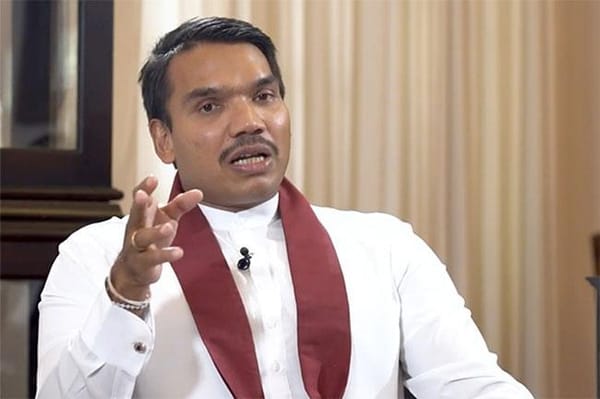
JAFFNA— Plans for a debating-style event featuring Namal Rajapaksa — a former cabinet minister and the political heir to the Rajapaksa family — were cancelled in Cambridge and Oxford following protests by Tamil student groups and sections of the diaspora.
Demonstrators argued that a platform at elite institutions should not be extended to a member of a political dynasty widely associated — in Tamil memory and in international human-rights discourse — with wartime atrocities, militarisation, and democratic backsliding.
Yet the organisers’ decision to cancel also sparked a sharp counter-argument: that the diaspora had, in effect, forfeited a rare opportunity to interrogate power publicly, on camera, before an international audience — and to force documentary disclosures and explicit commitments into the record.
Oxford and Cambridge are not merely symbolic venues. They are institutions built on argument, cross-examination, and the expectation that public claims must withstand hostile scrutiny. In such a setting, critics said, Namal Rajapaksa could have been confronted with evidence-based questions in a manner that would not easily fade — because the exchange would be recorded, archived, and circulated.
What was lost, these critics argue, was not civility.
It was testimony.
The Questions That Never Reached the Microphone
The following is a structured questioning brief prepared by the Jaffna Monitor editorial team, reflecting the kinds of evidence-based questions students and participants may have put to Namal Rajapaksa had either event proceeded. It does not claim to represent every question Tamils or other attendees may have wished to ask. It is a curated document grounded in publicly available evidence, and we publish it as part of the public record.
Where questions reference specific evidence — including satellite imagery, United Nations documentation, broadcast footage, and court records — those sources are identified. We invite Mr. Namal Rajapaksa to respond to any or all of these questions through his office, and we will publish his responses in full and without editorial alteration.
Question 1
Mr. Namal Rajapaksa, following the end of the war in May 2009, large areas of Tamil civilian land in the Jaffna peninsula — particularly around Palaly and Valikamam North — remained under military control. In 2013, your government issued gazette notifications formally acquiring more than 6,000 acres in Jaffna, citing public purpose and national security.
Human-rights organisations, including Amnesty International, documented, in the years after the war, the removal and demolition of civilian structures — homes, temples, and churches — within these zones. Satellite imagery analysed by independent researchers recorded significant post-war landscape changes in these areas. In a 2023 interview with Vice News, a Sri Lankan Army official acknowledged that houses in the Palaly area were demolished for security reasons.
Subsequent reporting by journalists and civil society monitors — including documentation by the Citizens’ Commission on Land in the North — indicates that portions of this land have since been used for military-linked agriculture, recreational facilities, and commercial tourism operations.
You were part of the ruling political establishment throughout this period and later served in the Cabinet.
If the post-war demolitions and long-term land acquisitions were strictly and proportionately justified on national security grounds, how do you account for the subsequent commercial and non-security uses of that land? And do you accept that the physical removal of civilian structures — years after active hostilities ended — had the practical effect of making restitution and return materially more difficult for displaced Tamil families?
Question 2
The documents underpinning these acquisitions — boundary maps, parcel-by-parcel records, written chain-of-command orders authorising demolition, and the threat assessments on which those orders were based — have not been made available for independent scrutiny.
Will you support the full public release of those documents?
And if your answer is that you are not currently in government: if you or your party return to power, will you commit, unequivocally, to publishing those records and permitting independent verification of how that land has been used since 2009?
Yes or no.
Question 3
You have served in Parliament for more than fifteen years. In that time, have you personally introduced legislation, tabled a formal motion, or requested a credible independent inquiry into civilian deaths during the final phase of the war?
Yes or no.
If the answer is no — and the parliamentary record will show whether it is — why should anyone believe that your expressed commitment to accountability today is something other than positioning?
Question 4
Your family and party have consistently argued that a domestic accountability mechanism is both sufficient and preferable to international processes. That argument has been made for fifteen years.
Can you name a single senior military or political official who has been criminally prosecuted and held accountable for alleged wartime abuses against civilians?
If you cannot, what does that tell us about the persistence of impunity — including under governments led by your own family?
Question 5
In 2011, Channel 4 broadcast Sri Lanka’s Killing Fields, which contained footage subsequently examined within UN processes — including the Panel of Experts report commissioned by Secretary-General Ban Ki-moon — and assessed as sufficiently credible to warrant formal investigation. The UN report, published in April 2011, concluded that there were credible allegations of war crimes and crimes against humanity committed by both sides.
Your family’s government dismissed the footage as fabricated.
Today, do you accept that the Channel 4 footage is authentic?
Yes or no.
If your answer is no, please cite the forensic analysis that supports that position, identify who conducted it, and place that evidence on the record now.
Question 6
The same UN Panel of Experts report documented large-scale civilian casualties and serious allegations — including the shelling of hospitals, food distribution lines, and government-designated No Fire Zones — during the final months of the war. Your father was Commander-in-Chief. Your uncle was the Secretary of Defence.
When did you first become aware that civilians were being killed in significant numbers during that final offensive?
Give us a month and a year.
And when you became aware — what, if anything, did you do?
Question 7
Do you accept that political leadership carries a legal and moral duty to prevent and punish unlawful harm to civilians — yes or no?
And do you accept that even in the course of defeating a brutal armed movement, the state has a non-negotiable legal obligation not to target or recklessly endanger non-combatants — yes or no?
Question 8
Between 2005 and 2015, members of the Rajapaksa family simultaneously held the Presidency, the Defence portfolio, the Finance portfolio, and multiple other senior Cabinet positions. Your father held the presidency and the defence and finance ministries concurrently for extended periods.
When a single family controls the executive, the security apparatus, and the national finances at the same time, how can oversight institutions — the judiciary, the auditor general, parliamentary committees — operate with genuine independence?
Do you accept that this concentration of power structurally undermined checks and balances — yes or no?
And will you support legislation explicitly prohibiting any one individual or family from simultaneously holding more than one of the following: the Presidency, the Defence Ministry, and the Finance Ministry — yes or no?
Question 9
You were arrested by the Financial Crimes Investigation Division on 11 July 2016 on charges of money laundering in connection with the Krrish project — specifically, the alleged misuse of Rs. 70 million received from the Indian real estate firm Krrish Realtech, funds that investigators say were diverted from their stated purpose of rugby development. You were released on bail. The Attorney General filed a formal indictment on 28 January 2025. The case remains before the Colombo High Court.
That is nearly a decade between arrest and trial.
What explains the delay?
And do you accept that your ability to remain an active political figure — including contesting the presidency — while facing unresolved criminal charges raises legitimate questions about equality before the law for ordinary Sri Lankans who do not have access to the same legal and political resources you do?
Question 10
Public trust in political leadership depends on financial transparency. Your years in government coincided with a period during which your family’s lifestyle was extensively reported as extravagant, and during which, according to Sri Lankan officials cited in international reporting, significant sums of public money are alleged to have been removed from the country.
Can you clarify, on the record, the sources of your personal income and assets during your years in public office?
And do you support the mandatory, publicly accessible disclosure of full financial records — including tax filings, asset declarations, and company directorships — for all sitting members of parliament and cabinet ministers — yes or no?
Question 11
In May 2012, rugby player Wasim Thajudeen died in a vehicle fire in Colombo. The death was initially ruled an accident. In 2015, a re-examination by the Judicial Medical Officer concluded that the injuries were inconsistent with a road accident and consistent with homicide, leading investigators to reclassify the case. A Criminal Investigation Department inquiry identified you as a person of interest, and you were questioned and released on bail.
What was the nature of your relationship with Thajudeen in the period leading up to his death?
And do you accept that the investigation — more than a decade later — has yet to proceed to a full criminal trial?
Question 12
Given that delay: do you believe the judicial process has moved at the pace it would have moved had the principal person of interest been an ordinary citizen without political influence or family connections — yes or no?
And do you support the appointment of a fully independent special prosecutor, with no ties to any government in which your family has served, to take over this case — yes or no?
Question 13
You entered Parliament in 2010, at the age of 24, while your father was President. You were appointed Minister of Youth and Sports in 2020, at the age of 34.
Sri Lanka has no shortage of educated, capable, and politically committed young people who have not had access to your family’s networks, influence, or name recognition.
Here is the direct question: do you believe you would have entered Parliament at 24 and held Cabinet office by 34 had you been born into an ordinary family?
And do you believe that a political culture in which dynastic inheritance determines access to power is compatible with democratic principles — the principles you invoke when you speak about Sri Lanka’s future?
We ask not to diminish whatever personal qualities you bring to public life. We ask because the answer bears directly on questions of democratic meritocracy and equal access to political opportunity in Sri Lanka.